

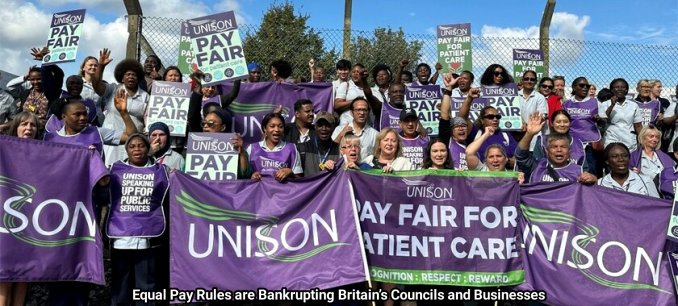
A new Centre for Policy Studies report warns that stretched ‘equal value’ rulings at employment tribunals are forcing councils and businesses to make enormous payments to female claimants. Birmingham was driven to effective bankruptcy by a bill of at least £1.3 billion, while Asda faces a possible £1.2 billion payout on similar grounds. The Telegraph has the story:
Equal pay for equal work. Who could possibly object to this? It clearly is not acceptable that women are paid less for doing the same job as men. And ensuring this did not happen was why the 1970 Equal Pay Act was passed.
But the equal pay claims which come before tribunals today are rarely based on blatant discrimination. Rather, they argue that the work done for an employer by a predominantly female workforce is of equal value to different jobs performed for the same employer by a predominantly male workforce. And some of these judgments seem to be based on rather stretching the notion of equal value.
The 1970 act was one of the very last moves of the first Harold Wilson government. It was given Royal Assent on the very day Parliament dissolved for that year’s general election, which Labour lost.
The party’s winning manifesto in 1964 had pledged to legislate for “equal pay for equal work”, but the Wilson government procrastinated and initially had other priorities. What brought matters to a head was the 1968 Ford sewing machinists strike, since immortalised in the 2010 film Made in Dagenham and its subsequent adaptation as a West End musical.
The strike ended after three weeks, with agreement that the women’s pay would be raised to the rates of predominantly male jobs over two years. The Ford strikers galvanised other women who were equally hard-done-by and ensured the traditionally male-dominated trade union movement finally pushed for equal pay legislation.
Trade unions had not always been this enlightened. NASUWT – with more than 250,000 members, one of the two main teaching unions – is now impeccably Left-wing. Its general secretary Matt Wrack, a fireman rather than a teacher, is a former member of the Trotskyist Militant Tendency.
But its origins over a century ago are rather different. It started as the National Association of Men Teachers and was an explicitly sexist campaign, as the history of the union by Nigel de Gruchy, its former general secretary, makes clear.
During the First World War, more women became teachers when men went to fight. The union was set up to demand that the returning men should not have female superiors and that pay differentials between the sexes be maintained. Only when that battle was lost was a sister union set up for women teachers.
The history of the teaching union is far from the only case of historical institutionalised sexism in the union movement, but this has faded with time as more women joined the workforce.
As Suffocated by Tribunals – a new report for the Centre for Policy Studies by Alan Hibben and Robert Colvile – shows, today’s world is radically different from that faced by the 1960s Dagenham women, let alone 1920s female teachers.
In 2024, employment tribunals found that more than 3,500 employees working for the retailer Next deserved a total of £30 million in compensation on the grounds of gender discrimination. These were not women who were paid less for doing the same jobs as men. Rather, it was that Next was paying more to its warehouse staff (53% of whom were male) than to its retail staff (77% female).
The tribunal accepted that, with changing retail patterns, there was an increase in demand for warehouse staff and a fall in that for retail staff. It further accepted that the vacancy rates for warehouse staff were double that for retail staff. This alone suggests that one job is more desirable than the other, and to fill those vacancies extra pay needs to be offered. But the tribunal nevertheless ruled against Next, under the principle of the work being of “equal value”.
It is this nostrum which underpins nearly all the recent major equal pay rulings. Birmingham council was driven to effective bankruptcy due to having to pay out at least £1.3 billion to predominantly female cleaners and clerical staff for being paid less than overwhelmingly male dustmen. Asda is facing a possible payout of £1.2 billion on similar grounds.
Worth reading in full.
See Related Article Below
Employment tribunals are strangling British growth
ALAN HIBBEN
- Tribunals were meant to be the escape route. Now they’re the trap
- Behind every equal pay settlement lies years of misspent time
- A country arguing about the past shouldn’t be surprised it can’t build the future
Britain has built a tribunal system so sprawling and risk-free that it now consumes the very people who should be running organisations, improving products and services and designing more productive companies. What was meant to be a quick, low-cost alternative to the courts has become a parallel bureaucracy that traps skilled workers in disclosure exercises and procedural theatre. A country that spends this much time arguing about the past should not be surprised that it struggles to build the future.
As Robert Colvile and I argue in a new paper for the Centre for Policy Studies, tribunals were originally designed as the escape route – quicker, cheaper, less formal. What we have now is a network of specialist chambers and ombudsmen, thousands of decision-makers, and a calendar filled with sitting days. Every hearing brings with it the familiar procession: HR directors, in-house counsel, external lawyers, union representatives, experts and the claims-management industry. These are people who should be running organisations and improving products and services, not feeding paper into the system.
When the most rational use of scarce managerial and professional time is to minimise exposure to a proliferating network of potentially ruinous hearings, it is hardly surprising that investment and innovation look weak
The Human Rights Act has amplified this shift. By turning a wide range of policy decisions into justiciable ‘rights’, it has ensured that almost any contentious change eventually finds its way to a tribunal. This is the endpoint of a system built on the twin premises that entitlement is sacred and that the state’s duty to provide is unlimited. Article 6 guarantees a fair hearing; Articles 8 and 14 are invoked to challenge everything from welfare rules to housing allocations. What was meant to prevent serious injustice has become a mechanism for turning policy disagreements into litigation. The result is not only delay. It is that the people who might otherwise be improving the system are trapped in disclosure exercises, case management and appeals.
Equal-pay litigation shows the scale of the problem. The doctrine of ‘equal value’ is almost entirely a tribunal creation. These are not small disputes about individual discrimination, but multi-year operations involving thousands of claimants and an entire ecosystem of no-win-no-fee firms. The Next case is a good example: more than 3,500 claimants, no allegation of direct discrimination, and years of job-evaluation analysis to argue that retail and warehouse roles should be paid the same. The headline number – £30 million – is large enough. The uncounted cost is the management time consumed in defending a pay structure that reflects obvious market differences in skill and scarcity.
Local government has already lived through the consequences. Councils such as Birmingham and Glasgow have faced liabilities running into the billions. To meet them, they have sold assets, cut services and raised council tax. Behind those decisions sits a vast administrative effort: HR teams reconstructing decades of pay decisions; legal teams running disclosure; senior managers producing witness statements and case strategies. Every hour spent on that work is an hour not spent improving services or modernising operations.
The incentives built into the structure make this almost inevitable. For claimants and their representatives, the downside risk is minimal; for respondents, the downside is open-ended. Legal aid, conditional-fee arrangements and flat case fees mean that bringing a claim is close to costless, while defending one is always expensive and uncertain. That asymmetry is what allows no-win-no-fee firms to turn equal-pay litigation into a volume business, and what encourages rights-based challenges to almost any policy change. The rational response from employers and public bodies is to settle early, over-insure and divert resources into compliance and legal defence. None of this contributes to productivity. All of it is predictable given the rules.
A serious reform agenda has to begin with the incentives: modest, well-designed fees to discourage speculative claims; automatic cost-shifting when parties ignore clear warnings or reasonable settlement offers; proportionality limits so that low-value cases cannot generate elaborate procedures; and clearer statutory boundaries on how far rights arguments can be stretched in tribunal settings. None of this would abolish tribunals or remove genuine protections. It would reclaim human capital from unproductive process, while returning the system to its original purpose: resolving serious disputes efficiently.
Our report is titled ‘Suffocated by Tribunals’. That isn’t a metaphor. When the most rational use of scarce managerial and professional time is to minimise exposure to a proliferating network of potentially ruinous hearings, it is hardly surprising that investment and innovation look weak. Unless we redesign the incentives that drive claim after claim, we will go on wondering why Britain’s productivity refuses to recover.
‘Suffocated by Tribunals’ is published by the Centre for Policy Studies.
This article (Employment tribunals are strangling British growth) was created and published by CapX and is republished here under “Fair Use” with attribution to the author Alan Hibben
Featured image: The Daily Sceptic


Leave a Reply