

PAUL BIRCH
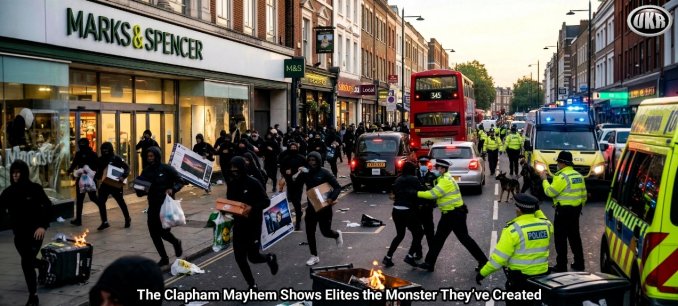
On the nights of March 29th and Tuesday 31st, public disorder broke out in Clapham. Hundreds of largely African-Caribbean heritage youths gathered along the high street (organised as a ‘link up’ beforehand on social media), proceeded to steal from shops and carry out acts of criminal damage – although the primary purpose seems to have been to dominate the public space through force of numbers and menacing behaviour.
The Retail Director of Marks & Spencer, whose Clapham outlet was one of the main targets of the crowd, has directly criticised London Mayor Sadiq Khan for being soft on crime. The police, yet again failing to realise that perception is everything, took a softly-softly approach and made few arrests, promising to feel the collars of the wrongdoers later.
Naturally, liberals have attempted to explain away the mayhem as it simply being a matter of there not being enough ping-pong tables for teenagers. But this was not just youth culture expressing itself. It was a public demonstration of power: brazen, co-ordinated and utterly predictable. These adolescents were sending a message: that the streets can be claimed, rules can be broken and authority can be ignored, all without consequence. And it did not occur in a vacuum. Why are the African-Caribbean youths who rioted last week so disengaged from any sense of British common life, despite being born and brought up in this country?
The first failure is the most obvious and the most routinely avoided: parenting. Too many of the young people involved in these scenes have not been properly raised. They are being managed and indulged by a timorous state and, in some cases, effectively left to raise themselves. It is visible in their behaviour. Teenagers who think it is acceptable to swarm a public space for online attention have not absorbed basic lessons about respect, restraint or responsibility.
This is not to demonise parents who are trying their best under increasing social and economic pressure. But we have to be honest: there is a growing cohort of young black people for whom boundaries are either weak or non-existent. The word ‘no’ has lost its force. Consequences are negotiable. Authority is optional.
Another unpalatable truth in relation to the African-Caribbean diaspora in the United Kingdom is absent fathers. Where stable male role models are missing, boys in particular are more likely to seek identity and validation elsewhere, often in peer groups who revel in risk, defiance and spectacle. The ‘link up’, then, becomes a proving ground. Status is earned not through achievement but through visibility and bravado. The louder, the more chaotic, the more attention grabbing the act, the greater the renown – as witnessed by the notorious ‘Mizzy’ phenomenon a few years ago.
Into this vacuum also steps rap music. In its ‘drill’ and ‘trap’ subgenres particularly, criminality is presented as status, violence is celebrated and instant wealth is shown as only coming from illicit sources. There are documented cases where the music has intersected with actual gang conflict. The problems are only heightened by the accelerant of social media. In the absence of discipline and oversight, online platforms become tools for instant mass misbehaviour. There is no friction, no gatekeeping, no adult in the room; just a cascade of messages: ‘Be here. Bring your friends. Let’s make it big.’ And ‘big’ increasingly means disruptive, confrontational and unmanageable.
But if the family is the first line of defence, the state is the second. And here, too, the record is risibly weak. Policing in situations like Clapham has become hesitant to the point of ineffectiveness. Officers are expected to maintain order while navigating a minefield of scrutiny, denunciation, political sensitivity and a total lack of support from senior officers. The result is predictable. Delay, caution and a reactive posture that allows situations to spiral before they are confronted.
This is not a criticism of individual officers. It is a criticism of the environment in which they are asked to operate. When every firm intervention risks being dissected for perceived bias or excess, the incentive is to hold back. And young people, again, are perceptive. They sense hesitation. They test it. And when they find it, they push further. From a policing point of view, no-one does a spontaneous hostile crowd like the black community. But I guess that’s not surprising, as we seem to have imported the grievance industry wholesale from the US.
The police need to rediscover their confidence, and quickly. When a gathering shows signs of turning into disorder, it should be broken up robustly before it gains momentum. Those who organise or repeatedly promote disruptive link ups should be identified and face real penalties; fines that sting, community orders that really bite and, where thresholds are crossed, criminal charges.
As well as police failure, there is also a broader failure of nerve in public discourse. Certain patterns are simply not discussed with the candour required. Why? Because the moment you attempt to analyse them, you risk being branded with that most career ending of accusations: racism. So instead, we retreat into vague language about ‘youth issues’ and ‘community tensions’, as if euphemisms will somehow restore order.
Layered on top of this is a cultural shift that has eroded any idea of consequences. In schools, discipline is inconsistent, contested or watered down. Teachers spend as much time managing behaviour as they do delivering lessons, largely because of the permissive culture they themselves have engendered. And out on the streets, the pattern continues. Meaningless dispersal instructions are issued, crowds are moved on and the cycle repeats. For many involved, the thrill and the attention outweigh any minimal risk. That calculation must change or nothing else will.
Also, social media companies cannot continue to wash their hands of responsibility. If platforms can amplify these gatherings, they can also help curb them. This already happens with terrorist content, where police and companies generally enjoy a good working relationship. There needs to be rapid co-operation with law enforcement to identify organisers, swift removal of content directly inciting public disruption and algorithms that do not reward escalating chaos. These are not unreasonable demands. They are the minimum expected in a society that should be taking public order seriously.
We need real honesty in how we talk about these issues. This means refusing to be bullied into silence by the fear of reflex allegations of bigotry. It means distinguishing between legitimate concern and prejudice, between analysis and accusation. If the African-Caribbean community is disproportionately affected by particular problems, the answer is not to look away. It is to engage, to understand and to act in partnership with those who want better for their children.
This requires political will, an institutional backbone and a willingness to withstand performative criticism. But the alternative is already visible: public spaces which feel less secure, authority that feels less credible and generations of useless young people turning into unproductive adults.
Clapham was not an anomaly. It was a signal. A signal that the social elite’s ideological obsession with diversity at any cost has spectacularly backfired. A signal that a pushy minority, emboldened by weak boundaries, can disrupt the many. The answer is not panic. It is resolve. Draw the lines wider society expects. Enforce the rules without apology. Support those who uphold them. And stop pretending this is a price we have to pay for ‘vibrant’ multiculturalism.
Paul Birch is a former police officer and counter-terrorism specialist. You can read his Substack here.
This article (The Clapham Mayhem Shows Elites the Monster They’ve Created) was created and published by The Daily Sceptic and is republished here under “Fair Use” with attribution to the author Paul Birch

••••
The Liberty Beacon Project is now expanding at a near exponential rate, and for this we are grateful and excited! But we must also be practical. For 7 years we have not asked for any donations, and have built this project with our own funds as we grew. We are now experiencing ever increasing growing pains due to the large number of websites and projects we represent. So we have just installed donation buttons on our websites and ask that you consider this when you visit them. Nothing is too small. We thank you for all your support and your considerations … (TLB)
••••
Comment Policy: As a privately owned web site, we reserve the right to remove comments that contain spam, advertising, vulgarity, threats of violence, racism, or personal/abusive attacks on other users. This also applies to trolling, the use of more than one alias, or just intentional mischief. Enforcement of this policy is at the discretion of this websites administrators. Repeat offenders may be blocked or permanently banned without prior warning.
••••
Disclaimer: TLB websites contain copyrighted material the use of which has not always been specifically authorized by the copyright owner. We are making such material available to our readers under the provisions of “fair use” in an effort to advance a better understanding of political, health, economic and social issues. The material on this site is distributed without profit to those who have expressed a prior interest in receiving it for research and educational purposes. If you wish to use copyrighted material for purposes other than “fair use” you must request permission from the copyright owner.
••••
Disclaimer: The information and opinions shared are for informational purposes only including, but not limited to, text, graphics, images and other material are not intended as medical advice or instruction. Nothing mentioned is intended to be a substitute for professional medical advice, diagnosis or treatment.
Disclaimer: The views and opinions expressed in this article are those of the author and do not necessarily reflect the official policy or position of The Liberty Beacon Project.


Leave a Reply