

The laws of last resort
DOMINIC ADLER
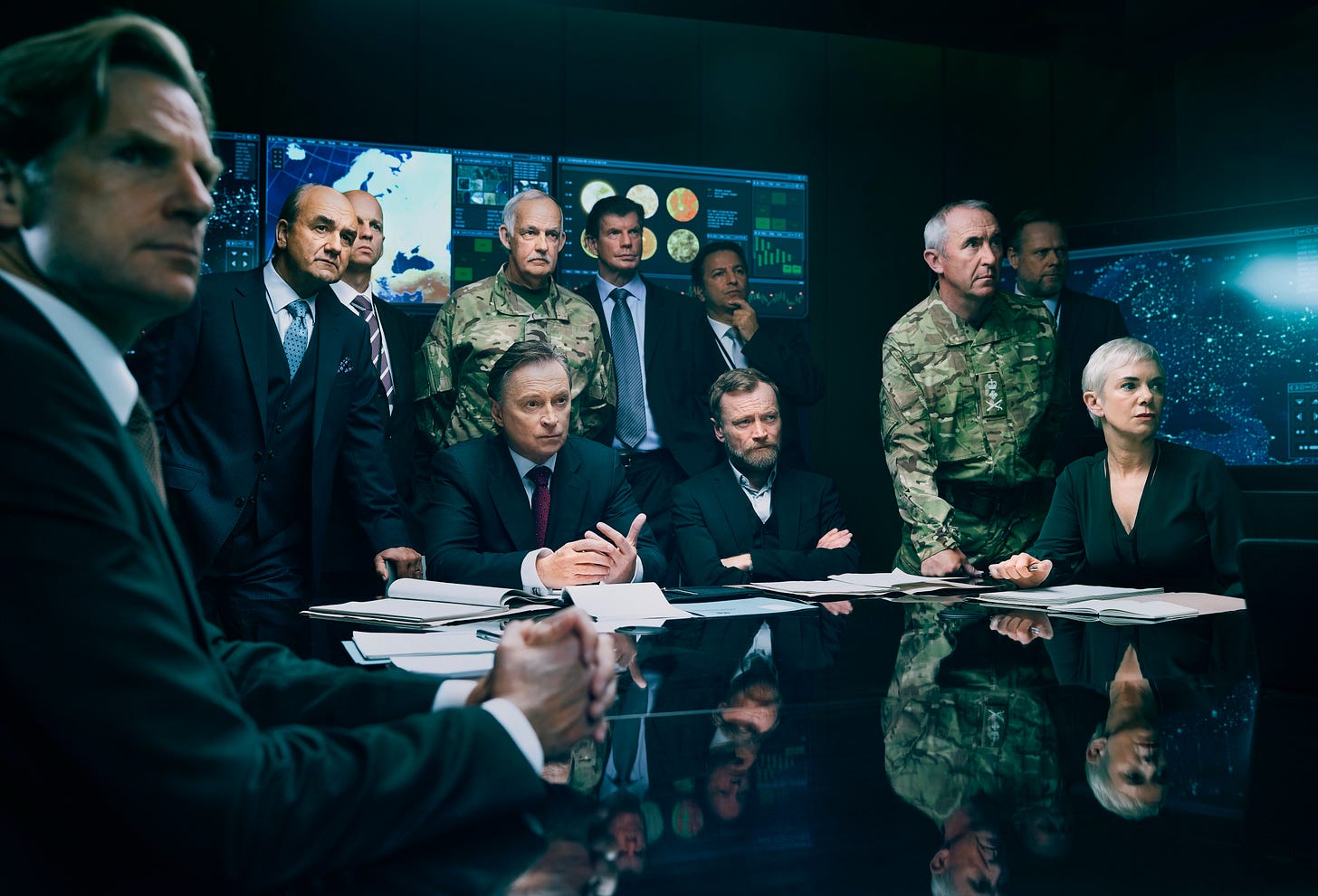
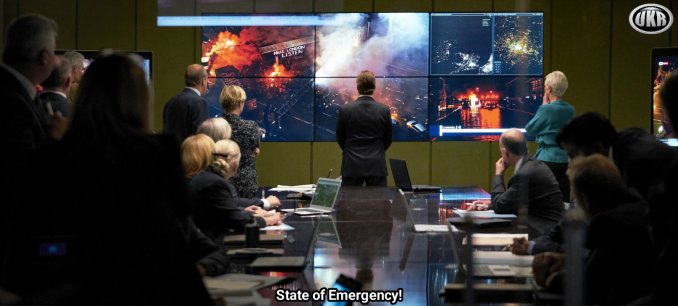
Sky TV’s drama ‘Cobra’ imagines a series of national emergencies.
This Substack occasionally concerns itself with worst-case scenarios. For example, a national police strike. Or a military coup. I’ve discussed David Betz’s essay on civil war and Keir Starmer’s putative UK gendarmerie.
In a similar vein, I suspect most of us have seen films and TV dramas where a national emergency is declared. I was especially tickled by Sky’s Cobra, which destroyed the Isle of Sheppey with a tsunami.
Such disasters invariably escalate into rioting, food shortages, petrol famines and rule by feral gangs of looters – basically Croydon on any given Friday night. Or, of course, New Orleans. Which, of course, is where the police come in.
I found myself exploring the real legislation concerning national emergencies. What powers, in extremis, does the British Government have at its disposal? Researching the subject, I was alternatively horrified and bemused. Which, on reflection, isn’t surprising – lawyers and politicians decide this stuff; it stands to reason the result might be, er, rather legalistic and political. I’m hardly an advocate of Government overreach, but I do wonder if the people responsible for drafting the Civil Contingencies Act 2004 ever dealt with a full-blown, life-or-death emergency. Wee Dougie Alexander, who sponsored the Act, hardly strikes me as the sort of man who’d prosper in a post-apocalyptic wasteland, after all.
To be fair, legislators can’t win – one side of the argument bends towards bold, decisive (and possibly authoritarian) action. The other demands restraint and proportionality, lest power-hungry politicians develop a taste for dictatorship. How, I wondered, might that conflict impact on real-world decision-making? Especially in an arena that is, to date, entirely notional…
As we shall see, the legislation under discussion has never been used.

Yes, I’ve read it. So don’t worry, the Government has a plan.
The Act itself is quite dull, so I’ll confine myself to the crunchy bits. One thing I will say, though, is this: the CCA is definitely of its time. A piece of technocratic legislation conceived during ‘The End of History’, but rudely interrupted by 9/11. I remember the period well, when technocratic legislators really did believe they were on the verge of a post Cold-War, centrist, globalist Shangri-La. Then the murderous fuckery for which our species is known, yet again, spoiled their carefully laid plans.
The CCA also comes in two parts. The first concerns emergency planning for stuff like floods, natural disasters and the role of local authorities and responders. The second, which is the part of the Act, Emergency Powers, concerns stuff the Government can – and can’t – do when everything goes pear-shaped.
What, then, is an ‘Emergency’?
I like to think our leaders would instinctively know a national emergency when they saw one. That isn’t, however, how legislation works – we’re required to establish a definition. The Act offers the marvelously ambiguous;
(1)In this Part “emergency” means—
(a)an event or situation which threatens serious damage to human welfare in the United Kingdom or in a Part or region,
(b)an event or situation which threatens serious damage to the environment of the United Kingdom or of a Part or region, or
(c)war, or terrorism, which threatens serious damage to the security of the United Kingdom.
There are provisos and safeguards involving severity and proportionality, involving Parliamentary consent for the continuation of powers. Remember, the Act was passed in 2004, when society was less divided than it is now. One wonders how, say, a future Green / Red coalition might react? I suspect Zack Polanski’s view of a disaster might differ from mine. One can imagine, for example, Zack and friends declaring a ‘Climate Emergency’ which demanded coercive powers.
That’s fine, Zack, I always wanted to join a resistance movement.
Thus far, though, cooler heads have prevailed. Fellow doom-watchers cite how the spicy flu Covid pandemic never triggered the CCA. This is a relief, given SAGE included card-carrying communists like Susan Michie.
I’d still argue the UK of only six years ago was still a significantly different place – perhaps at its ‘Uniparty’ technocratic apogee, untroubled by populist competitors – than today. Which is to say, could a modern British Parliament ever actually agree what constituted a national emergency?
The CCA allows legislators to restrict freedom of assembly and introduce curfews. It can requisition or even order the destruction of property. The armed services can be deployed to assist the civil administration. Government may issue direct orders to public services and private utility providers. Non-compliance can be determined a criminal offence. At this point, one might look at the menagerie of buffoons surrounding Keir Starmer and begin panicking. Giving David Lammy such a smorgasbord of powers? It would be allowing the characters from ‘Trainspotting’ play Supermarket Sweep in a hospital pharmacy.
Which brings me to the equally intriguing safeguards, turning the CCA into a game of Kafkaesque ping-pong between doves and hawks. It offers a revealing look inside the minds of those who drafted the legislation.
Lawyers, Lawyers, Lawyers
This stuff sounds dry, but it’s important. It’s why “arrogant, progressive fools” like Richard Hermer really run the UK, and why lawyers now sit in military headquarters pontificating on the legality of bombing terrorists. Law is now politics and politics is now law.
Of course, then, the CCA’s Blairite architects ensured it contains critical safeguards involving our old friends the European Court of Human Rights (ECHR) and the 1998 Human Rights Act (HRA). To wit:
- emergency regulations cannot amend or disapply the HRA
- ministers must ensure (emergency) regulations are compatible with Convention rights
- courts retain the ability to review emergency measures
Yes! Judges who pontificate on the cruel and unusual nature of Albanian chicken nuggets might also decide whether government decision-making is proportionate during a national emergency.
I know, I feel safer already too.
This means the only tool available to legislators wishing to enact changes to ECHR rights is the standard Article 15 derogation process. So yes, it is possible to curtail some rights – but only via the route used during peacetime.
Here’s the guide to derogation in times of national emergency, which involves (as you would imagine) a Gordian knot of stated cases which suggest decision-makers may be held liable – by a foreign court – at some point. The use of Art. 15 derogation by the British Government was most famously tested in the years after 9/11, during the ‘Belmarsh Judgement’ on pre-trial detention. It, of course, lost when the House of Lords (before the establishment of the UK Supreme Court) declared it incompatible with existing human rights law.
So, no, looters (sadly) may not be shot on sight. Nor can enemy prisoners be set to clearing rubble (that’s slavery). The following are strictly forbidden under any circumstances:
- right to life (except lawful acts of war)
- prohibition of torture or inhuman treatment
- prohibition of slavery
- prohibition of retrospective criminal punishment
Depending on your (possibly Schmittian) point of view this is either (a) milquetoast nonsense or (b) quite reassuring. We really are between a rock and a hard place: David Lammy on one side and Richard Hermer on the other. I can imagine the pair of them discussing the legality of deploying cluster munitions as hordes of Slavic mercenaries rampage through Westminster’s smouldering ruins.
Hermer’s consciousness will, I imagine, be subsequently be uploaded to an AI-controlled legal program. It will prosecute absolutely everyone who might have – at any point – made a decision contrary to human rights law, emailing the radioactive husk of the ECHR in Strasbourg. Deep in an armoured server room, an AI euro-judge will agree. Meanwhile, mutated humans will be living in favelas and eating tins of antique dog food.

As of the time of writing, Lord Hermer (formerly of Matrix Chambers, because of course he was) would be a crucial decision-maker during a national emergency.
Gradually, then suddenly
How fast does as crisis have to occur to constitute a crisis? As Ernest Hemingway famously said of going bankrupt, it occurs gradually, then suddenly.
The CCA places a premium on decision-making and Parliamentary scrutiny. I’m sure many readers have been involved in real emergencies, situations too fast-moving for a second reading or a ten-minute bill. You were too busy dialling 999 or performing CPR, right? Hyperbole aside, I’m not suggesting our decision-makers are that clueless. What I am suggesting is the CCA was written by people who’d spent peaceful, measured and considered lives. That, I would suggest, is the real ghost in the machine.
Then there’s what politicians have always referred to as “events, dear boy” – Black Swan events. Which is why governments have intelligence services, apparently. Then there’s Hemingway’s dictum about crises – they’re gradual then sudden. For example, some might argue we’re currently in the middle of a crisis. This argument turns on the idea problems are cumulative – for example, I don’t think it requires a crystal ball to see how the next Southport level atrocity might pan out.
This might sound abstract, but events sometimes are. Yet law and legislation is meant to squeeze abstractions into neat jurisprudential boxes. Which is why, I suspect, when push comes to shove, the CCA will prove as useful as an ashtray on a motorcycle. I’m suddenly reminded of a sign I once saw on the desk of an extremely able army warrant officer many years ago. It said, Lead, Follow, or get out of the way.
I say this not as an advocate of rolling martial law. In fact, the more I think about it, I wonder if a degree of unpreparedness is part of the Faustian pact we make as part of living in a reasonably free society. After all, after Chernobyl, the Soviet state’s emergency response was disciplined and vigorous. Yet wasn’t Soviet corruption partly-responsible for the accident in the first place?
Where’s the balance between nanny-state preparedness and free-wheeling freedom? The answer to that, I would suggest, is competence. Competence is the faithful hound, scaring the wolves of crises away. The real crisis, then, is perhaps one of ability, quality and character. And the fish, remember, rots from the head.
This isn’t a crisis, sadly, covered by the CCA.

We’re ten minutes ‘til midnight! It’s okay, here’s another key decision-maker.
What about the Police?
Yes, this Substack primarily discusses policing, something on which the CCA has much to say. Emergencies threatening critical infrastructure pose a risk to public order. As the saying goes “we are only ever three meals away from chaos.”
So, time for a brief detour to Part One of the CCA, which nominates the police as ‘Category One’ responders. This gives them a very Blairite ‘suite’ of statutory responsibilities, process-mapped and impressive-looking. In reality, I suspect they’re like a dusty first aid kit, bought just-in-case, languishing in the boot of an old car. According to the Act, police have a legal duty to:
- contribute to local risk assessments
- participate in producing Community Risk Registers
- plan for a wide range of threats, not just crime
Community Risk register? I worked in domestic extremism, public order, counter-terrorism and all that jazz for yonks. Never heard of one. Oh well.
The Act, amusingly, also demanded:
- intelligence and planning units expanded
I wonder what any impact assessment made around Tory policing policy, 2010-2024, made of that? All I remember are savage cuts. This subsequent paucity of intelligence capability was laid bare during the Southport riots – as the police inspectorate subsequently revealed in an excoriating report.
The CCA refocuses police away from their traditional role, that of keeping The King’s Peace, towards resilience planning: transport disruption, community tensions, business impact, medical support, infrastructure strain, and coordinated communications.
For me, this is where devils hide in the details. If you consider the other obligations on policing – say, for example, the 2010 Equalities Act, I would argue the CCA puts police in an uncomfortable political position. Resilience planning involves making political trade-offs, not least around resources, business continuity and protest action. Should a chief constable become embroiled in such decisions?
Here’s a recent – and damning – peacetime example: the West Midlands Police scandal. A craven chief constable found himself making nakedly political decisions. They trumped obvious operational imperatives (in this case, doing his bloody job). If such pressures exist in day-to-day policing, in the name of ‘community cohesion’? One can only imagine what they would be like during a bona fide national emergency.
It’s the end of the world as we know it (and I feel fine)
Cantering through the world of emergency powers led me to making the following conclusions:
- The Civil Contingencies Act was clearly drafted by people who thought they’d never need to use it. It reeks of legal arse-covering, and of politicians with one eye on ‘legacy.’
- It’s written for the world legislators would prefer to live in, not the one history dropped on their toes.
- To me, as a former operational police officer, Parts One and Two seem uneasy bedfellows. They seek to achieve too much. Is the term ‘civil contingency’ too broad?
- If “war is too important to be left for the generals”, is a national emergency too important for politicians to declare? If not, then who does? The decision to declare an emergency is inherently political – do you honestly think the pack of shysters currently infesting Westminster can be trusted to make non-partisan decisions?
- The Act unduly politicises chief constables.
- The ECHR is an obvious, and potentially dangerous, impediment to effective emergency management during time of war, or serious civil unrest.
- Here’s a list of safe places to move to in the event of World War Three.
Thanks, as ever, for reading (if you got this far). If you found it interesting, should I apply the same format to other areas of law?
Cheers,
Dom
This article (State of Emergency!) was created and published by Dominic Adler and is republished here under “Fair Use”
Featured image: iNews


Have you seen this?
https://www.youtube.com/watch?v=TGUkf94Oktc
Truly disgusting.