

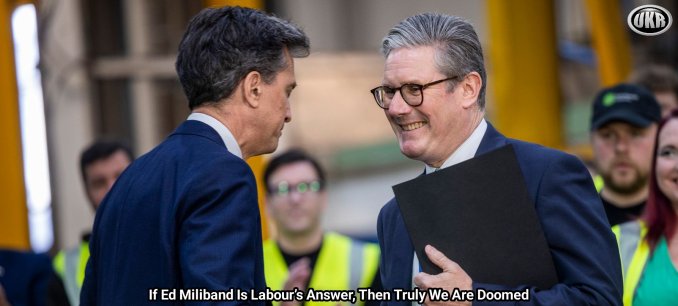
If Ed Miliband is Labour’s answer, then truly we are doomed
An abject failure as Labour leader, the Energy Secretary now appears to be positioning himself for another tilt
Starmer increasingly resembles a dead man walking – his fate likely to be sealed by what promises to be a bruising set of local elections for Labour on May 7 – the once-laughable prospect of Miliband returning to the helm of Labour is fast appearing a serious prospect.
Angela Rayner may have fired the starting gun on her own leadership bid this week, warning Mainstream, an internal organising group, that the Government is “running out of time”. But ask many within Labour who they believe will ultimately succeed Starmer, and it is Miliband’s name that keeps resurfacing.
This is as puzzling as it is troubling. You might expect that the war in Iran – and subsequent attacks on oil-rich Gulf states – would have forced a rethink of Miliband’s rigid commitment to net zero. They have revealed its vulnerabilities.
Even before the first missiles were launched, UK electricity prices ranked among the highest in Europe. Now households face soaring bills and punishment at the pumps. The knock-on effects are everywhere: higher transport costs, more expensive goods, and surging airfares. Britain’s lack of energy self-sufficiency is no longer theoretical – it is immediate and painful.
Contrast this with the approach taken during the 1970s energy crisis under James Callaghan, who expanded North Sea drilling to shield Britain from external shocks. Today, despite still possessing significant reserves, the UK is increasingly reliant on imports. And what is Miliband’s response? To double down.
His “Clean Power 2030” plan – aiming to decarbonise the electricity grid by 95 per cent within four years – may be ambitious but it is also implausible. At a moment when energy security should be paramount, his strategy risks entrenching dependence on foreign fuel while driving up domestic costs.
The Chancellor, Rachel Reeves, used her Mais Lecture this week to champion Britain as a future hub for artificial intelligence. Yet this vision also collides with reality. Data centres require vast amounts of reliable energy, something increasingly in doubt under current policy.
Miliband, however, remains unmoved. As unyielding as his infamous “Ed Stone”, he appears incapable of adapting even as circumstances change. Dramatic developments in the Gulf aren’t even enough to persuade him.
When asked whether fuel duty should rise in September, he equivocated. It was a telling moment: conviction without clarity when it matters most. And yet, among Labour’s grassroots, Miliband retains a curious appeal. The revival of “Milifandom” reflects a lingering ideological affinity reminiscent of Jeremy Corbyn. After Labour’s defeat in Gorton and Denton, Miliband appears to be positioning himself as the alternative to that other proponent of student politics Zack Polanski – just in a suit.
The Telegraph: continue reading
See Related Article Below
Keir Starmer has surrendered to Ed Miliband – and we are all paying the price
Labour MPs who want Wes Streeting to be their leader have, apparently, one great fear. If their man triggers a contest, they are terrified it will lead to Ed Miliband entering the race to stop the Health Secretary – and coming out top. A Miliband premiership would, they worry, be the death of Labour. I’ve got news for them: we are already governed by Ed Miliband. This is now his administration. And they, and the rest of us, had better get used to it.
Keir Starmer is no longer really in charge of this government – if he ever really was. He is Prime Minister in name only. His foreign policy, at this time of war, is Ed Miliband’s. His economic policy, Ed Miliband’s. His Chancellor, his political positioning, his very quest for meaning. All. Ed. Miliband. The country may have thought we’d moved on from him in 2015. But, like war in the Middle East, he’s back after a decade and badder than ever.
Indeed, Miliband’s ascendancy has been secured by the war. As our political editor, Tim Shipman, revealed last month in his reporting on the inner workings of the National Security Council, it was Miliband who commanded the majority around the table dictating British policy. And Starmer who took direction. Miliband insisted on the UK keeping Donald Trump at arm’s length and denying the US access to UK bases. He was backed by Rachel Reeves, one of the most energetic supporters of his 2010 leadership run. Starmer and Defence Secretary John Healey, who initially favoured closer alignment with the US, were overruled.
It was another reverse for a Prime Minister who had once set such store by his ability to maintain the integrity of our alliance with America. But it was yet another victory for Miliband. The Energy Secretary won the Labour leadership in 2010 on the back of his opposition to Blair’s Iraq War stance. His most consequential act as Labour leader was thwarting UK support for US strikes against Assad’s Syria in 2013. Labour’s most profound historic splits have always been over foreign and defence policy. Starmer’s aim in office was to re-establish Labour as the Bevinite party of Nato and forward action against dictators. But Miliband has out-manoeuvred him and managed once more to unite the party behind the peacenik position. Starmer now mouths the anti-war lines. But it’s Miliband’s hand up his back where a spine should be, controlling the ventriloquist’s dummy.
The ramifications of the war should, ironically, only weaken Miliband’s position in government. As energy prices rise, further crippling industry and spreading to the forecourts, his insistence on running down our native oil and gas supplies looks more and more quixotic, to put it at its politest. Miliband has banned further exploitation of our North Sea resources. His actions are devastating the economy of the north-east of Scotland in advance of the Holyrood elections, derailing Labour’s principal aim of bringing the cost of living down and destroying the manufacturing firms in steel, ceramics, refining and other sectors which still provide high-paying jobs in the Midlands and north.
It’s Miliband’s hand up Starmer’s back where a spine should be, controlling the ventriloquist’s dummy
Miliband’s policies make us more reliant on imported fossil fuels, at a time when their flow through the Strait of Hormuz has been choked. Other European nations with impeccable environmental credentials, such as Norway and Denmark, are now taking a much more permissive approach to the extraction of fossil fuels in their own sovereign waters. And this week the chief executive of RenewableUK, hitherto one of the staunchest allies of the Miliband drive towards wind and solar, argued that it made no sense to leave domestic oil and gas in the ground. Real energy security, she argued, meant the utilisation of all our available resources. But Miliband remains, literally, unmoved.
Starmer has been told repeatedly by those he once trusted that Miliband’s anti-fossil fuel fundamentalism is bad for growth, toxic for jobs and dangerous for our national security. That’s why he tried to move Miliband from the Energy Department at the last reshuffle. But Miliband point-blank refused to be shifted. And Starmer folded, conscious that Miliband’s popularity among party members, as the soft left’s champion, made it too risky to earn his enmity. And Miliband, having reminded Starmer then where real power lies, continues to determine the Prime Minister’s position. So earlier this week, when challenged on how to respond to rising energy costs, Starmer dutifully recited all Miliband’s talking points.
The Spectator: continue reading


Leave a Reply