

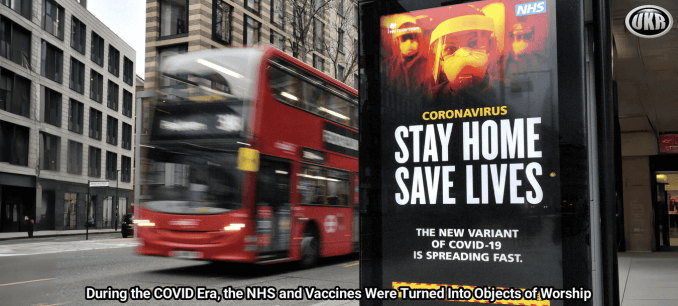
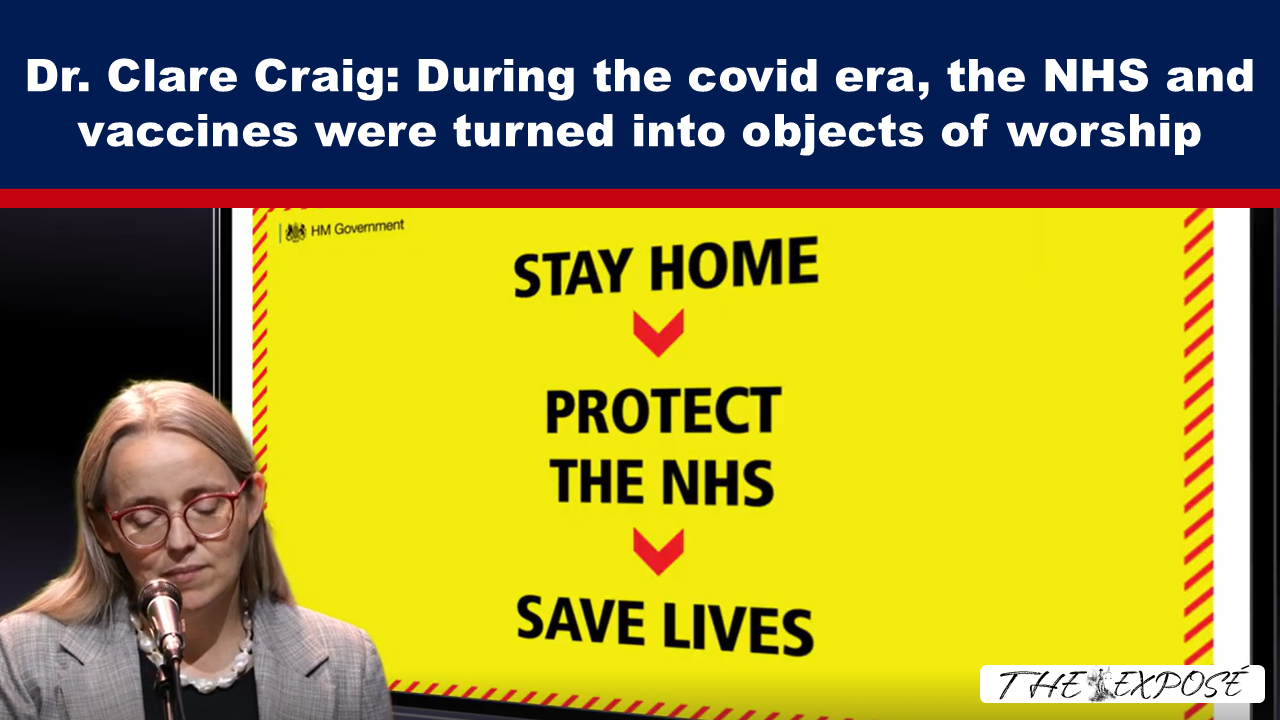
Dr. Clare Craig: During the covid era, the NHS and vaccines were turned into objects of worship
RHODA WILSON
On 20 September, Health and Truth held a summit to explore the impact of Covid on the Christian church community. One of the speakers was Dr. Clare Craig, a British pathologist and Co-Chair of the Health Advisory and Recovery Team (“HART”).
She delivered an evaluation of the societal and policy responses to the covid pandemic in the UK, framing the period from 2020 onwards as driven by a combination of pathological pessimism about the virus and pathological optimism about solutions like lockdowns and vaccines.
Her presentation highlights the fear-driven policies, their consequences and the quasi-religious fervour surrounding certain public health measures.
Health and Truth: Modern False Idol Worship by Dr Clare Craig, uploaded 30 October 2025 (40 mins)
The following is a summary of Dr. Craig’s presentation as published by Health and Truth. You can find out more about Health and Truth on its website HERE and follow them on Substack HERE. Videos from the summit can be found on YouTube HERE and Odysee HERE.
Introduction and Context
Dr. Craig begins by thanking the organiser and the audience for the opportunity to speak. She sets the stage by framing the last five years (2020–2025) as a period dominated by pathological pessimism about the virus, which led to pathological optimism about achieving zero covid and later about vaccines as a miraculous solution. This duality, she argues, shaped the global response to the pandemic in ways that were often misguided and harmful.
The Climate of Fear in March 2020
Dr. Craig describes the early days of the pandemic in March 2020 as marked by unprecedented fear, deliberately amplified by government behavioural scientists. She cites their strategy of increasing the “perceived level of personal threat” through “hard-hitting emotional messaging” to ensure compliance. This fear affected everyone, including herself, and had profound consequences, particularly for vulnerable groups like children and the elderly. The messaging instilled fear of the virus, other people and even the air itself, leading to prolonged social isolation and anti-social distancing that persisted into mid-2021 and beyond for some.
She highlights how this fear led to multiple lockdowns, even after evidence of harm emerged, and how the media and politicians globally spoke in unison, raising questions about coordinated narratives. This fear also fostered a form of societal “worship” of the NHS, exemplified by public displays like clapping for healthcare workers and the awarding of the George’s Cross to the NHS in 2022 for acts of “greatest heroism or courage.” Dr. Craig questions the narrative of overwhelmed hospitals, pointing to TikTok dances by NHS staff as evidence that wards were not consistently full.
Misconceptions About Virus Transmission
Dr. Craig challenges the government’s early claim that covid-19 spread primarily through large droplets falling within two metres, calling it a “lie.” She explains that the virus spreads via aerosols, which are tiny, evaporate quickly and can remain suspended in the air indefinitely, travelling long distances. This was acknowledged by the government only in 2022, long after policies like social distancing and masking were implemented. She likens infected individuals to “Pig Pen” from the Peanuts comic, surrounded by a cloud of aerosols that linger after they leave a space.
This aerosol transmission, she argues, renders measures like lockdowns and masking ineffective, as nothing can stop an airborne virus. She cites wastewater data from the USA showing consistent, steep waves of infection, unaffected by interventions, as only a fraction of the population is susceptible to each wave. These waves, she notes, peak seasonally (January, late October, April and, occasionally, summer), driven by susceptibility rather than close contact, contradicting predictive models.
Impact of Fear-Driven Policies
Dr. Craig details how fear led to reduced healthcare access:
- Emergency department attendance dropped sharply before lockdowns, as people with symptoms like coughs or fevers were told to stay home or were barred from hospitals.
- Healthcare staff shortages exacerbated the issue, with one in nine NHS workers sent home for minor symptoms like coughs or fevers, and others staying away due to perceived vulnerability.
- Antibiotic prescriptions plummeted, as shown in a graph comparing expected versus actual prescriptions, leading to untreated pneumonias and increased mortality.
She references a 2020 Sunday Times investigation that revealed a scoring system for rationing intensive care, which excluded those over 80 or over 60 with comorbidities. This system, circulated with an NHS logo, was misinterpreted by some professionals as a directive to deny care, resulting in 11,800 care home residents in England being turned away from hospitals. Of the 59,000 excess deaths in England and Wales in 2020, only 8,000 occurred in hospitals, with the rest in care homes, homes or even hotels.
Dr. Craig shares harrowing accounts from the UK and Scottish covid inquiries, including:
- A GP pressured to add patients to a “do not resuscitate” (“DNR”) list, accessible by ambulances, to deny hospital admission.
- Cases of blanket DNR orders applied to elderly or disabled people without consultation, such as a 49-year-old with Down syndrome who died after being denied care.
- A care home resident prescribed end-of-life drugs instead of oxygen or antibiotics, with families barred from visiting due to covid restrictions.
She criticises the use of respiratory depressant drugs like morphine and midazolam in care homes, administered without medical oversight or family advocacy, contributing to deaths. These policies, she argues, created a positive feedback loop where fear-driven measures increased mortality, which was then used to justify the virus’s perceived deadliness.
Vaccine Optimism and Missteps
Dr. Craig critiques the shift from fear of the virus to optimism about vaccines, which were initially targeted at high-risk groups (e.g., those with disabilities, who accounted for 60% of covid deaths). She notes that people with learning disabilities had a mortality rate 3.7 times higher than their healthy peers, not due to the virus but due to denial of care.
She challenges the narrative of vaccines as a “miracle,” citing:
- A 2000 US Institute of Health report and a 2021 paper co-authored by Anthony Fauci, which stated that injected vaccines cannot provide mucosal immunity to prevent respiratory virus infections.
- Initial caution in 2020 about vaccine safety and efficacy, which gave way to exaggerated claims in 2021, such as Fauci’s assertion that vaccines made individuals a “dead end” for the virus, halting community spread.
Dr. Craig argues that vaccines did not significantly alter mortality patterns, as evidenced by:
- Comparable death waves in Europe and the USA before and after vaccination.
- High mortality in heavily vaccinated countries like New Zealand, Australia and South Korea during the Omicron wave (400 deaths per million), despite Omicron being a third as deadly as earlier variants.
- Japan surpassing France in total covid deaths, despite high vaccination rates.
She cites data showing that vaccinated people were infected more often than the unvaccinated, with risk increasing with more doses, and references biological explanations for this phenomenon.
Vaccine Mandates and Societal Division
Dr. Craig describes the vaccine rollout as a campaign of manipulation, starting with incentives (e.g., free pizza, lotteries, taxis) and escalating to coercion and mandates. She highlights extreme measures, such as offers of sex in Switzerland and Austria, and threats of prison, fines or denial of healthcare for the unvaccinated.
She shares cases of unvaccinated people denied organ transplants, including a 12-year-old in 2025, and cites surveys showing the vaccinated discriminated against the unvaccinated at levels comparable to societal outcasts like ex-convicts. The unvaccinated faced exclusion from public spaces, such as the Canadian Museum of Human Rights, and were dehumanised as “blasphemers” or a “killing force,” as per a World Health Organisation (“WHO”) video likening dissent to terrorism.
Dr. Craig criticises the censorship of vaccine injury support groups, which used code (e.g., carrot emojis) to avoid detection. She argues that dismissing these concerns as “worth it for the greater good” ignores the lack of evidence for vaccine efficacy and the harm caused.
A Return to Reason and Faith
Dr. Craig concludes with a call to reject the “cruel theocracy” of fear and vaccine worship, advocating for a return to science grounded in openness, debate and humility. She praises figures like Florida Surgeon General Joseph Ladapo, who rejected vaccine mandates as infringing on bodily autonomy, and Robert F. Kennedy Jr., who has raised awareness about vaccine safety without being “anti-vaccine.”
She frames science as a “window into the world” that requires constant refinement, not dogmatic adherence. Quoting Jesus, she emphasises that truth sets us free and urges a return to God, rejecting the quasi-religious fervour that dominated the pandemic response. Her presentation ends with a call to amplify the voices of those harmed by these policies, which have been underreported despite emerging in inquiries.
Key Themes
- Fear as a Tool of Control: Government messaging deliberately amplified fear, leading to harmful policies and societal division.
- Ineffective Interventions: Lockdowns, masking, and social distancing could not stop an airborne virus, and fear-driven policies reduced healthcare access, increasing mortality.
- Denial of Care: Vulnerable groups, particularly the elderly and disabled, were systematically denied treatment, with blanket DNR orders and end-of-life drugs contributing to excess deaths.
- Vaccine Overreach: Exaggerated claims about vaccine efficacy, coupled with coercive mandates, ignored scientific evidence and caused harm, including discrimination against the unvaccinated.
- Quasi-Religious Fervour: The NHS and vaccines were elevated to objects of worship, with dissenters vilified as blasphemers, stifling debate and dehumanising critics.
- Call for Truth and Humility: Dr. Craig advocates for a return to evidence-based science, bodily autonomy and faith, rejecting the fear-driven “theocracy” of the pandemic era.
Tone and Delivery
Dr. Craig’s tone is impassioned and critical, blending scientific analysis with moral outrage at the harm caused by policies and the suppression of dissent. She uses emotive language (e.g., “cruel,” “brutal,” “blasphemers”) to underscore the human cost and draws on religious imagery to critique the quasi-spiritual devotion to public health measures. Her presentation is data-driven, referencing graphs, wastewater data and inquiries, but also deeply personal, sharing stories of people denied care and her own susceptibility to early fear.
This article (Dr. Clare Craig: During the covid era, the NHS and vaccines were turned into objects of worship) was created and published by The Expose and is republished here under “Fair Use” with attribution to the author Rhoda Wilson
See Related Article Below
Dancing Nurses | A Test For The Distortion Of Reality | Gaslighting During The Covid Scamdemic
DEREK KNAUSS
Prologue
Dancing nurses were never about the morale of healthcare workers or stress relief. They were a test, a sorting mechanism, revealing who would accept the contradictions and who would resist them. These videos on TikTok, which appeared simultaneously across all continents while governments declared medical emergencies, represented something unprecedented in the history of propaganda: the authorities showed that they could make populations accept two mutually exclusive realities at the same time.
What we witnessed was not traditional propaganda aimed at persuasion, but something more akin to what abuse experts recognize as gaslighting on a large scale. The psychological mechanism was elegant in its cruelty: it presented citizens with an apparent contradiction—hospitals that were both overcrowded and empty enough for choreographed routines—and then punished them socially for noticing it. Those who pointed out the inconsistency were labeled “conspiracy theorists,” while those who defended the videos unwittingly became pawns in the operation.
This essay explores how this technique fits into the broader context of psychological warfare described by researchers from Paul Linebarger to Michael Hoffman, from Peter Pomerantsev to Annalee Newitz. It examines how the “revelation of the method“ — which shows the audience the manipulation while remaining powerless to resist it — serves to discourage and fragment resistance.
The dancing-nurses were a test for the distortion of reality. Once populations accepted this initial contradiction, they were prepared for more: masks that worked, except when they didn’t, vaccines that prevented transmission until they stopped preventing it, two weeks to “flatten the curve” that ended up being two years. Each accepted absurdity weakened the public’s ability to trust their own observations.
Almost four years later, we can see how this enterprise created precedents that persist. The infrastructure of cognitive control—digital identity systems, social credit mechanisms, curation of reality through algorithmic manipulation—continues to expand. But understanding the technique is the first step toward resistance. This essay is an attempt to capture that moment when the masks came off, when power showed its face, dancing in empty hospital corridors while the world sank into panic and manufactured fear.

1. The Performance of Power
In March 2020, as governments around the world declared a state of emergency and citizens huddled in their homes awaiting updates on overloaded hospitals, something strange began to appear on social media: choreographed videos of medical staff dancing in seemingly empty hospital corridors. These were not spontaneous celebrations captured on cell phones—they were carefully produced performances, often set to popular music, with synchronized routines performed by groups of nurses and doctors in full personal protective equipment. From Jerusalem to New York, from London to Melbourne, medical professionals performed coordinated dance routines, while the world was told that healthcare systems were facing unprecedented collapse.
The discord was immediate and jarring. Official messages insisted that hospitals were war zones, that medical systems were on the verge of collapse, and that healthcare workers were exhausted heroes barely holding the line against an [faked] invisible enemy. News reports showed refrigerated trucks allegedly storing corpses, field hospitals being set up in Central Park, and grim warnings about the distribution of ventilators. At the same time, however, these same hospitals were producing what amounted to music videos—not one or two, but hundreds, appearing with suspicious timing around the world.
The Rockefeller Foundation’s 2010 “Operation Lock Step“ scenario envisioned a pandemic that would lead to authoritarian control through citizen compliance with emergency measures. The document described how “citizens willingly cede some of their sovereignty—and privacy—to more paternalistic states in exchange for greater security and stability.” But even this prophetic document did not foresee this particular form of psychological operation: the weaponization of absurdity itself. The dancing nurses represented something beyond traditional propaganda—they were a show of force through the deliberate creation of cognitive dissonance.
Paul Linebarger, in his seminal work on psychological warfare, wrote that effective propaganda must maintain internal consistency in order to be believable. But here was something different: propaganda that flaunted its own contradictions, provoking the audience to notice the impossible juxtaposition of crisis and celebration. When citizens pointed out the obvious—empty hospitals while they were told hospitals were overloaded, staff dancing while they were told they were exhausted—they were met not with explanations, but with gaslighting. To question the videos meant that we would be labeled “conspiracy theorists,” that we would dishonor the heroes of healthcare, that we would spread “dangerous misinformation“…
This technique seems to draw inspiration from what Michael Hoffman calls “method disclosure“ — the practice of cryptocracy revealing its activities in plain sight, knowing that public inaction in the face of such a revelation produces a discouraging effect. The message becomes: “We can show you the contradiction between our words and our actions, and you will do nothing. You will accept both the lie and the evidence of it.” It is a form of ritual humiliation that works not through concealment, but through unabashed display.

The dancing nurses were not trying to convince anyone that the hospitals were functioning normally—they were trying to show that the authorities could make citizens accept two mutually exclusive realities at the same time. It was not simply a matter of controlling information; it was about breaking the public’s trust in their perception of reality, creating what Soviet dissidents once called “fog,” where nothing could be known with certainty.
2. The Architecture of Humiliation
The concept of ritual humiliation in psychological warfare operates on a principle that predates modern propaganda: forcing the subjugated to participate in their own degradation. Ancient conquerors understood this when they made defeated peoples crawl under yokes or bow down to their victors. The dancing nurses represented a refined evolution of this technique—not the humiliation of healthcare workers themselves, but rather of the audience that was forced to watch and accept the spectacle.
Consider the specific elements of these performances. Healthcare workers, the designated “heroes“ of the pandemic narrative, engaged in frivolous entertainment while wearing the very equipment we were told was in critical shortage. They gathered in groups, while citizens were arrested for attending funerals or visiting their dying relatives. They demonstrated that hospitals had both the space and the staff available for elaborate rehearsals, while the public was told that medical systems were facing imminent collapse. Each piece of information exacerbated the offense, creating what psychological intervention researchers recognize as a “cascade of humiliation“ — where each accepted contradiction makes it easier to impose the next.
Peter Pomaranchev, in his analysis of modern propaganda, describes how modern information warfare does not aim to persuade, but to confuse, to create what he calls “censorship through noise.” But the dancing nurses went beyond confusion—they represented something more akin to what happens in abusive relationships, where the abuser deliberately creates situations that force the victim to deny their own perceptions. “That didn’t happen. And if it did, it wasn’t that bad. And if it did, it’s no big deal. And if it did, it’s not my fault. And if it did, I didn’t mean it. And if I did, you deserved it.”
This psychological mechanism mirrors what Robert Jay Lifton identified in his studies of thought reform: the creation of a “doctrine versus individual“ environment, where abstract ideas take precedence over lived experience. Citizens could see the contradiction—hospitals were both overcrowded and empty enough for dance routines—but they were forced to subordinate that observation to the official narrative. This was achieved not through violence, but through social pressure, through the fear of being labeled “conspiracy theorists” or “trolls” for pointing out the obvious.
The timing of these videos was crucial. They appeared just as populations were adjusting to unprecedented restrictions on their freedom. Locked in their homes, separated from their loved ones, watching their businesses collapse, citizens saw images of their “exhausted heroes“ performing synchronized dance routines. It was as if the system was mocking them: “We took everything from you under the guise of an emergency, and now we’re going to show you that it’s not even real — and you’ll thank us for it.”
This represents what Hoffman identified as a key technique of covert psychological warfare: the deliberate disclosure of the method combined with public consent. The real victory is not in deceiving the population—it is in showing them the deception and watching them accept it anyway. Every accepted contradiction reduces the public’s ability to resist, creating learned helplessness on a cultural scale. The dancing nurses were a test, and to a large extent, the public passed it exactly as predicted: by accepting the unacceptable.
3. Bonding With Trauma
The phenomenon of the dancing nurses operated within a broader psychological context, similar to what trauma experts recognize as trauma bonding — the strong emotional bonds that form between abusers and victims through cycles of threat and relief. During the pandemic, populations experienced unprecedented psychological stress: isolation from loved ones, economic devastation, constant messages of fear of infection and death. In this environment of constant anxiety, the videos of dancing nurses served a perverse function: they provided moments of cognitive relief through absurdity, even as they exacerbated the overall psychological violation.
The mechanism worked as follows: citizens, already destabilized by weeks of devastating messages, were confronted with these videos and experienced a momentary respite from relentless fear. The cheerful music, the synchronized movements, the smiling faces behind masks and face shields all offered a brief respite from the devastation. But this relief came packaged with its own poison. Accepting the comfort of the videos meant accepting their fundamental contradiction with reality. It meant agreeing not to think too seriously about why hospitals had time for choreography during a crisis that threatened civilization.
This dynamic mirrors what Joost Meerloo described in “The Rape of the Mind“ regarding the systematic destruction of independent thought. He observed that totalitarian systems do not simply impose their ideology through violence. They create conditions where the mind seeks refuge in accepting contradictions rather than enduring the psychological tension of resistance. The dancing nurses created precisely this kind of double bind: either reject them and be labeled a dangerous conspiracy theorist who dishonors heroes, or accept them and surrender your ability to recognize obvious contradictions.
The production quality of these videos deserves special attention. These were not spontaneous expressions of joy from exhausted staff—they required planning, rehearsals, equipment, and editing. Someone had to organize the staff, someone had to choreograph the routines, someone had to film and edit, someone had to upload and promote. This level of coordination in many hospitals worldwide suggests institutional support, if not direct instruction. The message embedded in this production value was itself part of the operation: “We have the resources and the authority to make this happen, everywhere, simultaneously.”
Michael Hoffman’s research on “twilight language” and “method disclosure” provides another lens through which to understand these performances. In occult psychology, the victim must participate in his own degradation for the ritual to be complete. The dancing nurses enforced this participation. Citizens shared the videos—sometimes mockingly, sometimes supportively, but they shared them nonetheless. Every share, every comment, every reaction represented a form of participation in the ritual, regardless of whether the participant supported or opposed the content.
The aspect of trauma bonding became more apparent in the way people defended the videos when asked about them. Stockholm syndrome describes how captives begin to identify with and defend their captors. Similarly, many citizens became aggressive defenders of the dancing nurses, attacking anyone who pointed out the contradictions. They had internalized the cognitive dissonance so completely that protecting it became psychologically easier than confronting it. The system had created its own defenders among its victims, a hallmark of successful psychological operations that Linebarger recognized as the ultimate goal of propaganda: to make the target population impose propaganda on itself.
4. The technology of deception
The dancing nurses represented a new development in what Annalee Newitz calls “weaponized narratives” — stories designed not to inform or persuade, but to destabilize and discourage. But these were not traditional narratives with a beginning, middle, and end. They were fragments of meaning, delivered through the surreal medium of social media, designed to bypass rational analysis and strike directly at psychological foundations. The platform itself—primarily TikTok—was an integral part of the operation, with its algorithm ensuring maximum penetration and its format discouraging critical thinking.
The choice of dance as a medium was neither arbitrary nor innocent. Dance is pre-verbal, physical, primal. It bypasses intellectual defenses and speaks directly to emotional and social processing centers. When performed by people in authority wearing uniforms—especially medical uniforms, which society codes as trustworthy and protective—it creates a specific kind of cognitive dissonance. The brain struggles to reconcile the seriousness associated with health professionals during a health crisis with the frivolity of choreographed entertainment. This failure to reconcile does not solve the problem. It simply exhausts critical capacity.
Consider how these videos proliferated. They did not originate from a single source that could be challenged. They appeared simultaneously on multiple platforms, from multiple hospitals, in multiple countries, creating what information analysts call “source laundering“ — when the origin of an operation becomes impossible to trace because it appears everywhere at once. This gave the phenomenon an organic appearance while serving a coordinated purpose. Individual hospitals could claim that their video was simply innocent stress relief, while the overall effect created a global psychological operation.
The element of mockery worked on multiple levels. On the surface, it mocked the very notion of a pandemic emergency — how serious could things be if nurses had time to rehearse dance routines? But more deeply, it mocked the vulnerability of the public. Citizens who had lost their jobs, missed funerals, been arrested for gathering outdoors, watched their children’s mental health deteriorate from isolation — these people were forced to watch their “heroes“ dance. It was reminiscent of Marie Antoinette’s infamous quote, “Let them eat cake,” except that this time the aristocracy made sure the plebs watched them eat it on social media.
Harry Vox’s 2014 warning about the Rockefeller Foundation’s “Lock Step” scenario proved prophetic, but even he did not foresee this particular improvement in control. The document focused on traditional authoritarian measures—quarantine, restrictions on movement, surveillance. But the dancing nurses represented something more sophisticated: control through performed contradiction, power through absurd display. As Nima Parvini later observed, the regime does not play four-dimensional chess—they telegraph their intentions. The dancing nurses were the telegraph, the message, and the humiliation, all in one.
This technology of mockery serves a specific function in psychological warfare: it identifies and isolates potential resistance. Those who pointed out the obvious contradictions were exposed as “problems” that needed to be monitored, excluded from social media platforms, or socially destroyed. [as Truth11.com was for pointing out the scam from the beginning of 2020] Those who participated in defending the videos identified themselves as successfully programmed. And the huge middle group, confused and discouraged, learned to remain silent rather than risk being lumped into either category. The dance videos became a sorting mechanism, a test of faith disguised as entertainment.
5. The Fog of Unreality
The dancing nurses ultimately served as a “drug“ in what would become an ongoing campaign of reality distortion. Once the populations accepted this initial contradiction, emergency and entertainment at the same time, they were prepared for greater violations of logic. Masks were imposed on people walking alone on beaches, while mass protests were considered safe. Deadly viruses respected the arbitrary two-meter distances and seating arrangements in restaurants. Vaccines that did not prevent infection or transmission, but were imposed for the “protection of others.” Each accepted absurdity made the next one easier to swallow.
This technique is in line with what Soviet dissidents described about life under late-stage communism—not a society that believed in propaganda, but a society that had abandoned the belief that anything could be known with certainty. Svetlana Boym called this “the shared apartment of the mind,” where contradictory realities coexisted without resolution. The dancing nurses helped construct a similar mental architecture in the West: a space where “the overwhelming overload of hospitals“ and “time for TikTok“ could exist simultaneously without cognitive collapse, because cognitive function itself had been deliberately disrupted.
The long-term psychological damage of this operation extends beyond the immediate period of the pandemic. By successfully forcing populations to accept obvious contradictions, the operation set a precedent. It proved that with sufficient social pressure and fear, people will surrender their most basic ability—the ability to recognize when things are not right. This acquired weakness, which Martin Seligman’s research showed could be caused by repeated exposure to uncontrollable contradictions, became embedded in the social fabric.
Those who orchestrated this operation understood something fundamental about human psychology: people will choose meaning over truth when forced to choose. Faced with the choice between admitting they had been deceived (and thus facing the terrifying implications for their institutions) or constructing elaborate excuses for the obvious contradictions, most chose the latter. The videos of dancing nurses became a test of how much reality could be distorted before it broke down—and the answer was “much more than anyone could have imagined.”
The success of the operation cannot be measured by how many believed that the hospitals were actually empty (there were few), but by how many learned to stop trusting their own observations. When people saw the videos, they saw the contradictions, but they chose silence over speaking up, participating in their own psychological enslavement. This is what Meerloo meant by killing the mind’s capacity for independent judgment. The dancing nurses did not kill thought. They taught people not to trust it.
As we emerge from this period, the challenge is not simply to record what happened, but to understand how it worked—how populations were persuaded to doubt their senses, to accept the contradictions that were enacted, to participate in their own humiliation. The dancing nurses were never about healthcare or morale or stress relief. They were about power—specifically, the power to make people accept the unacceptable, to break the link between observation and conclusion, to create a population that could no longer trust its perception of reality. And in this, unfortunately, they succeeded…
References
Primary sources
Hoffman, Michael A. (2018). Secret Societies and Psychological Warfare. Independent History and Research.
Linebarger, Paul MA (1954). Psychological Warfare. Washington: Infantry Journal Press.
Newitz, Annalee. (2024). Stories Are Weapons: Psychological Warfare and American Thought. New York: WW Norton & Company.
Pomerantsev, Peter. (2019). This Is Not Propaganda: Adventures in the War Against Reality. London: Faber & Faber.
Additional Related Sources
Bernays, Edward. (1928). Propaganda. New York: Horace Liveright.
Bezmenov, Yuri. (1984). Love Letter to America. Los Angeles: Almanac Press.
Desmet, Mattias. (2022). The Psychology of Totalitarianism. White River Junction: Chelsea Green Publishing.
Ellul, Jacques. (1965). Propaganda: The Formation of Human Attitudes. New York: Vintage Books.
Hopkins, CJ (2021). The Rise of the New Normal Reich. Berlin: Consent Factory Publishing.
Kissinger, Henry. (1974). National Security Study Memorandum 200: Implications of World Population Growth for U.S. Security and Overseas Interests. Washington: National Security Council.
Kessler, Arthur. (1940). Darkness at Noon. London: Jonathan Cape.
Le Bon, Gustave. (1895). The Crowd: A Study of the Popular Mind London: T. Fisher Unwin.
Lifton, Robert Jay. (1961). Thought Reform and the Psychology of Totalism: A Study of “Brainwashing” in China. New York: WW Norton & Company.
Meerloo, Joost. (1956). The Rape of the Mind: The Psychology of Thought Control, Mind Murder, and Brainwashing. Cleveland: World Publishing Company.
Rockefeller Foundation. (2010). Scenarios for the Future of Technology and International Development. New York: Rockefeller Foundation.
Seligman, Martin. (1975). Helpless: On Depression, Development, and Death . San Francisco: WH Freeman.
Szasz, Thomas. (1974). Ceremonial Chemistry: The Ritual Persecution of Drugs, Addicts, and Dealers. New York: Doubleday.
Yates, Frances. (1979). Occult Philosophy in the Elizabethan Era. London: Routledge.
Documentary sources
Johns Hopkins Center for Health Security. (2017). SPARS Pandemic Scenario 2025-2028. Baltimore: Johns Hopkins University.
World Economic Forum. (2019). Event 201 Pandemic Exercise. Geneva: World Economic Forum.
Source: https://0minus.substack.com/p/7c6
Note: Comments placed in [ ] are added by Truth11.com
This article (Helpful Steps towards understanding those ‘pandemic’ Hospital Dance Videos) was created and published by Prepare for Change and is republished here under “Fair Use” with attribution to the author Derek Knauss


Leave a Reply