

A Legacy of Rigged Justice and Suppressed Dissent

TOM ARMSTRONG
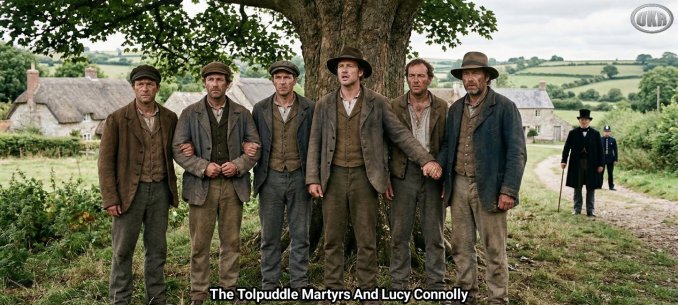
On 19 March 1834, in the cold courtroom of Dorchester Assizes, six Dorset farm labourers, George Loveless, James Loveless, Thomas Standfield, John Standfield, James Brine, and James Hammett, heard their fate. Sentenced to seven years’ transportation to Australia’s brutal penal colonies, these men, known forever as the Tolpuddle Martyrs, became symbols of establishment cruelty. Their crime? Daring to organise against poverty wages. This date is a stark emblem of rigged trials designed to crush dissent. Fast-forward to today, under Labour’s rule, and parallels emerge in the one-sided prosecutions of pro-British voices, like Lucy Connolly’s swift jailing for a heated social media post. History’s wheel turns, revealing how power elites, then Whig, now Labour, wield justice as a bludgeon against the inconvenient.
The background to Tolpuddle is one of grinding rural poverty and despair. In early 19th-century England, agricultural workers endured the fallout of the State’s act of grand larceny, the enclosure acts and of increasing mechanisation, which slashed jobs and wages. In Tolpuddle, a sleepy Dorset village, labourers scraping by on ten shillings a week in 1830 faced cuts to nine, then eight, then seven by 1833. The Swing Riots of 1830-31, where desperate workers smashed threshing machines, had been crushed with hangings and transportations. Yet hope flickered. The 1832 Reform Act promised change, and the Grand National Consolidated Trades Union inspired action. George Loveless, a Methodist lay preacher and self-taught radical, rallied five comrades to form the Friendly Society of Agricultural Labourers in October 1833. They sought a living wage of ten shillings, swearing a secret oath of loyalty, modelled on Masonic rites, to bind their group. This oath, innocuous in intent, became the noose.
Local landowners, led by magistrate James Frampton, smelled threat. Frampton, a hardline Tory, loathed unions as seditious. His spies and informants unearthed the oath ceremony. On 24 February 1834, constables arrested the six on trumped-up charges under the 1797 Unlawful Oaths Act, originally aimed at naval mutineers. The real motive? To strangle nascent unionism before it spread. The Whig government under Lord Melbourne, despite reformist pretensions, feared worker unrest amid economic turmoil. Melbourne’s Home Office backed Frampton, ensuring a show trial.
The trial, spanning 18-19 March 1834, epitomised rigging. Judge John Williams, a Whig appointee, presided with venom, branding the men “depraved” before evidence unfolded. The jury? Packed with Frampton’s kin and landowner allies, including his son and brother-in-law. Witnesses were coerced; defence counsel hamstrung. Prosecutors twisted the oath into conspiracy, ignoring its peaceful aim. The verdict came very quickly: guilty and, on 19 March, the Martyrs were sentence to seven years’ transportation, the maximum, to deter others. This wasn’t justice; it was class warfare. The establishment of landed gentry and government, intended to suppress dissent, viewing unions as revolutionary sparks in a tinderbox society scarred by Peterloo and Chartist stirrings.
Short-term consequences were savage. Chained and shipped, the martyrs endured hellish voyages to Van Diemen’s Land (Tasmania) and New South Wales. George Loveless toiled in chains, his health shattered; others faced floggings and isolation. Locally, union activity withered under terror. Frampton gloated, reporting “tranquillity restored.” Nationally, it chilled worker organisation, reinforcing the Combination Acts’ legacy of outlawing collectives. Yet backlash brewed. Petitions flooded Parliament; a London march on 21 April 1834 drew 100,000, chanting for pardon. An 800,000-signature plea bombarded Melbourne, who stonewalled until pressure mounted.
Long-term, Tolpuddle ignited transformation. In March 1836, full pardons came, though returns dragged to 1839. Five martyrs emigrated to Canada, farming freely; Hammett stayed in Tolpuddle. Their saga galvanised unions: membership surged, paving for the Trades Union Congress in 1868. Tolpuddle became hallowed ground, with annual festivals commemorating worker rights. It exposed establishment hypocrisy, fuelling Chartism and later labour laws like the 1871 Trade Union Act. Broader, it symbolised how rigged justice backfires, creating solidarity against oppression.
Echoes resound in 2020s Britain, under Labour’s equally oppressive iron fist. The establishment’s intent to muzzle dissent persists, now targeting pro-British protesters via one-sided trials. Take Lucy Connolly, jailed in October 2024 for a raw X post amid Southport riots. Grieving the stabbing of three girls, Connolly vented: “Mass deportation now, set fire to all the fucking hotels full of the bastards for all I care… If that makes me racist so be it.” Charged, without evidence, with stirring racial hatred, she was misled into pleading guilty and received 31 months as swiftly and severely as the Tolpuddle martyr’s miscarriage of justice. Critics decry two-tier justice: while Connolly was jailed, Labour councillor Ricky Jones, filmed urging “cut their throats” at far-right foes, walked free after acquittal. Jones’ words, at an anti-racism rally, deemed not incitement; Connolly’s, pro-British fury against migration, crushed hard.
This asymmetry reeks of bias. Labour, echoing Whig suppression, targets voices challenging open borders and multiculturalism—dissenters labelled “far-right” to justify gags. Connolly, a childminder and Tory wife, was no violent threat; her post, born of anguish over child safety incited nobody. Yet judge Melbourne Inman—ironic name—slammed her for endangering lives, ignoring context. Short-term: She became a “political prisoner,” per her words, her family torn. Genuine incitement from the Left, including ‘charities’ supported by the State, were ignored, exposing Labour’s selective justice, eroding trust in courts as tools for ideological control. Like Tolpuddle’s rigged jury, modern fast-track hearings post protests often turned violent by police action, results in mass miscarriages of justice with hundreds jailed swiftly in cases of predetermined guilt for the “wrong” views.
Tolpuddle’s martyrs, sentenced on 19 March one hundred and ninety-two years ago should remind us: when establishments rig trials to suppress, backlash follows. From Dorset fields to digital feeds, dissenters face the same axe. Connolly’s case, like theirs, highlights power’s fear of the voiceless rising. Yet history teaches resilience: protests pardoned the six, unions flourished. Today, demands for fair trials could shatter Labour’s facade. Every rigged verdict sows seeds of reform; ignore them and reap the whirlwind.
This article (The Tolpuddle Martyrs And Lucy Connolly) was created and published by Free Speech Union and is republished here under “Fair Use” with attribution to the author Tom Armstrong

••••
The Liberty Beacon Project is now expanding at a near exponential rate, and for this we are grateful and excited! But we must also be practical. For 7 years we have not asked for any donations, and have built this project with our own funds as we grew. We are now experiencing ever increasing growing pains due to the large number of websites and projects we represent. So we have just installed donation buttons on our websites and ask that you consider this when you visit them. Nothing is too small. We thank you for all your support and your considerations … (TLB)
••••
Comment Policy: As a privately owned web site, we reserve the right to remove comments that contain spam, advertising, vulgarity, threats of violence, racism, or personal/abusive attacks on other users. This also applies to trolling, the use of more than one alias, or just intentional mischief. Enforcement of this policy is at the discretion of this websites administrators. Repeat offenders may be blocked or permanently banned without prior warning.
••••
Disclaimer: TLB websites contain copyrighted material the use of which has not always been specifically authorized by the copyright owner. We are making such material available to our readers under the provisions of “fair use” in an effort to advance a better understanding of political, health, economic and social issues. The material on this site is distributed without profit to those who have expressed a prior interest in receiving it for research and educational purposes. If you wish to use copyrighted material for purposes other than “fair use” you must request permission from the copyright owner.
••••
Disclaimer: The information and opinions shared are for informational purposes only including, but not limited to, text, graphics, images and other material are not intended as medical advice or instruction. Nothing mentioned is intended to be a substitute for professional medical advice, diagnosis or treatment.
Disclaimer: The views and opinions expressed in this article are those of the author and do not necessarily reflect the official policy or position of The Liberty Beacon Project.


Leave a Reply