

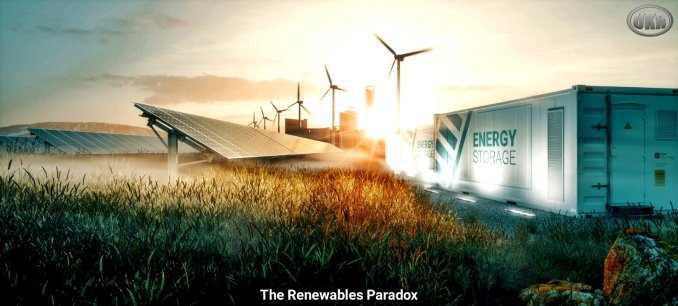
Chapter 4 — The Renewables Paradox
Why wind and solar can’t replace the fossil fuel system they depend on
RICHARD LYON
This is Chapter 4 in a series walking through the core arguments of my forthcoming book “The Energy Trap: Why the Renewable Energy Transition Can’t Work — And What Can”. Start with Chapter 1 here.
IN CHAPTERS 1 TO 3, I described the physical constraints that all energy systems must obey, the industrial processes that depend on hydrocarbons as chemistry rather than fuel, and the depletion of the oil endowment we depend on. Everything so far has been about the problem. Now for the proposed solution — wind and solar — and why the numbers do not add up.
The argument has several moving parts, but each one compounds the last. By the end, they multiply together into a conclusion that is devastating.
Net energy — the number that matters
It’s not what an energy system produces that sustains civilisation. It’s what is left over after the system has fed itself.
Every energy source consumes energy — to mine the ore, build the infrastructure, deliver the output. The ratio between what you get and what you spend is called EROEI: Energy Return on Energy Invested. A conventional oil well returns roughly 30 units for every one invested. The energy tax is about 3%. The surplus is enormous. For most of the fossil fuel era, nobody needed to think about this ratio because it was so favourable.
Wind turbines and solar panels also produce energy. That is not in dispute. But they must also be mined, manufactured, installed, connected, backed with storage, and replaced when they wear out — and every one of those steps consumes energy. The question is not do they produce energy? but how much is left over to power civilisation?
The energy cliff
At an EROEI of 30:1, about 3% of the output goes to feeding the system. At 10:1, it’s 10%. So far, so intuitive. But the relationship is not linear — it is an exponential curve with a cliff in it. At 5:1, the cost leaps to 20%. At 3:1, it’s 33%. At 2:1, you’re spending half your energy just getting energy.

This matters because the cliff means that imprecision at the bottom is catastrophic. At 30:1, an error of ten units is an inconvenience. At 5:1 — wind and solar territory — the same error can determine whether civilisation functions or collapses. And we are not even measuring the right number.
The number they don’t tell you
The EROEI figures most commonly cited for wind and solar measure the device — the wind turbine, the solar panel. Not the system needed to make the device useful. The difference is storage. And the difference changes everything.
A wind turbine in isolation may return 16 units of energy for every unit invested. But a wind turbine in isolation generates intermittent energy, and civilisation tolerates an intermittent energy supply about as well as you tolerate an intermittent air supply. An energy system must deliver power reliably, on demand. That means storage — batteries, pumped hydro, or hydrogen — each of which consumes energy to build and loses energy in every charge-discharge cycle. It means grid infrastructure. It means backup generation for the days when the wind does not blow and the sun does not shine. Each addition pushes the system EROEI further down the cliff.
How far? A 2023 Royal Society study modelled 37 years of UK weather data and found that wind output can remain below its long-run average for two to three consecutive years. Meeting demand through a multi-year wind drought requires tens of terawatt-hours of stored energy. The UK currently has about 0.03 TWh. That is a shortfall of roughly a thousand-fold. To close the gap with lithium-ion batteries would cost approximately the UK’s entire annual GDP — for batteries alone, which degrade and must be replaced every ten to fifteen years. And this is for electricity only, which accounts for about one fifth of total energy demand.
Add storage of that magnitude, grid, and backup to the turbine’s claimed 16:1, and the system EROEI drops to roughly 4:1 — deep into the danger zone on the cliff. That assumes pumped hydro storage. With batteries it is worse still.
Every link in the chain burns hydrocarbons
The energy cliff is still an abstraction until you translate it into physical reality. A single 5-megawatt wind turbine contains roughly 900 tons of steel, 1,500 tons of concrete, 45 tons of composite, and 15-20 tons of copper. Now trace the supply chain backwards. The steel was smelted from iron ore in a blast furnace burning coke. The ore was mined by diesel excavators, transported by diesel trucks, shipped by vessels burning heavy fuel oil. The concrete was mixed from cement fired in a gas-burning kiln. The copper was mined in Chile or the Congo and refined in a fossil-fuelled smelter. The fibreglass blades are made from resins derived from oil. The lubricant is a petroleum product. The crane that lifted the nacelle runs on diesel.
Every single link in the supply chain is a hydrocarbon operation. Not some of them. All of them. This is the structure of the Global Industrial Manufacturing System, and electricity cannot replace it — because, as Chapter 2 showed, the processes at every link require hydrocarbons as feed-stock, not just fuel.
The IEA estimates that a net-zero buildout would require, by 2040, roughly seventeen times current lithium production, five times the cobalt, and three times the copper — from mines that do not yet exist, in jurisdictions that are not stable, using energy from the system being replaced.
The treadmill
A wind turbine lasts 20 to 25 years. A solar panel, 25 to 30. A gas plant operates for 40 or more. A nuclear plant, 60 to 80. A renewables-based energy system must therefore be entirely rebuilt two or three times within the operational life of the conventional system it replaces — and each rebuild demands the full bill of materials again.
A turbine blade cannot be recycled into a new turbine blade. The concrete in a foundation is not recoverable. The lithium in a spent battery can be partially reclaimed, but at significant energy cost. This is not maintenance. It is reconstruction. On a cycle that never ends and never gets cheaper in energy terms.
The paradox
Now put it all together. A system on the wrong side of the energy cliff requires multiples of generating capacity to deliver the same net output. Each multiple requires hundreds of times the land area and its own bill of materials. Each bill must be paid again every generation. The total is the initial buildout, multiplied by the number of replacement cycles, multiplied again by the EROEI penalty, multiplied again by the land penalty.
The numbers never stop growing, because the cycle never ends.
Every energy transition in history has met two conditions: there was surplus energy from the old source, and the new source was denser — more energy from less material and less land. Wood to coal, coal to oil, oil to nuclear. Each time, the old source funded the construction of something better while still keeping the existing arrangement running. The renewable energy transition violates both conditions. It asks us to use high-density energy to build low-density energy, hoping the new system can sustain itself. But if it returns less net energy than the fossil fuels consumed to build it, you can neither maintain current civilisation nor construct its replacement.
This is the Renewables Paradox. It is not a transition away from the hydrocarbon system. It is an expansion of the hydrocarbon system’s workload — undertaken in the name of eliminating it.
But surely there are escape hatches — efficiency, hydrogen, green growth? In Chapter 5, we’ll test the three most popular candidates. None of them survive contact with the arithmetic.
Richard
This is the fifth in a series previewing the core arguments of my forthcoming book “The Energy Trap: Why the Renewable Energy Transition Can’t Work — And What Can”, on release later this year.
If you found this useful, the share button is right there. Forward it to someone who should read it.
This article (Chapter 4 — The Renewables Paradox) was created and published by Richard Lyon and is republished here under “Fair Use”

••••
The Liberty Beacon Project is now expanding at a near exponential rate, and for this we are grateful and excited! But we must also be practical. For 7 years we have not asked for any donations, and have built this project with our own funds as we grew. We are now experiencing ever increasing growing pains due to the large number of websites and projects we represent. So we have just installed donation buttons on our websites and ask that you consider this when you visit them. Nothing is too small. We thank you for all your support and your considerations … (TLB)
••••
Comment Policy: As a privately owned web site, we reserve the right to remove comments that contain spam, advertising, vulgarity, threats of violence, racism, or personal/abusive attacks on other users. This also applies to trolling, the use of more than one alias, or just intentional mischief. Enforcement of this policy is at the discretion of this websites administrators. Repeat offenders may be blocked or permanently banned without prior warning.
••••
Disclaimer: TLB websites contain copyrighted material the use of which has not always been specifically authorized by the copyright owner. We are making such material available to our readers under the provisions of “fair use” in an effort to advance a better understanding of political, health, economic and social issues. The material on this site is distributed without profit to those who have expressed a prior interest in receiving it for research and educational purposes. If you wish to use copyrighted material for purposes other than “fair use” you must request permission from the copyright owner.
••••
Disclaimer: The information and opinions shared are for informational purposes only including, but not limited to, text, graphics, images and other material are not intended as medical advice or instruction. Nothing mentioned is intended to be a substitute for professional medical advice, diagnosis or treatment.
Disclaimer: The views and opinions expressed in this article are those of the author and do not necessarily reflect the official policy or position of The Liberty Beacon Project.


Leave a Reply