

Well, Come On and Let Me Know
Should I stay or should I go?
DAVID MCGROGAN
He remained annoyed with himself until he realized that not knowing what he wanted was actually quite natural.
-from The Unbearable Lightness of Being
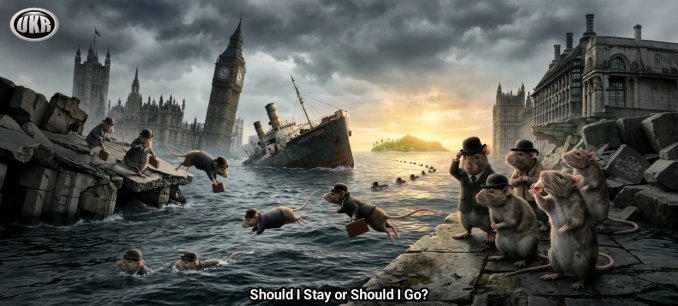
Britain in 2026 has the feeling of a sinking ship. And the role of a rat, leaping overboard and gleefully swimming off to set up home on a warm Pacific island, can rarely have seemed more attractive. The question that increasingly occupies those who have an exit option (money, connections, a second nationality, useful transferrable skills, etc.) is: why shouldn’t I take it?
In the year ending June 2025, 252,000 British nationals asked themselves that question, found themselves not to have a good answer to it, and promptly left. On May 21st 2026 the next set of data on external migration will be released by the Office for National Statistics – one wonders whether the new figures will be even higher.
I reflected on the ‘Should I stay or should I go?’ question myself at various times in the last month. I have an exit option, you see. I lived in Japan for almost a decade and through family connections could relatively easily move back. And, having spent the last two weeks or so there, I increasingly wonder what is stopping me. It has become trite among conservative talking heads to speak in glowing, idealised terms about what Japan can teach us. But the cliche exists for a reason; Japan is in very many respects a much more pleasant and comfortable place to live than any other with which I am familiar, even if over the years I developed a love-hate relationship with it, as many foreign residents do. It is almost crime-free; the food culture is the best in the world; the people are polite and considerate; the natural environment is stunningly beautiful; the big cities are more exciting and vibrant than in almost any other country. Two weeks there will convince anybody that the Japanese have perfected civilisation to a degree found nowhere else.
Yet the two weeks before that I spent largely on the road travelling across England (to rural East Suffolk, and Kent) and up in Scotland (mostly in the Borders and Dumfries & Galloway). And I was reminded on many occasions during these trips of Britain’s own charms. There is no sense belabouring all of the many ways in which we find ourselves to be floundering. Yet there is something there that is, indisputably, worth rescuing: a society that is imbued with great and terrible genius – able to conquer a world, reshape the global industry and economy, fight and win mighty wars, invent technologies of profound importance, produce literature and music and entire sporting pastimes that the rest of the world can only envy and mimic…and to do it all alongside creating a beautiful, stable and peaceful home for its people in its green and pleasant landscape. This genius is still present everywhere one cares to look, often half-hidden underneath rugs and behind sofas, admittedly, but there all the same, ready to be rediscovered and remembered.
The entire country feels as though all it really needs is for somebody to grab it by the lapels, possibly after slapping it across the chops, and yell into its face the spittle-flecked words, ‘Just bloody well pull yourself together!’ And one gets the sense that if that were to happen Britain would very rapidly realise that it had let itself go, take a decent swig of brandy, set its bowler hat back on its head, and get back in business. It just needs to stop being such a wet lettuce.
In The Unbearable Lightness of Being, Kundera describes to us our predicament as only a great novelist can: ‘We can never know what to want, because, living only one life, we can neither compare it with our previous lives nor perfect it in our lives to come.’ Every decision we make is like that of an ‘actor, going on cold’. And this causes the main character, Tomas, to conclude (at the novel’s outset) that there is not really any point in living at all. Because nobody ever knows whether a decision is ultimately for the better or worse, and has no counterfactual to compare anything to, this is tantamount to saying that consequences are irrelevant. A human life is ‘a sketch for nothing, an outline with no picture.’ Hence:
Einmal ist keinmal, says Tomas to himself. What happens but once, says the German adage, might as well not have happened at all. If we have only one life to live, we might as well not have lived at all.
Yet – no spoilers – the novel itself is a powerfully eloquent argument against that proposition. One must live, and to live is to make choices in the belief that some are better than others. Those Brits who are leaving for pastures new are doing so in pursuit of a better life and I certainly do not blame them – it is the decision I made myself, as a callow youth of 21, getting almost impulsively on a flight to Tokyo, and I never looked back. Yet there is a romantic project beckoning those who are of a different mindset – a project of national renewal that is waiting to begin. It is at the moment still in utero, like a spring that is about to be unleashed on a winter thaw, or the ink in a great author’s pen, ready to be spilled. But it is there, and it will be possible to be a part of it if one is willing to commit and see through the period of chaos which we all feel is coming in short order.
Should one stay or should one go? Answers to that question will vary according to many factors. But what is clear is that either decision requires a willed commitment. To leave and set up a new life, or to stay and face certain struggle. Neither option is easy; neither is without risk. But neither should be taken by default. I would advise anybody reading this who is, particularly, under the age of thirty to consider the choice as indeed a choice – an active decision to embrace a life overseas or a life at home. Either option will be difficult. There is no future for Britain that does not include hardship. To go and live in a foreign country requires sacrifices. But either option will be an adventure.
I remain on the fence.
This article (Well, Come On and Let Me Know) was created and published by News from Uncibal and is republished here under “Fair Use”

••••
The Liberty Beacon Project is now expanding at a near exponential rate, and for this we are grateful and excited! But we must also be practical. For 7 years we have not asked for any donations, and have built this project with our own funds as we grew. We are now experiencing ever increasing growing pains due to the large number of websites and projects we represent. So we have just installed donation buttons on our websites and ask that you consider this when you visit them. Nothing is too small. We thank you for all your support and your considerations … (TLB)
••••
Comment Policy: As a privately owned web site, we reserve the right to remove comments that contain spam, advertising, vulgarity, threats of violence, racism, or personal/abusive attacks on other users. This also applies to trolling, the use of more than one alias, or just intentional mischief. Enforcement of this policy is at the discretion of this websites administrators. Repeat offenders may be blocked or permanently banned without prior warning.
••••
Disclaimer: TLB websites contain copyrighted material the use of which has not always been specifically authorized by the copyright owner. We are making such material available to our readers under the provisions of “fair use” in an effort to advance a better understanding of political, health, economic and social issues. The material on this site is distributed without profit to those who have expressed a prior interest in receiving it for research and educational purposes. If you wish to use copyrighted material for purposes other than “fair use” you must request permission from the copyright owner.
••••
Disclaimer: The information and opinions shared are for informational purposes only including, but not limited to, text, graphics, images and other material are not intended as medical advice or instruction. Nothing mentioned is intended to be a substitute for professional medical advice, diagnosis or treatment.
Disclaimer: The views and opinions expressed in this article are those of the author and do not necessarily reflect the official policy or position of The Liberty Beacon Project.


Leave a Reply