

NOAH CARL
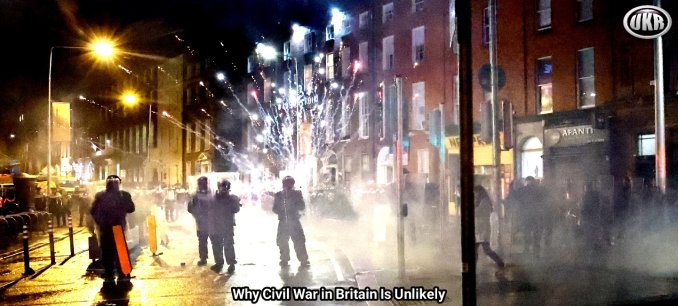
At the end of October, Elon Musk doubled down on his prediction that “civil war in Britain is inevitable”, having made the same pronouncement in August of 2024. Interestingly, he is far from the only commentator who sees full-blown armed conflict in Britain’s future.
The retired Colonel Richard Kemp has stated in an interview that he believes “not just civil unrest but civil war is coming to the UK in the coming years”. The academics David Betz and Michael Rainsborough have been sounding the alarm for several years, including in a recent essay for the Daily Sceptic.
Betz and Rainsborough list several factors that portend the outbreak of civil war, such as cratering trust in government, public anger over uncontrolled immigration, and support for political violence in surveys. They also point to real-world examples of violence, such as the anti-immigration riots that erupted in the summer of 2024, which they say reveal a shift in mood toward open defiance of the state.
While they make a number of valid points in their essay, I do not believe civil war in Britain is likely.
To begin with, we must define the term. Although there is some disagreement among scholars, most definitions mention protracted armed conflict between two or more organised groups — meaning that sporadic acts of terrorism or gang violence do not qualify. Some scholars even specify a minimum number of deaths. According to the Correlates of War project, “war must involve sustained combat, involving organized armed forces, resulting in a minimum of 1,000 battle-related combatant fatalities within a twelve month period”.
For illustration, the US had about 17,000 murders in 2024 — a per-capita rate more than five times higher than the UK. Yet America is obviously not embroiled in civil war, as the violence there is low-level and disorganised.
Which raises the question: if Britain had a civil war, who would the sides be? The Left against the Right? Muslims versus non-Muslims? The state against non-state actors? It’s not clear.
There are only two conflicts in Western Europe from the last half century that could reasonably be classed as civil wars: the Troubles in Northern Ireland and the Basque Conflict in Spain. Both of these had clear sides: Irish nationalists against the British state in the former, and Basque separatists against the Spanish state in the latter. It is difficult to identify any analogous political cleavage in modern Britain.
Even the Muslim population is spread across half a dozen cities, and is divided up into Pakistanis, Bangladeshis, Arabs, Turks, Somalis and others — groups with different national languages that often observe different traditions.
Betz and Rainsborough are correct about certain conditions that raise the risk of civil war being present in the UK: ethnic diversity, economic stagnation, widespread perceptions of elite failure. But it’s also true that the underlying risk in Western countries is low to begin with. (Civil wars are overwhelmingly concentrated outside the West.) And doubling or even tripling a low risk is still a low risk.
What is more, certain conditions that reduce the risk of civil war are also present. The country is heavily surveilled. It has an ageing population. It has a low rate of gun ownership. It has a powerful and centralised military that could presumably quash any attempted insurrection. It has few forests or mountainous areas for insurgents to hide out. And it is an island, which makes it hard to smuggle in weapons from the outside.
The fault lines that Betz and Rainsborough sketch out are real, and may well contribute to elevated risks of terrorism, race riots or other forms of civil unrest going forward. However, I’m not convinced that an actual civil war is on the cards.
This article (Why Civil War in Britain Is Unlikely) was created and published by The Daily Sceptic and is republished here under “Fair Use” with attribution to the author Noah Carl

••••
The Liberty Beacon Project is now expanding at a near exponential rate, and for this we are grateful and excited! But we must also be practical. For 7 years we have not asked for any donations, and have built this project with our own funds as we grew. We are now experiencing ever increasing growing pains due to the large number of websites and projects we represent. So we have just installed donation buttons on our websites and ask that you consider this when you visit them. Nothing is too small. We thank you for all your support and your considerations … (TLB)
••••
Comment Policy: As a privately owned web site, we reserve the right to remove comments that contain spam, advertising, vulgarity, threats of violence, racism, or personal/abusive attacks on other users. This also applies to trolling, the use of more than one alias, or just intentional mischief. Enforcement of this policy is at the discretion of this websites administrators. Repeat offenders may be blocked or permanently banned without prior warning.
••••
Disclaimer: TLB websites contain copyrighted material the use of which has not always been specifically authorized by the copyright owner. We are making such material available to our readers under the provisions of “fair use” in an effort to advance a better understanding of political, health, economic and social issues. The material on this site is distributed without profit to those who have expressed a prior interest in receiving it for research and educational purposes. If you wish to use copyrighted material for purposes other than “fair use” you must request permission from the copyright owner.
••••
Disclaimer: The information and opinions shared are for informational purposes only including, but not limited to, text, graphics, images and other material are not intended as medical advice or instruction. Nothing mentioned is intended to be a substitute for professional medical advice, diagnosis or treatment.
Disclaimer: The views and opinions expressed in this article are those of the author and do not necessarily reflect the official policy or position of The Liberty Beacon Project.


Leave a Reply