

FRANK HAVILAND
The British countryside is “too white.” At least that is, according to Defra—the Department for Environment, Food & Rural Affairs, as reported earlier this month in these pages. Following a reportin 2019, National Landscapes—a charity mostly funded by Defra—has been launching outreach programs aimed at encouraging ethnic minorities to break the stranglehold of “white communities,” “white spaces,” and “white environments.”
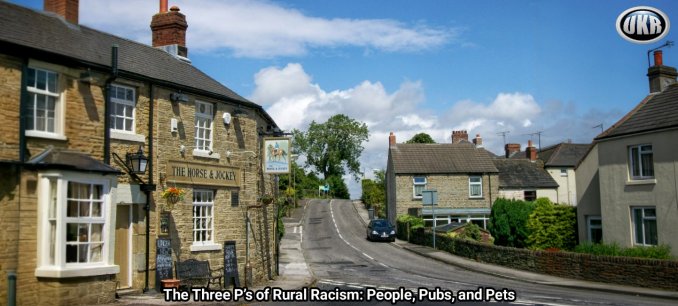
The initiatives focus on ‘people,’ ‘pubs,’ and ‘pets’—the three P’s of rural racism, surely? In terms of people, regrettably, the British countryside appears to cater to “white English culture”—which obviously has to change. Pubs traditionally involve drinking, which is unwelcoming to some communities. And pets—specifically dogs, are encouraged to be kept on a tighter leash, because Muslims do not like them. It’s worth pinching yourself and realising that this is not April 1st; this is real, and taxpayer money has been spent to reach these conclusions.
Neither is this Mother Nature’s first rodeo in terms of racism allegations. Only last year, it was reported that the British countryside was “overwhelmingly white” and was in need of more halal food. A year prior, rural England found itself a “racist colonial” white space, according to wildlife charities.
Of course, the British are used to this. Indeed, it is increasingly difficult to find things which aren’t‘too white’—and it would certainly make for a shorter list than those that are—e.g., maths, the media, milk, the Miss Scotland pageant, Miss World, modelling, and museums—and that’s just the M’s. What’s interesting about the attack on the whiteness of the countryside is that the crime appears to be the audacious congregation of white people in physical spaces without the coddling comforts of diversity. You will perhaps recall that jogging, gardening, and hiking have all been similarly lambasted as secret havens of white supremacy.
However much the architects of white replacement profess their commitment to ‘diversity,’ the erasure of Britain’s white past, present, and future is no longer a fringe theory, but an observable process unfolding in plain sight. British history is being steadily revised until it can pass a modern diversity audit; the nation’s literature, art, and public memory are being thinned of “dead, white men,” clearing the path for a more progressive narrative. In the present, the indigenous population finds itself increasingly treated as an embarrassment in its own homeland: white faces are algorithmically minimised in stock imagery, while white families are quietly edited out of ‘real London’ promotions.
Culturally, self-flagellation has become a civic virtue; institutions once central to national life now frame their own founding stock as the problem to be solved. Demographically, the trajectory is unmistakable: white British people are already a minority in their own major cities—and will be in the country as a whole within forty years, while white birth rates remain the lowest and immigration continues at record levels. When this replacement is pointed out, the response has shifted from denial to a shrugging “so what?”—as if the disappearance of the people who built and named the place were merely an interesting footnote rather than the central fact of modern Britain.
None of this however is, I believe, the correct place to start. The first question I would ask, and which no one as far as I am aware in the commentariat has dared to venture, is what exactly does “too white” mean; and, more to the point, who had the gall to come up with the concept in the first place? Is there an acceptable level of whiteness, beyond which we are pushing our luck? Are whites, by definition, undesirable? Should there be diversity quotas for absolutely every avenue of life? Implicit in the statement is the notion that while all other groups are encouraged to gather, there is something worrying or even dangerous when whites do it—as immortalised by the BBC’s Jon Snow a few years back when reporting on a Brexit march: “It’s been the most extraordinary day. A day which has seen … I have never seen so many white people in one place, it’s an extraordinary story.” I always felt, and continue to feel, that this said more about him than those he referenced.
It is remarkable how reticent journalists are to question this school of thought, however. Here for instance is the ‘anti-racist’ campaigner, Ken Hinds, voicing his support for the diversification of the British countryside, and bemoaning the fact that it has been “white for far too long”:
For some however, this does not go far enough. While le grand remplacement is customarily denounced as a far-right conspiracy theory, there are now those such as Spain’s far-left leader, Irene Montero, who are saying the quiet part about replacement migration out loud:
The countryside is of course not “too white”. But for those so heavily invested in the quotarisation of society, perhaps they should ask themselves why knife crime is “too black”, grooming gangs are “too Muslim”, and child sexual exploitation is “too Pakistani”?
Frank Haviland is the Editor of The New Conservative, and the author of Banalysis: The Lie Destroying the West.
If you enjoy my work, please consider buying me a coffee – it would really help to keep me going. Thank you!
This piece was first published in The European Conservative, and is reproduced by kind permission.
This article (The Three P’s of Rural Racism: People, Pubs, and Pets) was created and published by Frank Haviland and is republished here under “Fair Use”

••••
The Liberty Beacon Project is now expanding at a near exponential rate, and for this we are grateful and excited! But we must also be practical. For 7 years we have not asked for any donations, and have built this project with our own funds as we grew. We are now experiencing ever increasing growing pains due to the large number of websites and projects we represent. So we have just installed donation buttons on our websites and ask that you consider this when you visit them. Nothing is too small. We thank you for all your support and your considerations … (TLB)
••••
Comment Policy: As a privately owned web site, we reserve the right to remove comments that contain spam, advertising, vulgarity, threats of violence, racism, or personal/abusive attacks on other users. This also applies to trolling, the use of more than one alias, or just intentional mischief. Enforcement of this policy is at the discretion of this websites administrators. Repeat offenders may be blocked or permanently banned without prior warning.
••••
Disclaimer: TLB websites contain copyrighted material the use of which has not always been specifically authorized by the copyright owner. We are making such material available to our readers under the provisions of “fair use” in an effort to advance a better understanding of political, health, economic and social issues. The material on this site is distributed without profit to those who have expressed a prior interest in receiving it for research and educational purposes. If you wish to use copyrighted material for purposes other than “fair use” you must request permission from the copyright owner.
••••
Disclaimer: The information and opinions shared are for informational purposes only including, but not limited to, text, graphics, images and other material are not intended as medical advice or instruction. Nothing mentioned is intended to be a substitute for professional medical advice, diagnosis or treatment.
Disclaimer: The views and opinions expressed in this article are those of the author and do not necessarily reflect the official policy or position of The Liberty Beacon Project.


Leave a Reply