

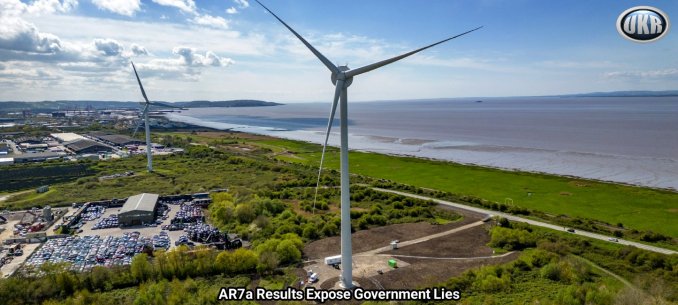
Government departments, ministers and agencies are not telling the truth about the cost of renewables and Net Zero.
DAVID TURVER
Introduction
Earlier in the year, we covered the results of the renewables auction AR7 that covered offshore wind technologies. In addition, I was asked by the GWPF to produce the Risks of AR7 report that was published a couple of weeks ago. The full report can be downloaded on the link below:
 The Risks Of AR7
695KB ∙ PDF file
The risks of AR7 and Miliband’s broader Clean Power 2030 plan. By David Turver for GWPF.
The results of second renewables auction, called AR7a, covering onshore and tidal technologies came out last week and on the face of it some of the prices achieved are relatively cheap. The Government has also recently released its Electricity Generation Costs 2025 report that updated their estimates of the levelised cost of energy (LCOE) from various sources. Both publications come hot on the heels of NESO’s analysis of the economic impact of Net Zero from late last year and of course the 7th Carbon Budget from the Climate Change Committee earlier in 2025.
The most recent releases have prompted Energy Secretary Ed Miliband to take to X to spread misinformation about what it all means (see Figure A).

We need a deep dive into the results to unpack it all so let’s dig in.
AR7a Results
In summary, AR7a awarded contracts for 4.9GW of new solar at a clearing price of £65.23/MWh (in 2024 prices), 1.3GW of onshore wind at £72.24/MWh and a further 21MW of tidal stream capacity at a staggering £265/MWh. In 2025 terms the cost of solar rises to £68/MWh and onshore wind to £75/MWh. This compares to the cost of gas fired electricity in December 2025, according to Ember, of £78/MWh comprising £49/MWh of fuel costs plus £29/MWh of carbon costs.
These results led to energy minister Michael Shanks claiming “solar and onshore wind are the cheapest power you can build and operate”. The Government press release claimed that AR7a has delivered the “largest ever procurement of solar projects in the UK – 4.9GW secured” and they have delivered “Britain’s biggest ever clean energy auction” and that the “new clean homegrown power secured today will reduce energy bills for families”.
False Claims of Cheap Renewables
However as we have covered before, Shanks’ and the Government’s analyses are at best misleading and at worst a downright lie. First, the Government analysis does not cover the extra costs of backup, grid balancing and expansion. Using 2024 data, we can estimate that the cost of backup and balancing for intermittent renewables at £33/MWh. This increases the costs of solar and onshore wind awarded contracts in AR7a to £100/MWh and £108/MWh, respectively. As shown in Figure B, this makes all the new renewables awarded contracts in AR7 and AR7a more expensive than current gas-fired electricity.

We should also note that this calculation does not include the eyewatering costs of grid expansion. CEO of Centrica, owner of British Gas, Chris O’Shea has warned that all these extra costs mean that “by 2030 the electricity price will be higher than it was at the peak of the Russian invasion of Ukraine”.
The claims of Miliband and Shanks rely upon their reading of the Generation Cost 2025 report, as shown in Figure C.

The numbers they quote rely on gas plants running at a load factor (LF) of just 30% which pushes up the cost to £145/MWh. Of course this is higher than the cost of solar, onshore and fixed bottom offshore wind even with grid balancing and backup costs added. However, their analysis is flawed for three reasons.
First, gas plants would only have such low load factors because of renewables. They only run to cover the gaps in intermittent generation. A better counterfactual would be to look at the load factors if intermittent renewables were not on the grid. It is unlikely that load factors would rise as high as their 93% scenario, but gas costs fall to £109/MWh in those circumstances.
Second, the costs of gas-fired generation are loaded with £41/MWh of essentially made-up carbon costs. If we followed Tory Party policy as abolished these carbon taxes, the LCOE for gas-fired generation would fall to £104/MWh (30% LF) or £68/MWh (93% LF).
Finally, as NESO acknowledged in their Clean Power 2030 Report (Annex 1, Table 1) we will need 35GW of unabated gas-fired generation in 2030 anyway. As the Risks of AR7 report shows (see Figure D, using data from DUKES Table 5.11) our existing gas fleet is aging.

If we assume a generous 35-year life for the existing gas fleet, then gas-fired generation capacity falls to about 25GW by 2030. These plants will need to be replaced and run at an even lower load factor, maybe as low as 5% which pushes up the costs to £424/MWh (or £383/MWh without carbon costs). Miliband’s plan involves spending money on two generation systems and running one of them sub-optimally pushing up overall system costs. We can see that Miliband’s claim to be bringing bills down and Shanks’ claim that onshore wind and solar are the cheapest power we can build are both brazen lies.
Comparison to NESO and CCC Claims
However, the brazen lies of the ministers and the department pale into insignificance compared to the lies being peddled by NESO and the CCC. We will now compare the contracts awards in the various allocation rounds to the assumptions made by NESO in their FES report and the CCC in their Seventh Carbon Budget alongside the costs in the latest Generation Cost report.
Solar Power Comparison
Starting with solar power, we can see in Figure E that solar power strike prices fell from the early days of AR1 to a low of about £66/MWh (2025 prices) in AR4.

Prices rose in AR5 and again in AR6 to £72/MWh. Prices have fallen back in AR7a to £68/MWh but if we adjust for the contract extension as per the government’s impact analysis for solar power, then prices would have risen again to ~£78/MWh on a like-for-like basis.
Even the AR7a headline price of £68/MWh is double the £34/MWh (2023 prices) assumed by the CCC for projects delivering in 2030 and almost double the interpolated cost assumed by NESO in FES 2025. The AR7a contract award prices are also above the £59/MWh in the Generation Cost report, but the gap is much smaller.
Onshore Wind Comparison
Moving on to onshore wind, we can see in Figure F that onshore wind strike prices fell from the early days of AR1 to a low of about £61/MWh (2025 prices) in AR4.

Prices rose to £75/MWh AR5 before falling slightly to £73/MWh in AR6. Prices have risen again in AR7a to £75/MWh but if we adjust for the contract extension as per the government’s impact analysis for onshore wind, then prices would have been even higher at ~£84/MWh on a like-for-like basis.
The AR7a headline price of £75/MWh is much higher than the £58/MWh assumed in the Gen Cost report and quite a bit higher than the ~£66/MWh interpolated cost for 2030 delivery calculated by NESO in FES 2025. The CCC did not bother to provide costs for onshore wind.
Fixed Bottom Offshore Wind Comparison
Turning now to fixed bottom offshore wind we can see in Figure G that offshore wind strike prices fell from the early days of AR1 to a low of about £54/MWh (2025 prices) in AR4.

No projects were awarded contracts in AR5 and then rose substantially to £85/MWh in AR6. However, the flagship Hornsea 4 project from AR6 was cancelled as uneconomic. Prices have risen again in AR7 to £94/MWh but if we adjust for the contract extension as per the government’s impact analysis for offshore wind, then prices would have been even higher at ~£107/MWh on a like-for-like basis.
The AR7 headline price of £94/MWh is lower than the £103/MWh in the Generation Cost report calling into question the viability of those projects awarded contracts. AR7 prices are two and a half times the £38/MWh assumed by the CCC in the 7th Carbon Budget for generic offshore wind and more than 50% higher than the interpolated value of ~£62/MWh for 2030 calculated by NESO in FES 2025.
Floating Offshore Wind Comparison
Finally, we have floating offshore wind in Figure H that shows strike prices have been rising steadily from the £125/MWh (2025 prices) awarded in AR4 to a staggering £224/MWh in AR7.

If we adjust for the contract extension as per the government’s impact analysis for offshore wind, then prices would have been even higher at ~£255/MWh on a like-for-like basis.
The AR7 headline price of £224/MWh is much higher than the £152/MWh in the Generation Cost report. The AR7 prices are nearly six times the £38/MWh assumed by the CCC in the 7th Carbon Budget for generic offshore wind and 58% higher than the interpolated value of ~£142/MWh for 2030 calculated by NESO in FES 2025.
Conclusions
Government ministers, government departments and government agencies like NESO and the Climate Change Committee are lying to us about the true cost of renewables and Net Zero.
Miliband claimed to be “lowering bills” and Shanks claimed solar and onshore wind are the cheapest power we can build and operate. Both claims are outright lies. When you consider the backup, grid balancing and expansion costs renewables are more expensive and as we have seen the “expensive” gas-fired plants will need to be built anyway to keep the lights on. Chris O’Shea was probably right when he said by 2030 our electricity prices will be higher than they were at the peak of the Russian invasion of Ukraine.
The agencies of government like NESO and the CCC are making even more egregious claims about the cost of renewables to make the whole Net Zero project look cheap. They can only make the capital and operating costs of Net Zero look even remotely palatable by making false assumptions and in the case of the CCC, dissembling in response to Claire Coutinho, Shadow Energy Secretary.
The new Generation Cost Report from DESNZ is closer to the truth than ministers or the government agencies. This shows that somewhere, deep in the bowels of DESNZ there are at least some people who are close to understanding the truth. This sham cannot be allowed to continue and there must be legal penalties for telling lies and misleading the nation.
This Substack now has over 5,100 subscribers and is growing fast. If you enjoyed this article, please share it with your family, friends and colleagues. Please consider signing up for or gifting a paid subscription.
This article (AR7a Results Expose Government Lies) was created and published by David Turver and is republished here under “Fair Use”

••••
The Liberty Beacon Project is now expanding at a near exponential rate, and for this we are grateful and excited! But we must also be practical. For 7 years we have not asked for any donations, and have built this project with our own funds as we grew. We are now experiencing ever increasing growing pains due to the large number of websites and projects we represent. So we have just installed donation buttons on our websites and ask that you consider this when you visit them. Nothing is too small. We thank you for all your support and your considerations … (TLB)
••••
Comment Policy: As a privately owned web site, we reserve the right to remove comments that contain spam, advertising, vulgarity, threats of violence, racism, or personal/abusive attacks on other users. This also applies to trolling, the use of more than one alias, or just intentional mischief. Enforcement of this policy is at the discretion of this websites administrators. Repeat offenders may be blocked or permanently banned without prior warning.
••••
Disclaimer: TLB websites contain copyrighted material the use of which has not always been specifically authorized by the copyright owner. We are making such material available to our readers under the provisions of “fair use” in an effort to advance a better understanding of political, health, economic and social issues. The material on this site is distributed without profit to those who have expressed a prior interest in receiving it for research and educational purposes. If you wish to use copyrighted material for purposes other than “fair use” you must request permission from the copyright owner.
••••
Disclaimer: The information and opinions shared are for informational purposes only including, but not limited to, text, graphics, images and other material are not intended as medical advice or instruction. Nothing mentioned is intended to be a substitute for professional medical advice, diagnosis or treatment.
Disclaimer: The views and opinions expressed in this article are those of the author and do not necessarily reflect the official policy or position of The Liberty Beacon Project.


Leave a Reply