

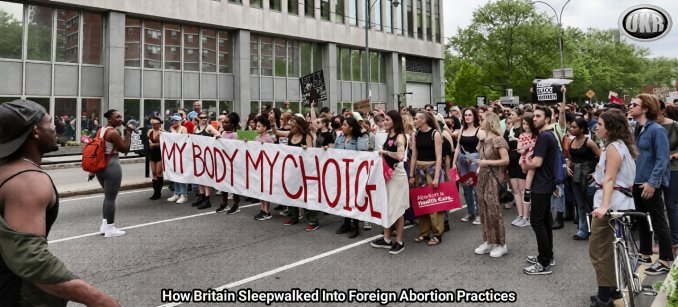
A law out of step with British values
JOHN MAC GHLIONN
Britain has never been a country that celebrates extremes. Its people argue and grumble about everything, from the weather and train delays to the price of a pint and the size of a biscuit. But when Parliament changes something intimate and irreversible, the public expects caution, consultation, and a basic level of seriousness. Clause 191 of the Crime and Policing Bill fails that test. It is being sold as a neat little “modernisation” of abortion law. In practice, it removes the last legal restraint on a woman ending her own pregnancy at any stage, for any reason, with criminal law switched off for her actions.
Supporters insist this is “limited” because it doesn’t change the 24-week framework for abortions provided in clinical settings, and coercion remains a crime. Fine. Yet the point of Clause 191 is precisely to remove the threat of prosecution for self-managed abortion “at any gestation”. It creates a space where the latest, most dangerous, most contested terminations can happen without legal consequence for the person doing them. The rest of the statute book doesn’t need rewriting to change a country’s moral climate. Removing the final fence is enough.
This is also the kind of change Britons instinctively distrust: slipped into a long bill, debated briefly, and treated like a footnote. Even among those broadly supportive of abortion access, there is deep unease with social surgery carried out at speed. The public preference is simple and sensible. Keep a legal line after 24 weeks. A Whitestone Insight poll found only a small minority back decriminalisation, with a clear majority opposed.
Now add the part nobody wants to say out loud in polite company: sex selection.
The problem already exists. Official birth data points to an abnormal imbalance among third births to Indian mothers in Britain, with ratios rising well beyond what biology produces by chance. Campaigners and analysts argue these figures are consistent with sex-selective practices. The Department of Health and Social Care’s position has long been unequivocal: abortion on the grounds of sex alone is illegal; sex is not a lawful ground under the Abortion Act.
But “illegal” is not the same as impossible, especially when enforcement is weak and cultural realities are ignored. Similar patterns are well documented in parts of the Muslim world, where male preference remains entrenched and female foeticide has distorted demographics for decades. Britain is not immune to importing those pressures, especially at a moment when abortion numbers continue to climb, year after year, reaching record highs. Scale matters.
When the law signals permissiveness, even indirectly, it doesn’t liberate women; if anything, it empowers coercion. In such environments, choice quickly shifts from the mother to the family, the husband, or the wider community. Clause 191 does exactly that. Once the mother’s act is decriminalised, the deterrent shifts. The law’s weight lessens. The evidential trail fades. What is left is a system that claims safeguards while actively abandoning them. The people most likely to suffer aren’t activists in Westminster, but women under pressure at home.
Sex selection is not a British tradition. It isn’t a brave extension of liberty. It’s discrimination dressed up as choice, with a long and ugly record. India’s own government surveys have documented tens of millions of “missing” women, driven in part by sex-selective abortion and unequal care. This has been the case for decades. Serious research has long shown that son preference — and the resulting skewed sex ratios — runs through parts of South and East Asia and the Middle East. This is precisely why Britain drew a legal boundary in the first place. The state can respect autonomy while refusing to legitimise targeted destruction.
The nonsensical claim that such cases are too rare to matter misses the point. They matter even if they number in the hundreds. They matter because the principle is corrosive. The moment a society shrugs at girls being consciously filtered out because a family wanted a boy, progress has reversed.
The irony is brutal. The loudest defenders of liberal abortion law spent decades warning about dangerous, unsupervised terminations. Clause 191 invites precisely that scenario at the point of highest risk: late pregnancy, at home, alone, using pills designed for early use. The closer a pregnancy is to viability, the greater the need for medicine rather than messaging.
There is also a distinctly British value being discarded: protection of the vulnerable. The law has long attempted — imperfectly — to hold two truths at once: women shouldn’t be treated as criminals for being in crisis, and viable unborn children aren’t disposable property. Clause 191 dissolves that balance.
This is about refusing to turn Britain into a place where anything goes, right up to birth, for any reason, with the state acting as if nothing of consequence has occurred. Most Britons do not want that. They may disagree fiercely about abortion at twelve weeks, sixteen, or twenty-four. But there remains a widely shared recognition that a line exists between early termination and ending a viable life in the final stretch. That instinct is admirable and humane.
If Parliament intends to change something this foundational, it should do so honestly: a dedicated bill, full debate, proper scrutiny, and public daylight. Not a stealth clause that loosens the law exactly where cultural coercion and sex selection are most likely to thrive.
This article (HOW BRITAIN SLEEPWALKED INTO FOREIGN ABORTION PRACTICES) was created and published by Courage Media and is republished here under “Fair Use” with attribution to the author John Mac Ghlionn
See Related Article Below
A new law will allow women to abort babies for ANY reason – including their sex – right up to full term. Now ROSA MONCKTON, who has vowed to fight it all the way, reveals the barbaric truth…
ROSA MONCKTON
In one week last June, the House of Commons passed two measures which would radically change the nature of our society.
The first, which I think everyone now knows, was to enable the state to facilitate and even encourage suicide for those diagnosed as having six months left to live.
But the other measure, which is far less well known, decriminalises abortion up to full term, for any reason, if it is performed alone by the mother. I promised readers of this paper that I would fight these in the House of Lords – where both are now being considered – and thus on Monday I put forward an amendment to strike out this radical reshaping of our abortion laws.
The Crime and Policing Bill now being debated in the House of Lords is a lengthy and important piece of legislation, which has been detaining peers, in our capacity as a revising chamber, for the past two and half months.
Most of the country, however, will be unaware that a clause, unrelated to this bill, had been sneaked in via an amendment in the name of the Labour MP Tonia Antoniazzi, after just 46 minutes of backbench debate in the House of Commons.
This is Clause 191, entitled ‘Removal of Women from the criminal law related to abortion’. It removes all remaining legal invigilation of women regarding abortion, allowing a mother-to-be to abort her baby, up to full term, for any reason at all, including its sex.
This clause passed the Commons without any evidence, scrutiny or public consultation. It is a reckless and radical proposal, with implications both for the mental and physical health of the mother, and disastrous consequences for the child
👶“THE BABY IN THE ROOM!!” Baroness Monckton (@MoncktonR) asks why abortion supporters do not even mention the unborn baby in their briefings to Peers lobbying them to support radical proposals that would lead to viable babies’ lives being ended with no legal repercussions. pic.twitter.com/dEVVR1fnbT
— Right To Life UK (@RightToLifeUK) February 2, 2026
This is a terrifying proposition, which could increase the likelihood of women suffering coercive third-trimester terminations – since an abusive partner could point out there was no longer any legal penalty – and the unspeakable trauma of a late-term abortion without any medical supervision.
This law change would, in effect, re-introduce the backstreet abortion, as women beyond the current 24-week legal limit are in effect to be encouraged to abort at home, on their own, using pills ordered through the post, which are not designed for use outside of a clinical context beyond ten weeks.
As I said in the debate on Monday, there is a supreme irony that those who always claimed to support legal termination on the basis that the alternative would be unsafe – backstreet terminations – are now proposing that women can perform illegal terminations (outside the terms of the Abortion Act) in an unsafe and unsupervised environment.
The Royal College of Obstetricians and Gynaecologists lobbied for the ‘abortion pills by post’ scheme, introduced during the lockdowns of the Covid 19 pandemic, which was never supposed to be permanent, though it now seems to be. They are among several Royal Colleges and abortion providers who are lobbying for Clause 191 to become law.
But I received a letter from a deeply concerned healthcare professional pointing out grim medical facts that most MPs seemed unwilling to contemplate in their perfunctory deliberations.
She pointed out that babies over the age of 22 weeks being legally aborted in a medical setting are clinically euthanised prior to surgery by a lethal injection directly into the heart. This procedure is recommended by the Royal College of Obstetrics and Gynaecology to prevent larger sentient babies from being delivered badly injured, but still alive. But babies aborted in a domestic setting, by the mother, alone, cannot be clinically euthanised.
Abortion medication only removes the lining of the womb and starts labour; therefore, late gestation babies aborted at home could be born alive. What happens then? Would the mother have to kill her ‘aborted’ but living baby? How would she legally dispose of her baby’s body if she left it to die? Would she then face a murder charge?
Along with – I assume – all members of the House of Lords, I received a letter from the public affairs manager of The Royal College of Obstetricians and Gynaecologists urging me to ‘Speak in favour of Clause 191’. It quoted the President of the Royal College criticising the existing law for ‘affecting women at the most vulnerable times’ and said that ‘women should not face the prospect of a criminal sanction for making decisions about their own health’.
I find it extraordinary and chilling that there is not a single mention of the unborn child in the statement. It was as if no such person exists.
The Daily Mail: continue reading

••••
The Liberty Beacon Project is now expanding at a near exponential rate, and for this we are grateful and excited! But we must also be practical. For 7 years we have not asked for any donations, and have built this project with our own funds as we grew. We are now experiencing ever increasing growing pains due to the large number of websites and projects we represent. So we have just installed donation buttons on our websites and ask that you consider this when you visit them. Nothing is too small. We thank you for all your support and your considerations … (TLB)
••••
Comment Policy: As a privately owned web site, we reserve the right to remove comments that contain spam, advertising, vulgarity, threats of violence, racism, or personal/abusive attacks on other users. This also applies to trolling, the use of more than one alias, or just intentional mischief. Enforcement of this policy is at the discretion of this websites administrators. Repeat offenders may be blocked or permanently banned without prior warning.
••••
Disclaimer: TLB websites contain copyrighted material the use of which has not always been specifically authorized by the copyright owner. We are making such material available to our readers under the provisions of “fair use” in an effort to advance a better understanding of political, health, economic and social issues. The material on this site is distributed without profit to those who have expressed a prior interest in receiving it for research and educational purposes. If you wish to use copyrighted material for purposes other than “fair use” you must request permission from the copyright owner.
••••
Disclaimer: The information and opinions shared are for informational purposes only including, but not limited to, text, graphics, images and other material are not intended as medical advice or instruction. Nothing mentioned is intended to be a substitute for professional medical advice, diagnosis or treatment.
Disclaimer: The views and opinions expressed in this article are those of the author and do not necessarily reflect the official policy or position of The Liberty Beacon Project.


Leave a Reply