

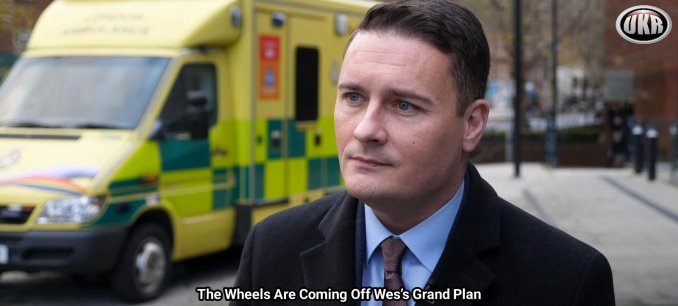
The Wheels are coming off Wes’s Grand Plan
Hope stranded somewhere between hospital floors.
CARL HENEGHAN
First, we had the Darzi review, followed by the 10-year plan, which repeated long-standing problems in the NHS rather than delivering new, implemented solutions.
If Darzi had genuinely highlighted evidence-based solutions, he would have pointed out that the NHS is structurally understaffed, that some services will need to be deprioritised to protect core care, and that productivity will not improve without capital investment that exceeds current plans.
Such conclusions were politically explosive, so they weren’t included in the plan; instead, the grand plan legitimised delay while appearing serious.
In late October 2024, Wes Streeting launched the Big NHS consultation, billed as a national conversation on the NHS’s future. Yet no genuinely new ideas emerged, and there’s a strong case that it was used as political cover rather than as a vehicle for policy generation.
The consultation didn’t ask which services should be prioritised and which should stop, which guarantees the NHS should abandon, and how – and by how much – the NHS should be funded. Instead, it asked safe, open-ended questions that funnelled responses into already agreed narratives.
Consequently, the output couldn’t be informative even if people wanted it to be. Can anyone point to a single NHS policy that exists because people said it in the consultation?
Consultations create the appearance of action without committing to spending, rationing, or restructuring. In that sense, it functioned exactly like a smokescreen.
The problem for the NHS is that Streeting’s role has become as much political and leadership-oriented as it is NHS-operational. Quietly, the problems are mounting.
In its 2024 manifesto, Labour pledged to deliver “an extra two million NHS operations, scans and appointments every year” After taking office, ministers boasted they had delivered this pledge early.
However, NHS trusts are reportedly receiving £3m per month in validation payments to remove patients from lists. From April to September last year, NHS England paid hospital trusts £18.8 million for “validation” exercises. Hospitals received approximately £33 per patient removed, resulting in more than half a million patients being taken off the lists in just six months.
The November decrease of 86,000 in waiting lists was primarily achieved by removing thousands of patients through a process known as “validation.” Notably, the November reduction in waiting lists occurred despite 10% fewer operations during that period.

Streeting has been credited with reducing waiting lists in some hospitals by introducing the controversial “Further Faster 20” programme.
However, a Health Foundation analysis found that the number of treatments increased only slightly among the trusts targeted by the programme. Instead, many patients were removed from waiting lists without necessarily being treated.
Improvements likely reflect list manipulation and fewer referrals, rather than actual service delivery to patients. The headline claims do not align with the underlying reality; a recurring pattern shows that Streeting’s messaging outstrips substance.
Even the Staunch Labour-supporting Guardian accused Wes Streeting of a ‘chaotic and incoherent approach’ to NHS reform, based on an Institute for Government report.

His overarching strategy lacks clear logic, prioritisation, and communication, and the NHS is unlikely to hit its own targets under the current approach.
The government is quick to claim success based on yesterdays figures showing waiting lists at their lowest in almost three years. However, there are still 7.29 million treatments for 6.17 million patients on the list, with the number of patients unchanged since November. Meanwhile, the number of people waiting more than 12 hours in A&E for a hospital bed has sharply increased, rising from 50,775 in December to 71,517 in January—the highest since records began in August 2010.
Thus, patients continue to suffer: The total number of people on the NHS waiting list in England for non-emergency (elective) treatments remains extremely large, at around 7.3 million as of late 2025 – close to the record highs seen in recent years.
According to independent data, the proportion of patients treated within the 18-week NHS constitutional target remains well below the standard, at roughly 62% as of late 2025 (far below the 92% target).
Queues are long, waits remain medically significant, and political targets are unlikely to be met in the near term. Even under optimistic scenarios, waiting lists will remain well above pre-pandemic levels through 2027.
Wes Streeting promised NHS reform. Yet all we got were reviews that reviewed reviews and consultations that consulted themselves. Waiting lists appear in spreadsheets, but increase in the real world of patient care.
Bold change became carefully crafted messaging, and all the NHS got was more slogans: “The NHS is broken,” “Reform, not just rescue,” and “patients before bureaucracy,” Wes said, while the patient queue kept shuffling toward an ever-receding promise.
However, it hardly matters to Wes. Streeting’s NHS reforms are beautifully unfinished, like winter planning that ends in November. Why fix waiting lists when you’re waiting for promotion? Health secretaries come and go while the NHS remains, clutching another strategy document, watching the lift doors close, hope stranded somewhere between hospital floors.
This post was written by two old geezers who will be promoted in a galaxy far, far away.
This article (The Wheels are coming off Wes’s Grand Plan) was created and published by Trust the Evidence and is republished here under “Fair Use”


Leave a Reply