

Why not embrace both?

JUPPLANDIA
There’s a division on the Right that has existed for a long time and that I’ve probably only ever addressed incidentally. In the UK this division has come to the fore recently following accusations that Rupert Lowe’s new Respect Party is an ethno-nationalist party, accusations which were increased when the party’s director of communications dared to state that Britishness was defined by a combination of ethnic inheritance and Christianity. In a recent largely friendly interview with the historian David Starkey Lowe was obliged to put those comments down to youthful error and, in the midst of an otherwise robust defence of tough talk on immigration and integration, somewhat apologise for anyone in his new party mentioning native white ethnicity as a constituent of national identity.
The old division all this touched on is of course that which is supposed to exist between ethno-nationalism and civic nationalism. And it’s clear even on the Right what we are supposed to think.
We are supposed to think that ethno-nationalism is impossibly blinkered, archaic and irrational, and that in order to be respectable or have any hope of obtaining power the Right must keep emphasising that we are civic nationalists, that we believe simultaneously that there is something unique and precious about our nation and that anyone from anywhere can access this preciousness, share in it, manifest it, and embody it as easily as the native population can.
In the US of course a similar understanding is applied in the way that Christian Nationalist and White Nationalist are deployed as interchangeable terms of abuse, supposedly embodying the same views as white supremacism or Nazism. We are supposed to believe that any element of ethnic or racial consciousness on the part of nationalists is a manifestation of racial superiority and malign hatred of other races.
Perhaps it is time to admit that this supposition is one crafted by people who fundamentally hate us because of our race and ethnicity, even while they claim to be opposed to such race based thinking in others?
Let’s take the use of White Nationalist as an insult first, since this is the easiest one to expose as a hypocritical nonsense. The reality is that anyone white who loves their nation is a ‘white nationalist’. This was once considered, and should be considered again, the default and normal expectation in a western, white majority nation. As an insult or criticism, it is a meaningless one. How are white people supposed to avoid being white, exactly? How is criticising them for being white any more legitimate than criticising black people for being black? It is patently, ridiculously hypocritical and racist to deploy White Nationalist as some kind of criticism. Doing so doesn’t object to racial prejudice, it enacts racial prejudice, since millions of people cannot change the innate characteristic of being white, and since if you think white innatrly means wrong, evil, or worthy of criticism, then you are simply expressing your racism.
Similarly the use of ‘nationalist’ as an insult is one that can only emerge after decades of false lessons on what nationalism is. Nationalism does not mean alignment with Nazism or some prepatory phase of incipient Nazism. It simply means that you like and respect your own country. Virtually everyone (with the exception of some Communist partisan guerrilla forces) who fought against and defeated Nazism was a nationalist. Nationalism was the strongest force opposing Nazism, and this was the case in both conquered or suborned nations (France, Greece, Holland, Belgium, Poland, Scandinavian countries) and in Allied nations that fought Nazi Germany without ever being conquered (Britain, the USA). Even the Communist Soviets turned to nationalist rhetoric and imagery when opposing Germany (Mother Russia exhortations little different to those made by the Tsars in World War I). And even an allied fascist regime that didn’t join the Axis powers withheld support on the basis of nationalism (Franco accurately assessing that remaining neutral served Spanish interests better than backing Germany would have).
No matter how much modern Communists and progressives like to pretend that their hatred of western nation states is noble and enlightened and that they are the true inheritors of the fight against Nazism, even where groups like Antifa use WWII pictures or condemn ‘white nationalists’ as Nazis….the truth is that the majority of people who fought Nazism were white nationalists whose average views would align much more closely with groups like MAGA than with groups like Antifa.
There can be few formulations then more inherently absurd than the use of ‘white nationalist’ to mean Nazi, or the use of ‘white nationalist’ as any kind of insult. In majority white nations with any kind of coherent identity, white people existing and also liking their own nation should be no more controversial than a Japanese citizen liking Japan while being racially and ethnically Japanese, and probably (given the brutality of the CCP) a lot less controversial than a Han Chinese person liking China.
For a nation state to be meaningful, the default assumption should be that you WANT and EXPECT your populace to be nationalists, regardless of origin or race. If they don’t like or care about the nation they are in, then they aren’t being an integrated citizen. And if they are hostile to that nation, then by definition they should lose the right to settle in that nation. There used to be absolutely nothing unusual or controversial about that position, and it is only rendered ‘problematic’ today because so many people now regard hatred of your nation as a moral good or a default position.
In other words, it is not radical or extreme to be a nationalist. It is the entire purpose of citizenship to be a nationalist. The only reason that nationalism can be deployed as an insult or described as an evil is because a radical new requirement of self loathing has been installed as a supposedly mainstream position. Nation states are built from, and exist because of, reciprocal loyalty. It is a total nonsense to suppose that national leaders who are not loyal to the majority of their citizens have any legitimacy, just as it is a nonsense to suppose that citizenship can or should be acquired to those who wish to radically alter the culture and demographics of a nation or who consider the nation itself illegitimate via concepts such as ‘stolen land’. One may technically be a citizen with a scrap of paper given by the government of the day, but without the loyalty the paper is supposed to represent what one possesses is something one does not deserve to possess.
Stolen land is a nonsense concept of ahistorical stupidity. But stolen citizenship is a modern problem consequent on the removal of loyalty as something you demand from both those living within your nation and those claiming to lead it. In immigration terms, integration is the name we give to the adoption of loyalty….without which the newly acquired citizenship, and certainly the residence without citizenship, can only be malign.
But to be loyal you must be loyal TO something. There must be a thing of prior existence to whom this loyalty is delivered. It is not the government of the day. It is not the entire sum of the culture, although it is important that this is at least respected. It is not the land itself, although emotional connections to a place and its particularities are often intimately tied to nationalist feeling. And it is not, unlike the assertion often given by both progressives and civic nationalists, a loyalty to some changeable list of abstract values or some designated set of institutions, since any of these can be falsely revised and altered and since an institution might itself betray the fundamental loyalty we are asking for.
So what is the loyalty which makes nationhood meaningful and particular? What is the difference between French loyalty and English loyalty, as much as between English loyalty and Nigerian, or Turkish, or Somalian, or Chinese loyalty? The flag of the nation is a symbol of this loyalty, not the thing we are really being loyal to. The anthem, likewise. The government is merely an administrative tool of this loyalty, given custodial possession of certain powers solely to enact this loyalty….but again is not the thing we are being asked to be loyal to when we become citizens or when we are adult enoigh to ask ourselves ‘what do I owe my country?’.
The nation state itself is a vehicle of this loyalty, which predates its formation, and the nation state was created to manifest and defend a loyalty which must have existed before the State in order for the State to come into being at all.
The truth of the reason for the existence of nation states does not come from a vague list of general principles or from a more specific list of legal and administrative frameworks, even those packaged in the most eloquent constitutional rhetoric. It’s not a system of government. When these loyalties first formed they were not to some post Enlightenment, classical liberal set of abstractions or qualities by which we from then on defined the modern nation state. What made the nation state originally and what still makes it meaningful today, the loyalty at its core, comes in most instances long before classical liberalism and long before the mix of forms of governance and political principles cited when globalists and progressives tell us what British Values or American Values or French Values are.
For example when people tell us that British Values are at the core of our nationhood, and that these values are Democracy, the rule of law, respect for others, a free press and individual rights (a typical formula offered in schools by the modern British State) what are they giving us that is specifically British? Under this interpretation of our nationhood, presumably every other nation that is a democracy, that has laws, that professes respect for others, that has a free press and that has individual rights is also Britain? How is one to understand the difference between Britain and anywhere else under this list of ‘British values’? One might say that other nations have these things because of our former power (that Canada, India, multiple former colonies and dependencies have these things because we put them there). But that doesn’t explain what is especially British about these things if others have them, and that doesn’t make them useful descriptors of what Britishness is in either the past or the present. All that is being described is a classical liberal political system NOT a specific nation or our nation both past and present.
Not only does the list describe things that are really types of political or administrative settlement as values when they aren’t values (loving the truth is a value, having a free press is a settlement…..and the modern free press show us repeatedly that the two aren’t the same thing at all and even that the second can damage the first if your free press is actually composed of purchased liars) it also similarly confuses older classical liberal features with much more recent abstract principles. Take the ‘respect for others’ one. That’s not a feature of the classical liberal nation state. Victorian classical liberals would have been a lot more aware of what an open ended and potentially false principle it is. Should we respect everyone and everything equally? But what if the thing we are being asked to respect is evil? Should we respect ‘otherness’ inherently and automatically? But isn’t that an injustice to better things that are less exotic, more known, and more familiar? Does behaviour towards us or alignment with or against us play no part in what we are prepared to respect? How can we have a refusal to make value judgements as a defining value without the whole thing being nonsensical?.
Respect towards others as a defining British value is simply a polite way of saying a malign and absurd thing-which is that you regard Britishness as an absence of qualities that are specific and unique, that you define Britishness as a perpetual deferral to the non-British, a sort of constant, willing self-erasure rather than a self to be expressed. Always respecting others is to always demean yourself, since you can’t imagine any scenario in which you would ever assert that you disagree with some other identity.
All this incoherence comes from the refusal to accept where national identity actually, historically comes from, which is automatically also a refusal to acknowledge who the nation state is supposed to serve and protect.
Nation states were always built by and for a specific people. An ethnicity. This has always been the case historically, by all races and ethnic groups. The only exceptions in history have been artificial imperial or noble dynasty constructs that fall apart more easily than homogenous ethnic nation states do. When a polity exists that fails to develop a sufficiently distinct ethnic sense seperate to some larger neighbour, it is eventually subsumed (Burgundy). When a people with a specific and strong ethnic sense of themselves are conquered they can persist in states of abject slavery and oppression for century or millennia and still reform their national identity once they claim their freedom (Greece, Israel).
Even the ‘melting pot nation of immigrants’ US could not have been formed by ‘diversity’. It was formed when it was much more homogenous than it is today, overwhelmingly by people of British descent, and at the point where their sense of themselves as a seperate people different to the people of Britain emerged too. America was built as a child of England asserting adulthood, NOT as an experiment in multi-ethnic, multi-racial, modern diversity. And America actually had firm immigration laws universally supported for most of its history, despite the professions of a poem on the Statue of Liberty. Indeed, some of the earliest distinct ethnic group arrivals were some of the strongest supporters of strict immigration law applied to subsequent arrivals (Irish Americans didn’t strive for their replacement, for example).
When America confidently demanded loyalty to a central identity, as Theodore Roosevelt did and as most Presidents did for most of its history, it WAS demanding loyalty to an Anglo created nation and identity, but this proved perfectly capable of incorporating people from all nations, races and backgrounds so long as they integrated, buying into the now shared identity and not questioning, attacking or hating its primarily White British roots. Since that element of loyalty was abandoned as a requirement, since attacking the Anglo roots of nationhood and the current Anglo descended portion of the populace was normalised, racial divisions and the consequences of racial hate and strife have increased. The political weaponisation of racial grievance and difference by the Left has been near fatal to the integrity and unity of the nation state itself, precisely because even ‘diverse’ nation states do have a racial majority and do start to unravel when hatred of the majority is considered normal and good.
When delegitimising and demonising a white majority through ‘stolen land’ and white guilt narratives becomes commonplace, and when rapid demographic replacement is both an aspiration and a policy, you cannot enact those things without of course betraying the purpose of nationhood and citizenship and without imperilling the existence of the nation state itself.
The distinction between ethno-nationalism and civic nationalism is therefore something of a false one. There can be no nationalism without respect to the majority of the population of a nation and deep respect and affection towards the founders of a nation, who nearly always were a specific people rather than a random global collection of people. Those of other backgrounds and races, immigrants arriving today or in the future or 100 years ago, are required to integrate for the nation to mean anything and for citizenship to mean anything, and without loyalty to the founders and the majority you aren’t integrated. If your race or your modern ideology or your communism makes you hate the people the nation was formed by and for, then of course you aren’t integrated and your attitude is as damaging as, if you aren’t a citizen, your immigration status is.
Ethno-nationalists are right in the sense that it’s an obscene modern fiction to suppose that a nation coheres with no core people to cohere around, and right too that it is evil and foul to support the eradication of a majority by stealth or war against their wishes with the stealthy modern betrayal being arguably less moral, and definitely far less honest, than old conquests were. Civic nationalists are right to the extent that people of different backgrounds and races can acquire loyalty and devotion to a nation state they didn’t found, but this is more difficult and can’t happen when they are taught to hate the group who forms the declining majority or to celebrate that decline as an improvement.
We are always told that the burden falls on ethno-nationalists to recognise the contributions of other ethnicities and the instances where multi-ethnic nations succeed. It is true that there are good and patriotic people excluded if we care solely about ethnicity. But the fact is that we currently have almost entirely extinguished ethnic self awareness in only one group, in white western populations and in nobody else.
Other races, and the rest of the world, aren’t pursuing diversity, and aren’t being asked to celebrate their rapid extinction. Only white western populations get asked to do that. At one time people could talk, naturally and without shame, of the French race, the German race, the Italian race, and the English race-a manner of speaking which showed acceptance of the link between nationhood and ethnicity. Today race when mentioned for any white group is used exclusively in a pejorative sense. But it is isn’t considered pejorative in any other instance (saving that of Jews).
The burden then must now be on civic nationalists to admit that there is nothing evil or shameful in knowing that nations form out of loyalty to a specific ethnic group, are formed by specific ethnic groups, and have a lasting moral imperative to defend that group when it is the majority. They must admit there is nothing evil in wanting to remain a majority and in fact that this desire is held by every other group and race anywhere and applies in every non white nation on Earth without a flicker of embarassment.
Thinking back to that Starkey-Lowe debate, it is incredible to realise that two very firmly patriotic rightwing thinkers, both of whom have been falsely accused of racism and ‘Far Right’ extremism, showed excessive embarrassment at somebody else even stating that British nationhood might just possibly have something to do with the native and still majority White British population.
It’s time to shed that kind of embarassment.
This article (The False Choice Between Ethno-Nationalism and Civic Nationalism) was created and published by Jupplandia and is republished here under “Fair Use”
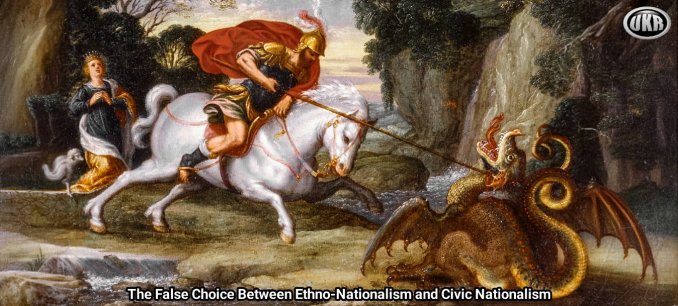
Featured image: Peter Paul Rubens, “Saint George and the Dragon”


Leave a Reply