

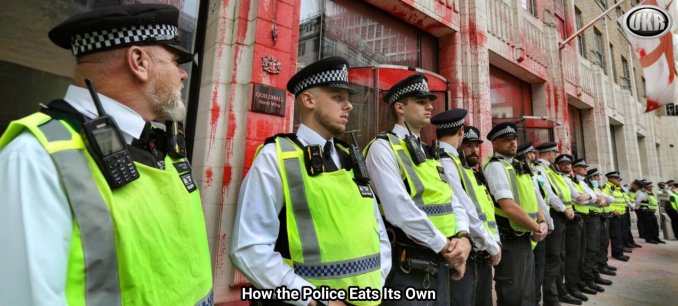
How the police eats its own
Cowardice and ideology have turned the management against the officers
DOMINIC ADLER
My old detective superintendent, on the Met’s anti-corruption command, held old-school views on police misconduct. “Occasionally, you need to nail the crow to the barn door,” he said. “It gives the other crows a warning.” He meant making an example of wrongdoers: cops leaking intelligence to criminals. Or those who stole, took drugs or sexually harassed their colleagues. Increasingly, though, this philosophy is applied to policing’s perennial bogeyman, “canteen culture” — a middle-class meme for a job the lanyard class doesn’t much like, and isn’t prepared to understand.
The police has form for overreacting to scandals
And so the hammer and nails are brandished for words likely to cause progressive pearl-clutching. As a detective from the British Transport Police discovered, when he was nailed to the barn door for using the word “Pikey” in a private WhatsApp group. Our topsy-turvy police forces appear reluctant to apply zero tolerance principles towards crime — even as the Met admits to employing sex offenders in order to satisfy diversity targets — except when it comes to language. Take, for example, the case of the detective inspector issued a written warning for being disrespectful about dwarves.
The police has form for overreacting to scandals. The Wayne Couzens and David Garrick outrages prompted a tsunami of ham-fisted misconduct cases, as panicky chief constables raced to “change the culture”. This partly explains why WhatsApp banter is a favoured target of police professional standards investigators, with a maximalist interpretation of the 2003 Communications Act — which predates encrypted messaging apps — weaponised by activist judges. Dark humour has long been a feature of police culture, arguably a coping mechanism for people undertaking an otherwise miserable job. However, like inquisitors, today’s police managers have little interest in any mitigation or proportionality — only in making sacrifices to their lanyard-wearing masters. Language, in line with the critical-theory driven narratives that now dominate policing, is assaultive. Officers, especially men, are suspected of virtual stochastic terrorism.
Police professional standards departments, detecting the mood music, react accordingly. The Police Federation has pointed out how, from 2022-2025, 100 police officers and staff died of suicide — partly attributable to heavy-handed internal investigations. Then there’s the roll-call of officers thrown under the bus for political expediency — like Pc Lorne Castle, who had the temerity to call a knife-wielding male suspect “a bitch”, Sergeant Rhodri Davies, accused of using disproportionate force against a 6’7” prisoner in custody, or Pc Matthew Pike, charged with causing death by dangerous driving (it was the suspect he was chasing who was driving dangerously, as a jury later found).
Then, if criminal “remedies” fail, the Independent Office for Police Conduct gets a second bite of the cherry by pursuing officers for professional misconduct. Compare such cases with that of the former West Midlands Police chief, Craig Guildford — found to have not only constructed a bogus intelligence case against Israeli football fans, but misled Parliament too. Operational officers go under the prosecutorial bus. Senior cops have “teachable moments”, after which they quietly retire.
How, then, did we get here? Many attribute the blame to reforms made by the Cameron government in the 2010s. Direct-entry schemes, fast-tracking candidates into management, meant decision-makers lacked operational experience. Furthermore, rigged promotion systems are controlled by the Home Office and its slavishly progressive offshoot, the College of Policing. Unless candidates demonstrate a proactive — and obeisant — attitude towards identity politics, they’re effectively barred from achieving high rank. This is the cohort now sitting in judgement over operational police officers.
Then there’s a heretical question: has the focus on female representation at the highest ranks also played a role? In high-profile cases such as Sgt. Davies’s and Pc Castle’s, key decision-makers were reportedly female. The undisputed history of misogyny in policing had to be addressed, of course, but have changes led to an overcorrection, with elements of contemporary police management not having the required experience of the operational realities that make policing distinct from other fields? (A serving officer asking such a question, incidentally, would almost certainly be disciplined for sexism.)
The overwhelming majority of senior officers also fully subscribe to a worldview contingent on critical theory. Take, for example, the Met’s latest review into racism — yes, I’ve lost count of how many too — “Thirty Patterns of Harm” by Dr Shereen Daniels. I suppose asking a seasoned DEI professional about race is like asking the Pope to offer a view on reproductive rights, as Dr Daniels presents her arguments as inviolable: “To meet this moment, the Met must shift out of its defensive posture, ‘but I didn’t agree with what you said on page fifty-four’, and into a position of accountable leadership: ‘I accept it. I will lead the change regardless.’ You must begin to name what has been protected. To recognise who has been harmed. To understand that proximity to discomfort is not a threat, but a precondition for repair…”
The activists who’ve infiltrated policing have won
Daniels’ argument is simple, but ingenious — disagree and you are being defensive, therefore, there can be no disagreement, as dissent is an obstacle to righteous change. As a consequence, police culture has simply shrugged on a new cloak of toxicity. Towards the end of my service, in 2018, the Met resembled the politically-correct dystopia of the Nineties action movie, Demolition Man. It has grown worse. I recently spoke to officers from a busy London police station — they described a Stasi-like atmosphere, with officers looking over their shoulders in case grievance-mongering or oversensitive colleagues misinterpret their words.
This maps across to how officers interact with the public, despite officers wearing body-worn video and suffering the attentions of phone-wielding trolls. Cops know their bosses are unlikely to accept that errors are made in bad faith, causing them to withdraw from confrontational situations as a result. And when police representatives voice concerns? They’re suspended by their own Federation for spurious allegations of racism. This is why the activists who’ve infiltrated policing have won. These disciples of Derrida, Foucault and Lyotard dispute the very concept of policing, as the state of our ever-failing forces demonstrates. Until their influence is undone, beginning at the very top, senior officers will continue nailing the wrong crows to barn doors.
This article (How the police eats its own) was created and published by The Critic and is republished here under “Fair Use” with attribution to the author Dominic Adler
Featured image: Alamy


Leave a Reply