

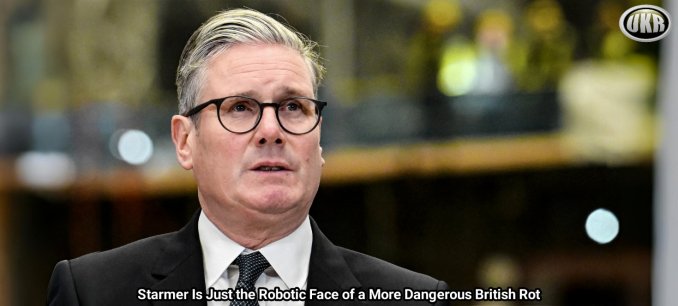
Starmer is just the robotic face of a more dangerous British rot
An obsession with rules and a refusal to see that procedure is not just an algorithm – the PM is a reflection of how the state functions
In theory Prime Minister’s Questions should be part of the efficient bit of the constitution. It is, after all, where the Prime Minister is held to account and his grip on his government judged. Perhaps not for much longer. It may be an exaggeration to call PMQs “dignified”, but it is certainly supposed to be about real politics and actual decisions. Under Starmer, it has become a circus denuded of meaningful content.
His habit of replying to a question with a question is now well known. This week, however, things got worse. Answering Kemi Badenoch’s question on whether the Jackdaw and Rosebank North Sea fields will ever get the go-ahead, Starmer said in effect it was nothing to do with him. “That is a matter for the Secretary of State” – that is, Ed Miliband … To say, as Starmer suggested, that he just had to wait and see what Miliband was going to do is an abrogation of responsibility, a refusal to use the political power that his office gives him.
Starmer’s words have of course struck observers so strongly because they both highlight “Windy” Miliband’s power in the government and encapsulate Starmer’s own “nothing to do with me, guv” approach to doing his job. Oil and gas in the North Sea? That’s a quasi-judicial matter, not a policy one. Go-ahead for the Chinese embassy? Ditto. A ban on an Israeli football team in Birmingham? “The wrong decision” but not one for Starmer actually to do anything about. And war in Iran? That’s for Lord Hermer and his mysterious ratiocination of the dicta of international law.
That’s just how it is with Starmer. As one Labour observer – quoted by Tim Shipman, the political editor of The Spectator – put it: “This Prime Minister doesn’t want to decide anything. Keir has never met a policy that he had a natural view on.” Starmer simply doesn’t seem to appreciate that a successful prime minister has to be chief advocate for what his government is doing, not a constitutional monarch manqué there to take advice and act accordingly.
[…]
Why is the British government so often overwhelmed by entropy, the constant disintegration of action into nothingness, the diffusion of a powerful current of policy-making into a million tiny rivulets with no energy behind them?
Partly it is the ongoing half-life of the mental deformation induced by EU membership, a system in which the British government could not take decisions on its own but instead sought to influence processes over which it had no control. But it can’t be just that. After all, when Germany needed liquefied natural gas (LNG) urgently in 2022, it passed the LNG Acceleration Act that bypassed much existing process and got new terminals built in a few months. We could do the same.
As Badenoch pointed out, if the Prime Minister didn’t like the existing laws on North Sea extraction, he could change them. In an emergency – which we are getting close to – this could be done quickly. But that’s not how the British state works.
No, there is something bigger involved. It is the triumph of the belief that government is actually best done non-politically, when decisions are delegated to experts who don’t have their hands muddied from the unpleasant business of politics. It began with Bank of England independence in 1997, but the model has spread.
And so we have regulators who are allowed to make their own rules, police chiefs who can’t be controlled or fired, a caste of government lawyers who can tell ministers what they can and can’t do. Even Parliament itself is now governed by endless committees of the great and the good.
The Telegraph: continue reading
See Related Article Below
We’re all living in the Miliverse
TALI FRASER
It was a Labour MP who first used the phrase to me: the Miliverse. He was worrying, before PMQs, about a world where Ed Miliband gets a promotion to Downing Street – either as Chancellor or, even, as Prime Minister.
If he was worried then, he’ll have been even more worried after PMQs. Because yesterday, in the House of Commons chamber, Sir Keir Starmer seemed not just comfortable with the idea that he is a member of Miliband’s government – he was almost eager to admit it.
Under questioning from Kemi Badenoch over the decision not to issue new licences for North Sea oil and gas drilling, Starmer slipped into full legal mode. He was at pains to clarify that the decision over the Jackdaw and Rosebank oilfields rested not with him but with the Secretary of State for Energy. Legally, it was Miliband’s call. Badenoch pounced. “He is the Prime Minister!” she told the chamber, deriding Starmer’s retreat into proceduralism.
The Prime Minister was, in effect, publicly conceding what one shadow cabinet minister put to me: that Miliband is “the real prime minister”. Another shadow cabinet minister joked: “It isn’t something we didn’t already know.”
But it is worth pausing on what that actually tells us about Starmer, because the Miliband story is, at its core, a Starmer story. Miliband’s influence over this government is not merely a function of his own ideological energy, though that is clearly considerable. It is also a function of the vacuum at the very top.
This is the context in which Miliband has thrived. When the man at the top is reluctant to own his government’s most politically contentious decisions – whether that’s the North Sea, net zero, or the broader direction of economic policy – someone else will own them instead. His Labour manifesto read: “We will not issue new licences to explore new fields because they will not take a penny off bills, cannot make us energy secure, and will only accelerate the worsening climate crisis.” That is clearly what they truly believe, so why won’t Starmer say it rather than hide behind legal process? Miliband is happily continuing the message of the manifesto, and filling the vacuum at the top while doing it.
As I have written before, Miliband’s influence on this Labour government has been perfectly clear: “The push towards ever more stringent net-zero obligations continues apace, even when the immediate effect is to increase costs for British taxpayers and businesses.” The Spectator’s Tim Shipman even reported that it was Miliband who commanded the majority around the National Security Council table on any involvement in Iran, with Starmer taking direction rather than giving it.
In a profile with the New Statesman, Miliband himself was candid about the scope of what he is trying to achieve. “We are charting a course to a different economic settlement,” he said. “I talked about it as leader and didn’t get to implement it.” He is implementing it now.
And there is the question of what comes next. Nigel Farage, of all people, has reportedly told friends he expects Miliband to be Prime Minister by 2027. That prediction may flatter his instinct for provocation, but it is not entirely absurd with Starmer’s leadership on the rocks.
Yesterday, the Prime Minister yet again tried to protect himself by hiding behind Miliband, but only revealed more about his lack of leadership in the process.
The Labour MP fretting in the corridors before PMQs, I suspect, finds that prospect deeply worrying – Ed Miliband’s world is not one he wants to inhabit. But without any voters say, the Miliverse seems to be ever expanding.

••••
The Liberty Beacon Project is now expanding at a near exponential rate, and for this we are grateful and excited! But we must also be practical. For 7 years we have not asked for any donations, and have built this project with our own funds as we grew. We are now experiencing ever increasing growing pains due to the large number of websites and projects we represent. So we have just installed donation buttons on our websites and ask that you consider this when you visit them. Nothing is too small. We thank you for all your support and your considerations … (TLB)
••••
Comment Policy: As a privately owned web site, we reserve the right to remove comments that contain spam, advertising, vulgarity, threats of violence, racism, or personal/abusive attacks on other users. This also applies to trolling, the use of more than one alias, or just intentional mischief. Enforcement of this policy is at the discretion of this websites administrators. Repeat offenders may be blocked or permanently banned without prior warning.
••••
Disclaimer: TLB websites contain copyrighted material the use of which has not always been specifically authorized by the copyright owner. We are making such material available to our readers under the provisions of “fair use” in an effort to advance a better understanding of political, health, economic and social issues. The material on this site is distributed without profit to those who have expressed a prior interest in receiving it for research and educational purposes. If you wish to use copyrighted material for purposes other than “fair use” you must request permission from the copyright owner.
••••
Disclaimer: The information and opinions shared are for informational purposes only including, but not limited to, text, graphics, images and other material are not intended as medical advice or instruction. Nothing mentioned is intended to be a substitute for professional medical advice, diagnosis or treatment.
Disclaimer: The views and opinions expressed in this article are those of the author and do not necessarily reflect the official policy or position of The Liberty Beacon Project.


Leave a Reply