

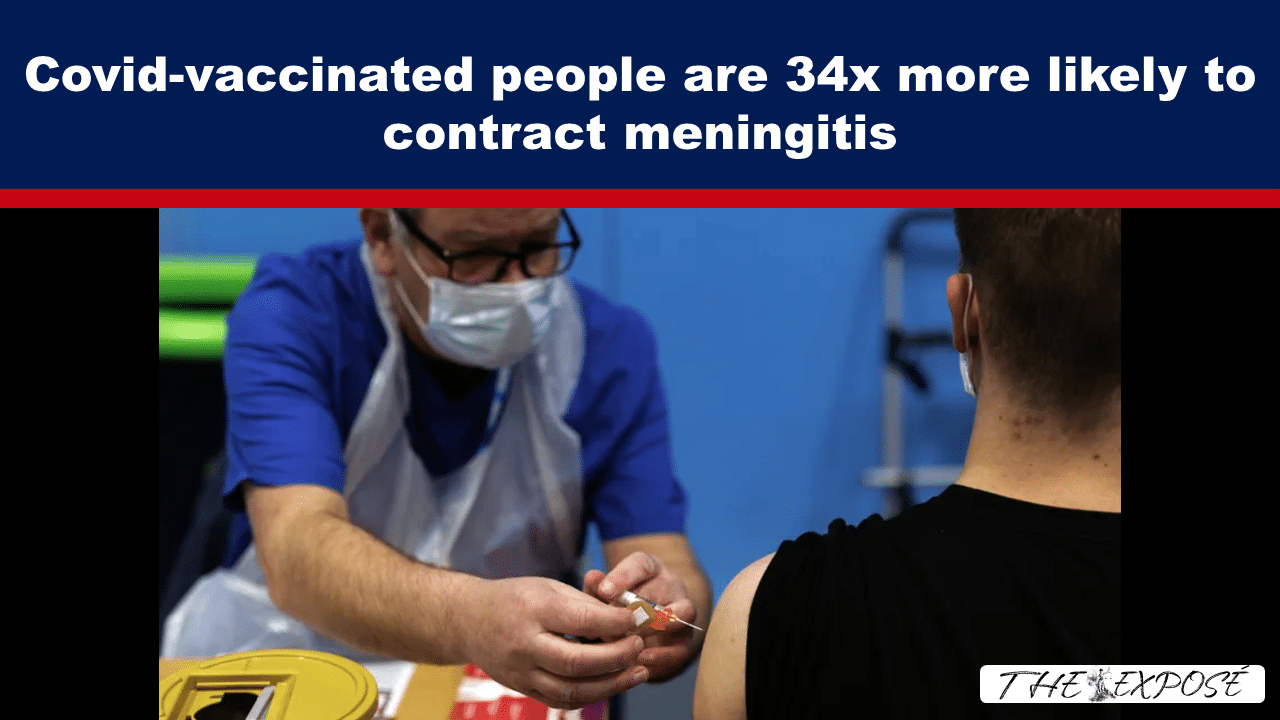
Covid-vaccinated people are 34x more likely to contract meningitis
RHODA WILSON
In November 2025, a study investigating the possible association between the central nervous system infection rate and covid vaccination was published in the International Journal of Research in Medical Sciences.
What is relevant to the UK’s recent meningitis “outbreak” is that the study found covid vaccinated people were 34 times more likely to succumb to meningitis than after the flu vaccination.
Broken down into the types, covid-vaccinated people are 53x more likely to contract Aseptic meningitis and 36x more likely to contract bacterial meningitis.
🚨STUDY: COVID-19 “Vaccines” Disrupt the Blood-Brain Barrier — 63 Serious Brain & Spinal Cord Safety Signals Identified
Meningitis, encephalitis, prion disease, brain abscesses, herpes reactivation, demyelinating syndromes—among DOZENS of severe neurological conditions… pic.twitter.com/hAvn6SneOB
— Nicolas Hulscher, MPH (@NicHulscher) March 25, 2026
Further reading:
- Is the UK meningitis “outbreak” diagnosing hangovers?
- Senate Investigation Finds Federal Officials Buried Covid-19 Vaccine Stroke Risk
Peer-Reviewed Study Finds Covid-19 “Vaccines” Linked to 63 Serious Brain and Spinal Cord Adverse Events
By Nicolas Hulscher, as published by Focal Points on 6 November 2025
The study titled ‘covid-19 mRNA Vaccination: Implications for the Central Nervous System’, authored by Kirstin Cosgrove, BM, CCRA; James A. Thorp, MD; Claire Rogers, MSPAS, PA-C; Steven Hatfill, MD; Nicolas Hulscher, MPH; and Peter A. McCullough, MD, MPH, was just published after successful peer-review in the International Journal of Research in Medical Sciences.
Using VAERS data from January 1990 through November 2024, we compared adverse events reported after covid-19 vaccination to those after influenza vaccination and all other vaccines combined. We focused specifically on the central nervous system (“CNS”) – the brain and spinal cord – which control everything from memory and thought to movement and vital body functions. In total, we identified 63 serious safety signals involving the brain and nervous system, ranging from meningitis and encephalitis to brain abscesses, herpesvirus reactivations, demyelinating syndromes, and even prion diseases – each breaching US Centres for Disease Control and Prevention (“CDC”) and Food and Drug Administration (“FDA”) thresholds that are supposed to trigger immediate safety investigations.
The mechanism is clear: lipid nanoparticles deliver mRNA into brain blood vessels, where spike protein is produced and drives vascular inflammation. This damages the blood–brain barrier (“BBB”), the brain’s protective shield, and allows pathogens and latent viruses to penetrate, bacteria to seed abscesses and immune responses to misfire against neural tissue. Spike protein itself can also cross into the brain, where it disrupts neurons and glial cells and promotes abnormal protein misfolding – a prion-like process resembling Creutzfeldt–Jakob disease and “mad cow disease.” Together, these effects explain why covid-19 vaccination is associated with such a broad spectrum of severe neurological injuries.
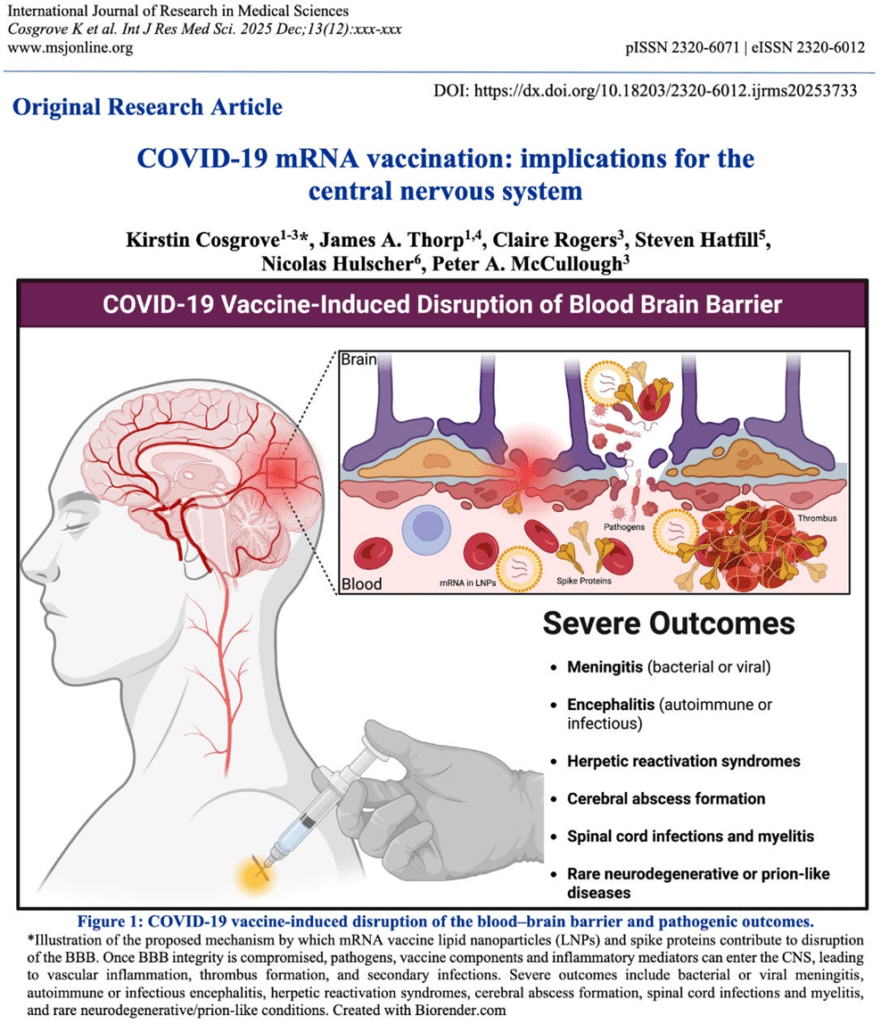
Here are some of the conditions we found to be far more likely to be reported after covid-19 vaccination compared to flu or other vaccines:
Central Nervous System Infections
- Meningitis (all types) – OR 34.2 (23.7–50.0), p<0.0001 → 34× more likely than after flu vaccination
- Aseptic meningitis – OR 52.8 (33.5–83.1), p<0.0001 → 53× more likely
- Bacterial meningitis – OR 35.7 (16.7–76.0), p<0.0001 → 36× more likely
- Autoimmune encephalitis – OR 78.9 (45.4–137), p<0.0001 → 79× more likely
- Limbic encephalitis – OR 146 (43.7–485), p<0.0001 → 146× more likely
- Bickerstaff’s encephalitis – OR 68.3 (19.8–236), p<0.0001 → 68× more likely
- Neuroborreliosis (Lyme CNS infection) – OR 321 (43.0–2390), p<0.0001 → 321× more likely
- Toxic encephalopathy – OR 157 (69.1–355), p<0.0001 → 157× more likely
- Progressive multifocal leukoencephalopathy (PML) – OR 44.6 (9.48–210), p<0.0001 → 45× more likely
Herpetic CNS Reactivations
- Herpes zoster meningitis – OR 1,260 (77.0–20,700), p<0.0001 → over 1,200× more likely
- Herpes zoster meningoencephalitis – OR 339 (45.5–2,520), p<0.0001 → 339× more likely
- Herpes zoster neurological disease – OR 680 (41.1–11,200), p<0.0001 → 680× more likely
- Herpes simplex meningitis – OR 132 (7.45–2,360), p=0.0009 → 132× more likely
- Herpetic meningoencephalitis – OR 136 (47.3–391), p<0.0001 → 136× more likely
- Varicella meningitis – OR 168 (9.61–2,930), p=0.0004 → 168× more likely
Brain and Spinal Abscesses
- Brain abscess – OR 120 (27.7–522), p<0.0001 → 120× more likely
- Extradural abscess – OR 169 (22.2–1,290), p<0.0001 → 169× more likely
- Spinal cord abscess – OR 89.1 (11.2–712), p<0.0001 → 89× more likely
- Subdural abscess – OR 35.7 (3.90–326), p=0.0015 → 36× more likely
Rare Neurodegenerative and Demyelinating Conditions
- Creutzfeldt–Jakob disease (“CJD”) – OR 847 (115–6,220), p<0.0001 → 847× more likely
- Myelitis (all types) – OR 31.3 (22.2–44.2), p<0.0001 → 31× more likely
- Transverse myelitis – OR 20.8 (15.0–29.0), p<0.0001 → 21× more likely
- Viral myelitis – OR 115 (6.37–2,070), p=0.0013 → 115× more likely
- Non-infectious myelitis – OR 132 (7.45–2,360), p=0.0009 → 132× more likely
- Prion disease (general) – OR 61.8 (3.15–1,220), p=0.0066 → 62× more likely
These findings indicate that covid-19 vaccination not only compromises the integrity of the blood–brain barrier but also initiates a cascade of neuropathological processes. In addition to facilitating infections and inflammatory injury, the spike protein exhibits prion-like behaviour – misfolding and inducing aberrant protein aggregation consistent with mechanisms underlying Creutzfeldt–Jakob disease, the human analogue of bovine spongiform encephalopathy (“mad cow disease”). Such prionogenic activity may also contribute to the formation of the anomalous white fibrous intravascular clots reported post-mortem, where amyloid and fibrin deposition suggest a novel, vaccine-associated pathology of protein misfolding.
[Nicholas Hulscher embedded two videos in his article, which we have not included here. You can watch these videos HERE and HERE.]
This unprecedented neurological impairment helps to explain why Thorp et al found that mRNA shots were linked to 86 serious neuropsychiatric disorders, including dementia, schizophrenia, suicidal and homicidal thoughts, stroke, psychosis, depression, cognitive impairment, delusions and more:
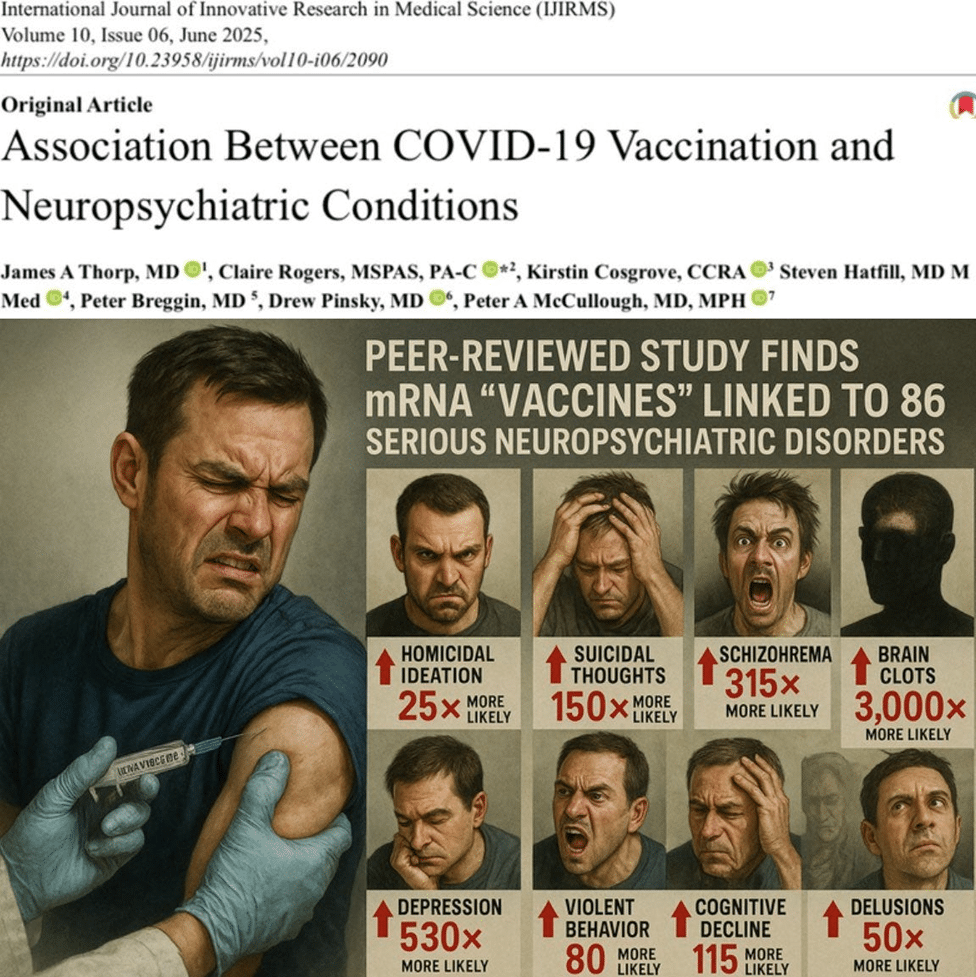
Taken together, disruption of the brain’s vascular defences and induction of prion-like processes represent a profound and urgent neurological safety concern.
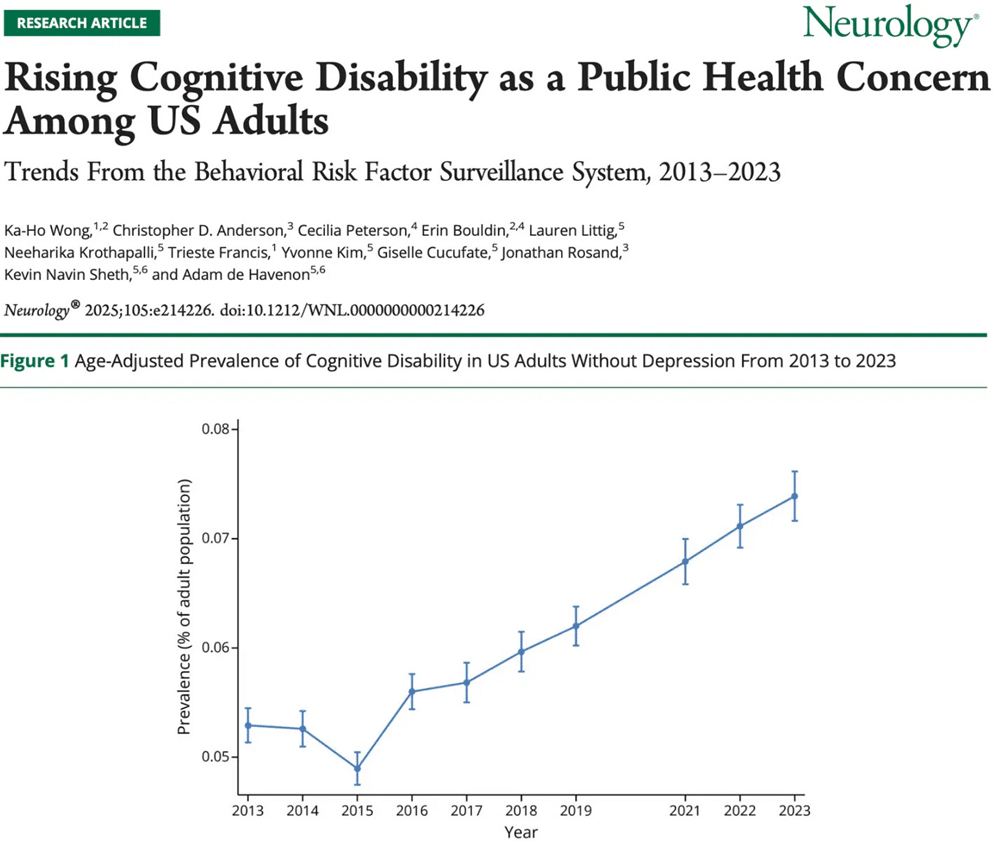
It’s no mystery why cognitive impairment is skyrocketing across America:
As we conclude in the study:
At the time of this publication, 4.5 years have passed since the initiation of the mass covid-19 mRNA “vaccination” campaign and yet the long-term effects of this programme are still being elucidated. Our data joins the work of others to firmly conclude the covid-19 vaccines and their boosters are not safe for human use and should be urgently removed from the market.
COVID-19 mRNA vaccination: implications for the central nervous system. International Journal of Research in Medical Sciences. Cosgrove Ket al. Int J Res Med Sci. 2025Dec;13(12):5104-5114. DOI: https://dx.doi.org/10.18203/2320-6012.ijrms20253733
The McCullough Foundation will continue leading the investigation on the long-term impact of mass covid-19 vaccination programmes – where public health authorities have failed.
If you’d like to support this vital research, please consider making a donation to the McCullough Foundation.
About the Author
Nicolas Hulscher, Master of Public Health (MPH), is an epidemiologist and Administrator at the McCullough Foundation, which publishes articles on a Substack page titled ‘Focal Points’.
Hulscher is known for his research on adverse events following covid vaccination, particularly focusing on myocarditis and other post-acute sequelae. He has been the lead author on several covid vaccination studies and a contributor to others. He has also co-authored research on the proximal origin of highly pathogenic avian influenza H5N1.
Featured image: A student gets the meningitis B vaccine at the University of Kent on Thursday, 19 March 2026, in Canterbury, England. Source: CNN
This article (Covid-vaccinated people are 34x more likely to contract meningitis) was created and published by The Expose and is republished here under “Fair Use” with attribution to the author Nicolas Hulscher. Intro by Rhoda Wilson
See Related Article Below
MenB Vaccine Aluminum Doses Overlap Equivalent mg/kg Levels That Produced Motor Neuron Death, Brain Inflammation, and Neurodegenerative Brain Changes in Peer-Reviewed Mammalian Study
Mice given aluminum hydroxide at Bexsero-equivalent mg/kg doses exhibited motor neuron death, brain inflammation, neuronal aluminum accumulation, and neurodegenerative changes.

JON FLEETWOOD
As Meningitis B vaccines are being pushed in the U.K. in response to a reported outbreak, the U.S. Food and Drug Administration (FDA) product insert confirms that each 0.5 mL dose of the meningococcal Group B vaccine Bexsero contains 1.5 mg of aluminum hydroxide (0.519 mg elemental aluminum).
Under the standard multi-dose regimen, this results in a cumulative aluminum hydroxide exposure of 4.5 mg per recipient.
When normalized by body weight, that cumulative exposure translates to approximately:
- 64 μg/kg (70 kg individual)
- 90 μg/kg (50 kg individual)
- 180 μg/kg (25 kg individual)
These levels fall within—or exceed—the lower cumulative dosing range examined in a 2009 peer-reviewed study published in the Journal of Inorganic Biochemistry, which evaluated the biological effects of injected aluminum hydroxide in a mammalian model.


Study: Neuropathology at Overlapping μg/kg Exposure Levels
In the study, animals received repeated injections of aluminum hydroxide reaching ~100 μg/kg cumulative exposure, a range that overlaps with the weight-adjusted exposure from a full Bexsero series.
At that level, researchers reported:
- Significantly increased apoptosis of motor neurons
- Neuroinflammation in the spinal cord and motor cortex, including:
- Reactive astrocytosis
- Microglial activation
- Intracellular aluminum accumulation within motor neurons
- Hyper-phosphorylated tau protein, a marker associated with neurodegenerative disease
At higher cumulative exposure (~300 μg/kg), the study further documented:
- Impairments in locomotor activity
- Deficits in spatial memory performance
The study abstract reads:
“Aluminum-treated mice showed significantly increased apoptosis of motor neurons and increases in reactive astrocytes and microglial proliferation within the spinal cord and cortex. Morin stain detected the presence of aluminum in the cytoplasm of motor neurons with some neurons also testing positive for the presence of hyper-phosphorylated tau protein, a pathological hallmark of various neurological diseases, including Alzheimer’s disease and frontotemporal dementia. A second series of experiments was conducted on mice injected with six doses of aluminum hydroxide. Behavioural analyses in these mice revealed significant impairments in a number of motor functions as well as diminished spatial memory capacity. The demonstrated neurotoxicity of aluminum hydroxide and its relative ubiquity as an adjuvant suggest that greater scrutiny by the scientific community is warranted.”

Dose Comparison: Direct mg/kg Overlap
The study’s lower-dose arm (~100 μg/kg cumulative aluminum hydroxide) sits within the same order of magnitude—and in some cases directly overlaps—with the cumulative exposure range produced by a standard 3-dose Bexsero regimen.
This establishes a direct comparison on a μg/kg basis using the same compound (aluminum hydroxide).
Meaning that, on a body-weight–normalized basis, a full Bexsero regimen delivers cumulative aluminum hydroxide exposure in the same range as the doses in this study where motor neuron death, neuroinflammation, and neurodegenerative changes were observed in mice.
The 2025 Danish Study Does Not Debunk the Bexsero–Aluminum Overlap
Some critics and mainstream sources will point to the 2025 Danish cohort study of 1.22 million children, claiming it “proves” aluminum adjuvants are safe because it found no association with autism, ADHD, autoimmune disorders, or other chronic conditions.
That claim collapses under scrutiny.
The Danish study only compared vaccinated children to other vaccinated children—it had no true unvaccinated placebo group (just 1.2% received zero aluminum).
It relied on tiny differences in aluminum exposure spread out over a full 24 months in infants.
In stark contrast, Bexsero is administered as three doses over a rapid 6-month window in adolescents and young adults, delivering a far more condensed aluminum hydroxide load.
Even worse, the Danish study never examined the specific neuropathological damage seen in the mammalian research—motor neuron apoptosis, neuroinflammation, intracellular aluminum accumulation, or hyper-phosphorylated tau pathology.
The Danish data therefore fail to address, let alone debunk, the central bombshell of this article: a standard Bexsero regimen produces cumulative aluminum hydroxide exposure that falls squarely within the exact μg/kg range proven to trigger those precise neurodegenerative effects in a controlled mammalian model.
Bottom Line
A standard Bexsero vaccination series delivers cumulative aluminum hydroxide exposure that, when adjusted for body weight, overlaps with levels shown in a mammalian model to be associated with:
- Motor neuron apoptosis
- Central nervous system inflammation
- Aluminum deposition in neural tissue
- Tau-related neurodegenerative pathology
- And, at higher cumulative levels, functional deficits in movement and memory
The findings do not establish causation in humans, but they demonstrate that the dosing range used in the vaccine aligns with exposure levels that produced measurable neurotoxic effects in controlled animal experiments.
This article (MenB Vaccine Aluminum Doses Overlap Equivalent mg/kg Levels That Produced Motor Neuron Death, Brain Inflammation, and Neurodegenerative Brain Changes in Peer-Reviewed Mammalian Study) was created and published by Jon Fleetwood and is republished here under “Fair Use”

••••
The Liberty Beacon Project is now expanding at a near exponential rate, and for this we are grateful and excited! But we must also be practical. For 7 years we have not asked for any donations, and have built this project with our own funds as we grew. We are now experiencing ever increasing growing pains due to the large number of websites and projects we represent. So we have just installed donation buttons on our websites and ask that you consider this when you visit them. Nothing is too small. We thank you for all your support and your considerations … (TLB)
••••
Comment Policy: As a privately owned web site, we reserve the right to remove comments that contain spam, advertising, vulgarity, threats of violence, racism, or personal/abusive attacks on other users. This also applies to trolling, the use of more than one alias, or just intentional mischief. Enforcement of this policy is at the discretion of this websites administrators. Repeat offenders may be blocked or permanently banned without prior warning.
••••
Disclaimer: TLB websites contain copyrighted material the use of which has not always been specifically authorized by the copyright owner. We are making such material available to our readers under the provisions of “fair use” in an effort to advance a better understanding of political, health, economic and social issues. The material on this site is distributed without profit to those who have expressed a prior interest in receiving it for research and educational purposes. If you wish to use copyrighted material for purposes other than “fair use” you must request permission from the copyright owner.
••••
Disclaimer: The information and opinions shared are for informational purposes only including, but not limited to, text, graphics, images and other material are not intended as medical advice or instruction. Nothing mentioned is intended to be a substitute for professional medical advice, diagnosis or treatment.
Disclaimer: The views and opinions expressed in this article are those of the author and do not necessarily reflect the official policy or position of The Liberty Beacon Project.


Leave a Reply