

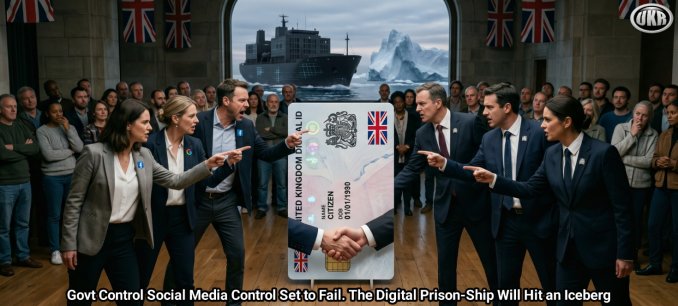
Anti-Social Media
Moves by government to control social media will fail. The Digital Prison-Ship is about to hit an iceberg.
JEFFREY PEEL
Some commenters on my piece yesterday (not on this platform but on others) seem to be under the impression that I was defending social media companies and had an expectation that they would ‘do the right thing’ in terms of protecting the rights of children, or whatever. I was not making any such claims at all. And I couldn’t care less what ‘protections’ they make – or so-called governments demand – in terms of controlling/patrolling free speech.

Let me explain exactly what I mean by going back to some basics. Let’s consider what media is and how it differs from social media. Then I’ll explain, again, why the proposed digital ID proposals are extraordinarily sinister (but doomed).
First of all, let’s consider the difference between media and social media. Let’s ask an AI bot to define the difference. This, courtesy of Gemini:
Media has historically served to inform, educate, and shape public opinion, acting as a bridge between events and the public. It establishes societal norms and holds institutions accountable. Social media differs fundamentally from traditional media by decentralizing this flow of information. It shifts the model from one-way broadcasts to interactive, two-way conversations.
Clearly it was inevitable that, with a pervasive, near-universal, free and open Internet that the balance of power would shift away from centralised, media-controlling, organisations (like the government) to individuals.
Note that in Gemini’s amalgam definition of ‘media’ it notes that it has a role to ‘shape public opinion’. And that is what it has done, and continues to do. But its influence is waning. In fact, it’s plummeting.
Even the BBC has been forced to admit the obvious.
Also, the role of the media, as per Gemini’s definition, of establishing societal norms and holding institutions accountable, is laughably absurd and elitist. But it’s a very accurate portrayal, for example, of the BBC’s positioning – as evidenced by this cringe-worthy video produced by the organisation, claiming that it is a single source of truth.
But alongside this collapsing trust (and collapsing licence fee revenue) is a growing reliance on social media for news content. But, remember, social media is not media. There is no centralised control (or shouldn’t be). Rather, people ‘get their news’ from social media by seeking out the opinions of their peers, their favourite ‘influencers’ or seeking network agreement for their own opinions (as I’m doing here, now). And, in the face of this, the traditional media (tell-sell, broadcast approach) just doesn’t cut it any more.
The BBC realised some time ago that it was never going to survive in the face of individual free thinking. That’s why few, if any, news articles on the BBC website are open for comment. But it’s also why the BBC was quickly scrambled during the fake pandemic to create an international censorship network that included all of the main social media platforms: the ironically titled “Trusted News Initiative”.
The organisation, or rather its spook handlers, realised that it was failing to control the narrative around the faked pandemic given the widespread availability of an opinion promulgation network (called social media). Therefore, it set about creating a censorship nexus.
The result, however, was widespread disaffection from the social media platforms that retained traditional media’s funding sources (advertising revenue). Customer disaffection isn’t a great business model so the social media companies rapidly rebranded after the Covid fiasco. In the case of Twitter it was ‘acquired’ by the same people and institutions that owned it before. But the rebranding included the idea of ‘freedom of speech, not freedom of reach’ to appease the automated digital advertising networks.
But after the COVID debacle the spooks are left with a dilemma. The ‘media’ island of Newspeak is getting smaller and less well funded. “News” and network anchors who were associated with the unrelenting propaganda around the “pandemic”, “climate change” and “culture wars” are slowly, but surely, being exited (often because of their arrogance, perversions or both). Just yesterday the BBC announced thousands of job cuts and vast cost savings – including the exit of Amol Rajan from the Today programme (it’s quite astonishing that the axing of just one presenter from one radio programme is highlighted in a story about huge cost-savings).
But, given this waning in the importance of media designed to ‘shape public opinion’ what’s a spook network to do?
By definition, social media companies do not publish. They provide a platform for people to publish, and advertisers to advertise and governments to shape public opinion. By attracting people (consumers, citizens, employees, PR types, commentators, journalists, politicians) to the platform they get to sound off about stuff. Or publish videos. Or photos. Or opinions. But there’s no central organisation or control of all this stuff. It just is. It’s a medium of exchange. And it attracts all sorts. Good and bad. And there are lots of competing platforms. Some platforms are effectively run by the state or technocratic super-state. Some are genuinely independent (although they tend not to last, or are bought-out).
So the only means available to governments and their spooks to re-establish control is to have total central intelligence of what’s happening on the networks. That requires each and every user to be identified. It also requires the building of vast data surveillance networks (and data centres) and also the promulgation of content from approved influencers with vast reach.
The lesson that central intelligence has learned from traditional media and is currently applying in social media is that big influencers must be seen to be mavericks who organically emerge. However, this is tricky to achieve when the ‘model’ they have been using is to migrate well known traditional media personalities (like Tucker Carlson or Russell Brand) over to the world of social media. Hence Carlson moves from Fox to Twitter. Or Piers Morgan is repositioned as a maverick ‘thinker’ and faux conspiracy theorist (look at his repositioning from vaccine peddler to sceptic). Russell Brand’s rapid adoption of Christianity is in no small part based on the observation that supposedly organically emergent social media influencers (like James Delingpole) are often Christian. This is the modus of central intelligence in the social media era…they use actors to ape crowd-created influencers.
The problem they face, however, is that people have an uncanny ability to detect wrong’uns, actors, and placed ‘talent’. Moreover, it’s often the case that anonymous accounts can achieve huge reach organically.
This explains why such efforts were made during the purging period from 2020 to around 2022. And it also explains why, starting with Australia, all members of the Five Eyes network will use the excuse of ‘child protection’ to implement control over social media platforms. Australia took the lead in 2025. Now the UK and Canada. Eventually the US states will do it too. And NZ no doubt. Slam dunk.
The only reason ‘parents’ apparently support it is because the governments make it appear so by commissioning rigged studies.
However, all of the efforts will fail, for the reasons I alluded to in my post yesterday. People will simply not agree to digital ID gate-keeping to maintain their social media accounts. Therefore, the social media platforms won’t try. As argued by MiriAF, yesterday, they’ll probably target anonymous accounts primarily, then give up. And age-policing of under-16s will come unstuck because of GDPR and, ironically, distrust of social media companies holding personal data. And the widespread use of VPNs.
In my view, it’s much more likely that the attempt to make society a digital-prison ship is about to hit a big iceberg. The circular economy that is the so-called ‘Magnificent 7’ Tech Bro companies, is teetering. So don’t let the latest spook strategy unsettle you too much. This particular good ship Digital ID is full of holes. But another one might be coming soon.
This article (Anti-Social Media) was created and published by Jeffrey Peel and is republished here under “Fair Use”
See Related Article Below
Internet freedom is fading in the new era of social control
“The evolution of digital media makes stricter regulation of online behavior not only feasible but inevitable,” writes media ecologist Andrey Mir.
ANDREW MIR
Twenty years ago, the internet was a medium liberating people from state control. Now, the internet is increasingly seen as a threat triggering calls to restore state control over online behavior. The latest twist in this trend is the growing demand to criminally prosecute both users and platforms for unacceptable speech or behavior. How did we get here?
Some view this phenomenon as a side effect of political struggle. In reality, though, it reflects the development of the medium itself: The internet progressed from undermining old mechanisms of gatekeeping to creating new forms of social control, now executed through digital platforms.
The evolution of digital media makes stricter regulation of online behavior not only feasible but inevitable.
Web 1.0: The global library with free access
The earliest version of the web, Web 1.0, granted people far greater individual access to information. This alone challenged the old order in which elites controlled the mechanisms of “manufacturing consent” through news media, education, and entertainment.
Uncontrolled flows of information undermined the elites’ monopoly over knowledge. But information alone was not the key. It was not the content but the very mode of access — the medium — that began to undermine authority. A close analogy: After the printing press made the Bible affordable to the masses, it wasn’t the verses of the Bible that triggered the Protestant Reformation, but rather the ability of a layman to read the Bible independently of a priest’s choice, find inconsistencies, and question the Church’s authority. The affordability of access to the Bible made it clear, for the first time, that the Church’s perspective is just that: a view.
In the 1990s, the freedom to browse and inquire disrupted the homogeneity of the dominant news agenda. For the first time, people gained control over what appeared on their screens. The message of this medium was the individual ability to browse and inquire at will — and people started doing just that. Traditional gatekeeping, which relied on a centralized and uniform agenda, began to lose ground.
Web 2.0: The emancipation of authorship and the revolts of the public
The 2000s ushered in Web 2.0, defined by the rise of user-generated content (UGC). The blogosphere and early social media emancipated authorship by granting people greater access to not only information but also self-expression. The early digital adopters — mostly young, urban, educated, and progressive — began informing each other, quickly realizing how significantly their views and values differed from the mainstream agenda. This led to what Martin Gurri called the “crisis of authority” in his 2014 book The Revolt of the Public. The Twitter revolutions — the “revolts of the public” — sparked around the world, from the Arab Spring to Occupy Wall Street.
Old institutions were clueless about how to react. They could not catch up with the changes because they simply could not catch anyone responsible for them, as there was no one. The dispersed, networked activity simply did not provide a specific target for traditional institutional countermeasures. In the battle between the bear and the swarm of bees, the swarm was winning, despite the seemingly prevailing power of the bear, who could take down some bees or even many of them, but never the entire swarm.
Soon, however, the counter-institutional environment of the internet underwent two important institutional adjustments. First, old institutions went digital and absorbed many of the bees into the ranks of the establishment. Having joined the political and corporate establishment, digital progressives found themselves in a paradoxical position: They needed to preserve their newly acquired institutional status while also continuing to dismantle the principles of the old world.
Their struggle to maintain power while disrupting old values found resolution with the arrival of the next wave of social demographics on social media by the mid-2010s — older, less educated, less urban, and less progressive. This second wave formed a new swarm, whose collective indignation eventually found political expression in Donald Trump. However, the alliance between the old elites and the first-born swarm of digital progressives had already been formed and reshaped discourse-making in news, academia, education, and corporations. The later, conservative swarm became a useful symbol of the old world, giving the new establishment — composed of digital progressives and traditional elites — a new target to combat. This is why political polarization skyrocketed in the second half of the 2010s.
However, the absorption of digital progressives into the establishment was not the primary game changer for the internet. An even more profound environmental change was caused by the rise of algorithms, which transformed the formless blogosphere into institutional entities: digital platforms.
Web 3.0: The rise of algorithms and digital platforms
Instead of the blogosphere run by humans, social media evolved into an ecosystem run by algorithms. These algorithms began defining the relevance of content and human connections. They enabled high precision in the personal customization of news feeds and created business opportunities, including selling users’ personal data to advertisers. This advertising service proved far more efficient and profitable than traditional media could ever provide.
A side effect of this adjustment was the economic decline of traditional media and the emergence of postjournalism. But the main outcome of the algorithms’ introduction was the coagulation of the amorphous and swarm-like environment into digital platforms: centralized corporations. The online public square turned into an online marketplace. Web 2.0 mutated into Web 3.0 — an internet with algorithms of relevance and digital platforms profiting off users.
Algorithms were also tasked with accelerating user engagement. They boosted the visibility of content that would likely trigger more reactions. People were increasingly exposed to more agitating content and, in turn, conditioned to respond with more agitating reactions. This not only accelerated engagement but also further fueled polarization and online outrage, contributing to the growing public anxiety about the internet.
Before that, old institutions struggled to handle Web 2.0 due to its dispersed, swarm-like nature. The best they could do was bribe digital progressives with grants, academic positions, and corporate HR jobs. However, Web 3.0 introduced digital platforms as corporate entities bearing the risks of losses and regulation. Old institutions are well-versed in dealing with corporations. As a result, the revolt of the public had lost its momentum, allowing old institutions to begin restoring their power under the new conditions — without traditional news media, but with digital platforms instead. The snake has shed its old skin and started growing a new one.
Web 4.0: The platforms’ political compliance and the restoration of corporate control
With the 2016 election of Trump in the U.S., the power of internet platforms to shape political outcomes became undeniable. Digital platforms could no longer preserve their political neutrality, especially after the January 6 attack on the U.S. Capitol in 2021. Fearing regulatory retaliation, the largest social networks banned Trump and thousands of his supporters. The elite control over discourse production, lost after the decline of traditional media, was regained through digital platforms. To deal with the swarms, the bear commissioned the beekeepers.
This development has given us Web 4.0 — an internet where platforms regulate users’ behavior to appease governments and avoid punitive measures. On Web 4.0, digital platforms not only provide services but also act as intermediaries between users and state authorities, restricting online speech and behavior at the state’s request in exchange for the license to continue doing business with users. They openly employ moral and political judgments regarding users’ behavior to protect public morality and democracy, as if appointed to do so.
It’s not a political conspiracy of the elites. Rather, it reflects the evolutionary logic behind the development of the internet into digital corporations that carry regulatory risks. Through this transformation, the establishment overcame the crisis of authority and restored its power. The convergence of the largest digital corporations with the state and its political forces was inevitable.
Of course, there have been resistance attempts, aiming to preserve what the internet was 20 years ago: a venue for opinion exchange, free of any control. Two notable examples include Telegram, with its encryption and the cult of privacy, and X/Twitter, still embodying the anti-establishment ethos of early 2010s social media. Both heavily rely on the personal commitment of their owners and therefore cannot be considered systemic factors.
The recent arrest of Telegram founder Pavel Durov in France has likely already made him more receptive and collaborative. Meanwhile, Elon Musk remains too big to fall, but his vast resources and now his close affiliation with President-elect Trump make his case even less of a systemic factor. The example of X illustrates the role of the individual in history rather than the natural development of digital media. It’s even quite possible that Musk altered the course of world history by buying Twitter out of the “censorship-industrial complex” — the previous Twitter would have effectively worked against Trump in the recent election. Ironically, however, after Trump’s win, Musk’s X/Twitter can easily convert into a platform controlling users on behalf of the dominant political force — precisely what it was becoming before Musk took over. Platforms are inherently designed to shape and therefore control users’ behavior. Besides, the need to define “lawful speech” remains and can and will be used for political prosecution.
All things considered, while resistance to increasing control exists, it lacks underlying systemic forces and can only slow the overall trend, not reverse it. Recent events provide numerous examples of the growing control over digital speech on behalf of the state and political elites. These include Pavel Durov’s arrest, Hillary Clinton’s call to criminally charge Americans for spreading Russian propaganda, Canada’s proposed Online Harms Act extending criminal prosecution for digital speech, and, notably, the UK’s first-ever arrest of a user for posting false information.
The criminalization of digital speech and behavior signals that online moderation — once primarily the responsibility of platforms — is now becoming the prerogative of the state. The establishment increasingly recognizes platforms’ previous efforts to control the internet as insufficient and is pushing for stricter punitive measures for both platforms and users. In the U.S., the pressure on digital freedoms will likely ease for a while after the recent election, but this will not change the global logic of media evolution. The establishment, regardless of political affiliation, will continue to strengthen business and regulatory control over digital platforms.
Web 5.0: Digital platforms as proxies for state control through social scoring
What comes next? Web 5.0: the platforms exercising full control over people on behalf of the state and corporations through the mechanisms of social scoring. We may not notice it yet, but algorithms are already tracking our transgressions and adjusting our access to digital services accordingly. For example, Facebook can not only ban users for significant violations but also apply various degrees of “moral” judgment and punishment, restricting certain users’ activities for certain periods. For example, users receive “strikes” for certain violations; two to six strikes result in restrictions from posting in groups for a time period, while 10 or more strikes will lead to “a 30-day restriction from creating content.” Although not yet termed social scoring, this already represents its essence.
Beyond socializing, nearly all human activities are going digital: banking, transportation, governmental services, and so on. The platforms providing these services are introducing some forms of social scoring, albeit in a scattered manner. For example, the credit score, which is now collected and calculated algorithmically from users’ personal data, directly embodies the concept of social scoring. Different insurance systems utilize customer scoring for actuarial calculations, but they also function as behavior modifiers. Many consumer platforms employ scoring to reward loyalty, but some, like Uber, also use customer scores for punitive measures: the lower your score, the longer you wait for ride-matching.
In some cases, governments now impose restrictions on people’s access to services or online activities as a form of digital punishment. This is where the criminalization of online behavior is required. For example, some supporters of Canadian Freedom Convoy lost access to donation platforms and even their bank accounts after the truckers’ protest was criminalized. This shift epitomizes the Institutional Restoration: The same platforms that enabled grassroots mobilization and crowdfunding for anti-establishment protests during Web 2.0 are being used in reverse. With total digital platformization, the reversal use of this “network effect” allows reaching out to the grassroots and weeding out the non-compliant.
The idea of Web 5.0 paints a future where platforms operate not only as businesses but also as proxies for the state, employing their power over users on behalf of governments in exchange for the license to keep doing business. The combination of censorship, algorithmic control, and the criminalization of online behavior will only grow more sophisticated as digital platforms continue to evolve and converge with the state. Both political elites and corporations seek greater control; the growing digital platformization of users/citizens will provide more opportunities to gain it.
Facing such explanations and predictions, people usually ask, “How do we fix it?” That’s the wrong question. One cannot “fix” media evolution. The right question is: “How are we going to live with it?” There are two main strategies: 1) resistance and 2) cooperation with the inevitable. The former entails self-sacrifice, while the latter necessitates specific media literacy aimed at environmental survival.
This article (Internet freedom is fading in the new era of social control) was created and published by Big Think and is republished here under “Fair Use” with attribution to the author Andrew Mir

••••
The Liberty Beacon Project is now expanding at a near exponential rate, and for this we are grateful and excited! But we must also be practical. For 7 years we have not asked for any donations, and have built this project with our own funds as we grew. We are now experiencing ever increasing growing pains due to the large number of websites and projects we represent. So we have just installed donation buttons on our websites and ask that you consider this when you visit them. Nothing is too small. We thank you for all your support and your considerations … (TLB)
••••
Comment Policy: As a privately owned web site, we reserve the right to remove comments that contain spam, advertising, vulgarity, threats of violence, racism, or personal/abusive attacks on other users. This also applies to trolling, the use of more than one alias, or just intentional mischief. Enforcement of this policy is at the discretion of this websites administrators. Repeat offenders may be blocked or permanently banned without prior warning.
••••
Disclaimer: TLB websites contain copyrighted material the use of which has not always been specifically authorized by the copyright owner. We are making such material available to our readers under the provisions of “fair use” in an effort to advance a better understanding of political, health, economic and social issues. The material on this site is distributed without profit to those who have expressed a prior interest in receiving it for research and educational purposes. If you wish to use copyrighted material for purposes other than “fair use” you must request permission from the copyright owner.
••••
Disclaimer: The information and opinions shared are for informational purposes only including, but not limited to, text, graphics, images and other material are not intended as medical advice or instruction. Nothing mentioned is intended to be a substitute for professional medical advice, diagnosis or treatment.
Disclaimer: The views and opinions expressed in this article are those of the author and do not necessarily reflect the official policy or position of The Liberty Beacon Project.


Leave a Reply