

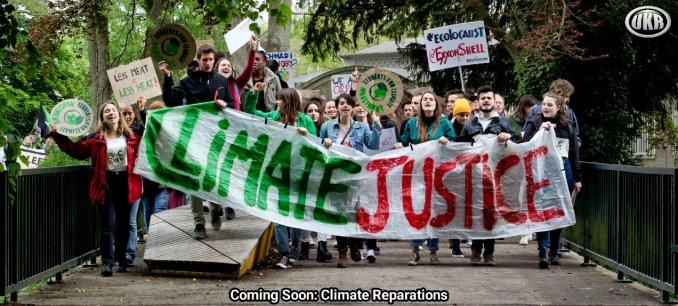
Coming soon: climate reparations
NIALL MCCRAE
What does it take to be described as one of the most important philosophers in the world today? Ideological rectitude is necessary, but also it helps to have a darker shade of skin. Perhaps I’m being unkind, but from the writings of Olúfémi O Táíwò I don’t see any unique insights on the human condition. The assistant professor at Georgetown University is in the right place at the right time with his message: climate reparations for racial justice.

A zealot of identity politics and promoter of slavery reparations, Táíwò is one of the invited authors of Greta Thunberg’s recent production The Climate Book. This voluminous compilation is described as telling ‘the biggest story in the word’. Indeed, it’s a fairytale bludgeoned into the minds of schoolchildren and students. The blurb concludes that ‘the time has come for us to tell this story, and perhaps even change the ending’, but that can only be achieved by the people realising that they are being misled by a Pied Piper of Hamelin.
Táíwò’s chapter begins with the bold assertion that ‘the climate crisis is the culmination of centuries of racial injustice’. He wants to remake the world.
The world as it exists today is the product of ‘the global racial empire: the historically unprecedented colonial conquest and racial slavery that began in the 1400s’. I doubt whether the Arabs waited till the fifteenth century to take African slaves. Slavery, to be sure, is as old as human civilisation; a form of exploitation not limited to racism.
The British Empire is responsible for Táíwò’s formulation of racial and ecological crime. The colonies supplied labour and resources from which the coal-powered Industrial Revolution made Great Britain the richest and most powerful nation. The Americans and other powerhouses of the ‘Global North’ continued the pillage and pollution.
Whether wittingly or not, Táíwò’s proposed redistribution of wealth from the Europe and North America to the ‘Global South’ would merely be a cover for expropriation of land and wealth by the predatory elite. For a philosopher he shows little understanding of the term ‘elite’, believing that it simply means privileged. But perhaps he is clever in refraining from naming the beast. Consequently, his outlook of identity politics puts all white people in the same status as beneficiaries of global injustice, ignoring the reality that ordinary white citizens in the West are being fleeced (increasingly taxed for the Net Zero scam and destructive mass immigration).
A ‘constructive approach’ to reparations, Táíwò argues, will ‘build pipes that will funnel advantages to the previously disadvantaged’. This is the absurdity of ‘positive discrimination’ writ large. ‘We should start with a goal that has been rightly viewed as central in the long history of Black radical agitation for reparations: cold, hard cash’. And the money should be handed to the correctly coloured recipients unconditionally, in the form of direct payments to descendants of slaves, or perhaps through a racially-weighted global universal income.
This Táíwò is no Immanuel Kant, is he? He cannot see that the globalist cabal is seizing Africa and other poorer regions of the planet, not for the benefit of the indigenous folk but to use the money taken through tax or reparations from the West to establish total control of population and resources. Indeed, depopulation and ‘rewilding’ will make great swaths of land out of bounds for the traditional tribal communities, who occupy terrain that the misanthropic elite want for mineral extraction, or an adventure playground.
‘Fossil fuel’ extraction in the Niger Delta is bad for racial equality, Táíwò notes, despite its bountiful boost to the Nigerian economy. He omits mention f the vast mineral mines in the Congo, where children are subjected to forced labour. Whereas Niger basin oil fuels millions of African taxis, for example, the rare elements from equatorial strata are used for batteries powering electric vehicles driven by affluent Westerners.
The inevitable plunder is cloaked in virtue-signalling about global redesign fo social and racial justice. ‘Participatory budgeting’ is as realistic as Nigel Farage’s Reform party reforming anything for the benefit of long-suffering white Britons. Let’s be honest, Táíwò is shitting on his black brethren by pushing this race-climate nonsense. He will go far, but the poor black communities will get nothing in real terms, beyond their use in undermining established white Christian culture.
Western society has been so weakened, that if Keir Starmer announced tomorrow that a few billion pounds would be sent from the exchequer to a black bank (really BlackRock), there would be no protests. The path has been laid, and we should expect an announcement soon. Perhaps Táíwò will pen a celebratory piece in the Guardian.
This article (Coming soon: climate reparations) was created and published by Niall McCrae and is republished here under “Fair Use”


Leave a Reply