

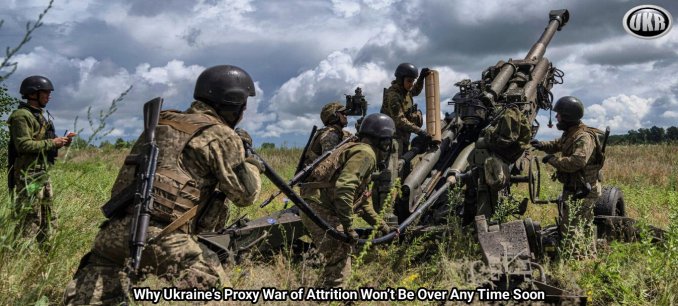
Why Ukraine’s proxy war of attrition won’t be over any time soon
PATRICK BENHAM-CROSSWELL
WE’RE now entering the fifth year of the Ukraine war with no obvious end in sight. Any ceasefire is predicated upon where the lines will be drawn on maps, how it will be implemented and who will keep it. When the Korean War puttered into stalemate (after General MacArthur’s desire to go nuclear was put on ice) an armistice and a demilitarised zone (DMZ) were agreed. That was in 1953; the peace talks continue.
Either side of the DMZ both Koreas maintain strong military forces. The South Korean side is augmented by 25,000 US troops and an awesome array of hardware. (The nuclear component was removed in 1991.) Aside from the odd spat, the combination of armistice, massive firepower and the crucial DMZ have worked.
Korea is an obvious model for a ceasefire in Ukraine, although there are huge military problems, most obviously size. The Korean DMZ is 124 miles long; the Ukrainian line of contact with Russia is some 746 miles, plus about another 620 miles of border with Belarus. That’s a lot of fence to erect. Keeping it under observation will require an awful lot of peacekeeping troops, plus a fair amount of deployed combat power to deter both sides from taking on the peacekeepers.
While Boris Johnson and John Healey may wish to get British troops on the ground, as former Chief of the Defence Staff General Sir Nick Carter pointed out in last week’s Spectator, the UK might just about be able to field 10,000 troops (from an army of nominally 70,000). If, as is likely, this would be a long deployment, the number would fall to fewer than 5,000. That’s enough credibly to cover some 31 miles of border (peacekeepers who aren’t credible fail, as was demonstrated in Srebrenica). Worse (for Nato), troops keeping the peace in Ukraine aren’t deterring aggression elsewhere.
The reality is that we’re in a bind from which there is no easy exit, let alone a pleasant one. We’re not alone, the rest of Western Europe is in the same mess. President Trump’s Ukraine policy put American interests first. Top was not to get sucked into World War Three (which hasn’t started, no matter what President Zelensky may say) and his second priority was to stop haemorrhaging US taxpayer cash. He’s achieved both, plus a deal on mineral rights, so there is some hope of a return on Biden’s spending.
While Trump is happy to supply selected weaponry to Ukraine, it’s not a gift – the Europeans must pay for it, which of course means you and me. Our government has committed some £13billion of weaponry and almost £9billion of other support. That’s about £4.5billion per year. We’re committed to £3billion a year of military aid for as long as it takes.
Much of the military aid is ammunition, which we desperately need ourselves to rebuild stockpiles, vital if a war with Russia kicks off in the Baltics as many commentators fear. Money spent in Ukraine isn’t available for building our Armed Forces, let alone with sufficient speed to build a military that deters.
That’s not the only hit the British taxpayer is taking. There are some 250,000 Ukrainians in the UK, all of whom are ahead of you in NHS queues. Many of them work, which contributes to rising British unemployment.
While some Ukrainians are refugees, many are health tourists. I met one who became a refugee to receive £80,000 of cancer treatment to avoid selling an investment property in Kiev. There’s plenty of medicine available in Ukraine, but it’s not free. The patient’s home was safe; he kept returning to Ukraine between bouts of treatment. He struggled to understand British generosity.
China and India are doing well out of the war too. Russia is selling them lots of oil and gas at below market price. Notwithstanding sanctions, 18 per cent of China’s oil came from Russia in 2025 (the largest source). Cheap oil makes for reduced production costs. Plus of course Russia needs weaponry and technology that China has.
The war is bad, but not (yet) disastrous for Russia. They have willing buyers of their oil and other natural resources. Sanctions are biting, but President Putin remains in charge. Their casualties have been horrific and their tactics found wanting. However it is they who continue to advance. Those in the West who think the solution is economic collapse followed by the removal of Putin (by whom?) haven’t come up with an idea of who will replace him. The also forget that it was Putin (and his supporters) who prevented post-Yeltsin Russia from collapsing into anarchy and probably another civil war.
Obviously the war is a disaster for Ukraine. Their existence depends upon the whim of President Trump and the goodwill of the politically weak leaders of the ‘coalition of the willing’ (but impotent). Ukraine has fought the invaders to a standstill but cannot recapture lost terrain without vast amounts of military hardware, which the West simply doesn’t have and can’t manufacture quickly. It’s in hock to the West and it’s far from clear who will pay to rebuild it. Even Rachel Reeves knows there isn’t any money and President Trump is more interested in Mediterranean resorts in Gaza.
Those in the West who believe in the threat of further Russian expansionism and in realpolitik have worked out that £3billion a year to pay the Ukrainians to keep destroying the war machine is far cheaper, quicker and more effective than rebuilding European (Poland and Sweden excepted) armed forces from their current pathetic state.
And that’s Zelensky’s real problem: it’s in none of his backers’ interests for him to win.
This article (Why Ukraine’s proxy war of attrition won’t be over any time soon) was created and published by Conservative Woman and is republished here under “Fair Use” with attribution to the author Patrick Bentham-Crosswell


Leave a Reply