

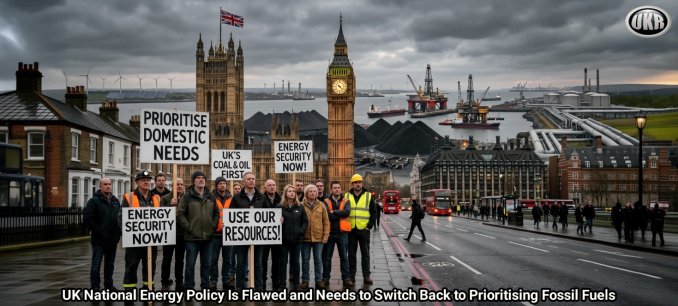
UK national energy policy is fundamentally FLAWED and needs to switch back to prioritising fossil fuels to supply domestic needs
The UK has an abundance of fossil fuels. Why won’t the UK stand on its own two feet?
PETER HALLIGAN
Exploration is desperately needed to maintain output from fields that are being slowly depleted.
I urge you to watch he o hour YouTube video below which covers the on-current issues In the energy market – spoilr alert -STUPID EU, UK AND California
US Gasoline Prices lower than Europe: California says ‘Hold my Beer’
From Brave AI:
“The UK possesses significant conventional offshore oil and gas reserves, though production has peaked and the sector is in decline, alongside substantial but unproven and highly uncertain shale gas and oil resources.
Conventional Oil and Gas
- Reserves: As of recent estimates, the UK has approximately 3 billion barrels of recoverable oil reserves remaining. Gas reserves are estimated at 647 billion cubic meters (as of 2007 data, with ongoing exploration).
- Production Status: UK Continental Shelf (UKCS) production peaked in 1999. While some reports suggest 90% of potential production may have occurred under current economic/tax conditions, significant resources remain undiscovered or technically recoverable under different regulatory frameworks.
- Key Fields: Major offshore fields are located in the North Sea, particularly the Central Graben (Forties and Brent fields). Recent discoveries have also been made west of Shetland.
Shale Gas
- Potential Estimates: Estimates vary widely due to lack of production data. The US Energy Information Administration (EIA) estimated 26 trillion cubic feet (approx. 740 billion cubic meters or 0.74 trillion cubic meters technically recoverable) in 2013.
- Recent Adjustments: A 2019 British Geological Survey (BGS) analysis significantly reduced earlier 2013 estimates for the Bowland-Hodder area (the largest potential site) from up to 64.6 trillion cubic meters down to approximately 4.0 trillion cubic meters.
- Viability: The UK has four main potential areas: Bowland-Hodder (NW England), Midland Valley (Scotland), Weald Basin (Southern England), and Wessex Basin (Southern England). However, the Scottish and Welsh governments have imposed moratoriums or bans on fracking.
Shale Oil
- Weald Basin: The BGS estimated the Weald Basin contains approximately 4.45 billion barrels of shale oil potential. This is significantly less than the North Sea’s historical production but represents a major domestic resource if economically viable.
- Scotland: Estimates for shale oil in the Midland Valley are around 6 billion barrels, though data is less certain than in England.
- Recovery Rates: Unlike the US, UK shale rocks have lower oil concentrations, and the technically/economically recoverable portion is expected to be very low (a few percent).
- he UK North Sea possesses potential in existing mature fields requiring enhanced recovery and recently licensed developments awaiting final approval.
- Active and Developing Giant Fields The UK sector currently operates approximately 30 to 40 active oil fields and 100 to 150 platforms, with production declining as reserves deplete. Key established “giant” fields (>500 million barrels) include:
- Buzzard: The largest UK field discovered in the 21st century (2001), with producible reserves of nearly 400 million barrels.
- Brent: Discovered in 1971, it has produced over 3 billion barrels and serves as the benchmark for global oil pricing.
- Forties: Discovered in 1970, it has contributed over 1.5 billion barrels to UK production.
- Clair: A complex field west of Shetland with an estimated 640 million barrels recoverable via bridge-linked platforms.
- Schiehallion: Located west of Shetland, developed via the Glen Lyon FPSO with substantial remaining reserves.
- Pending and New Developments The UK government, under current policy, restricts new exploration but permits “tiebacks” to existing infrastructure. Two major projects are under consideration for final approval:
- Rosebank: Britain’s largest untapped oil field, located 80 miles northwest of Shetland, which also produces gas.
- Jackdaw: A significant gas field located 150 miles east of Aberdeen, potentially connectable to the UK network within months.
- Future Potential and Transition The North Sea is classified as a mature basin with output falling over 65% since its 1999 peak. While optimistic scenarios suggest up to 7.5 billion barrels could be extracted by 2050 through advanced technology, gas production is projected to drop such that 94% will need to be imported by 2050. Future potential increasingly lies in CCUS (Carbon Capture, Utilization, and Storage) and transitioning offshore infrastructure and skills toward floating offshore wind projects.
- UK consumption of oil and gas – DESPITE ALL THE roll-out of plantations of solar panels and forests of wind turbines that are destroying the countryside ad decimating animal, bird and fish species.
· The United Kingdom consumed approximately 1.395 million barrels per day of oil and 2.735 trillion cubic feet of natural gas in 2023. Total final energy consumption in the UK reached 128.1 million tonnes of oil equivalent (1,490 TWh) in 2024, with oil accounting for 45.5% and natural gas for 29.0% of that total mix.
· Domestic production currently covers a significant portion of this demand, with 48% of oil consumption and 51% of natural gas consumption met by UK sources in 2024. The transport sector remains the largest consumer of oil products at 72.7% of usage, while the residential sector drives 73.1% of natural gas consumption.
Oil is essential for the production of plastics – without plastics people WILL DIE.
Here’s the change in average UK household electricity bills over the last ten years.
‘UK household electricity prices have increased by over 50% in the past decade. According to analysis, the average annual electricity bill for a typical household rose from approximately £460 in 2010 to over £1,200 by 2022. The current average annual electricity bill for a typical UK household (2-3 people) is £947.47
£947.47 from £460 IN TEN YEARS = An INCREASE OF106% over ten years
‘Based on the historical Henry Hub Natural Gas Spot Price data, the price ten years ago (April 2016) was $1.92 per MMBtu.
The current price of Henry Hub Natural Gas futures is approximately $2.51 to $2.58 USD per MMBtu as of late April 2026.
An increase of around 30% over ten years
Gas prices up 30% whilst household electricity bills have more than doubled over the last ten years.
The UK needs refined oil products – for cars, vans and trucks ad jets.
Here’s a few numbers
Let’s hope the armed forces have an unlimited and secure supply of fuel/oil derivative products.

As of 2026, there are over 2 million plug-in electric vehicles (including both fully electric and plug-in hybrids) on UK roads.
Under the UK’s Zero-Emission Vehicle (ZEV) Mandate, manufacturers face financial penalties for failing to meet their required sales quotas for electric vehicles. The current fine structure for 2026 is set at £12,000 per non-compliant car and £9,000 per non-compliant van.
Current and Upcoming Car Sales Targets
- 2024: 22% of new car sales must be zero-emission.
- 2025: 28% of new car sales must be zero-emission.
- 2026: 33% of new car sales must be zero-emission.
- 2030: 80% of new car sales must be zero-emission.
- 2035: 100% of new car sales must be zero-emission.
Van Sales Targets
- 2024: 10% of new van sales must be zero-emission.
- 2030: 70% of new van sales must be zero-emission.
- 2035: 100% of new van sales must be zero-emission.
Key Context
- Review Status: The government has announced a review of these quotas, with a report expected by early 2027, citing challenges such as a 17% drop in UK car production and industry concerns over financial penalties.
- Penalties: Manufacturers failing to meet these targets face fines of £15,000 per non-compliant car and £9,000 per non-compliant van sold outside of their allowance.
- Flexibility: Manufacturers can trade credits or borrow from future years’ allowances (though borrowing limits are tightening) to avoid fines. Self-charging hybrids remain exempt from the zero-emission count but are allowed to be sold until 2035.
PRODUCE EVS ARE THE GOVERNMENT WILL SHUT YOU DOWN – hardly democratic.
In 2025, there were 2,536,156 flights in UK airspace, according to data from NATS (National Air Traffic Services).
Which brings us to the point.
The UK NEEDS oil/oil derivative products. IT HAS NORTH SEA OIL. – IT DOES NOT HAVE THe REFINERIES TO PROCESS THIS OIL into petrol/diesel/jet fuel/plastics etc.
‘North Sea oil can be refined into petrol, diesel, and jet fuel, but the UK’s refining infrastructure is not currently optimized to process the specific types of crude extracted domestically, leading to a reliance on exports and imports.
- Product Mismatch: The majority of North Sea production consists of light, sweet crude, which is technically suitable for refining into high-value products like petrol and jet fuel. However, the UK’s demand is heavily skewed toward diesel and jet fuel, which light crude yields less of compared to heavier crudes.
- Refining Capacity: The UK has limited refining capacity, highlighted by the closure of Scotland’s Grangemouth refinery. While some light crude is refined domestically (accounting for roughly 20% of production), the remaining ~80% is exported to specialized refineries in Europe (such as in the Netherlands or Norway) that are better equipped to process premium crudes or balance product slates.
What is required for UK energy independence is the extraction of north sea oil and its refining IN THE UK.
‘North Sea oil can be refined into petrol, diesel, and jet fuel, but the UK’s refining infrastructure is not currently optimized to process the specific types of crude extracted domestically, leading to a reliance on exports and imports.
- Product Mismatch: The majority of North Sea production consists of light, sweet crude, which is technically suitable for refining into high-value products like petrol and jet fuel. However, the UK’s demand is heavily skewed toward diesel and jet fuel, which light crude yields less of compared to heavier crudes.
- Refining Capacity: The UK has limited refining capacity, highlighted by the closure of Scotland’s Grangemouth refinery. While some light crude is refined domestically (accounting for roughly 20% of production), the remaining ~80% is exported to specialized refineries in Europe (such as in the Netherlands or Norway) that are better equipped to process premium crudes or balance product slates.
STOP EXPORTING – start refining NORTH SEA OIL and supplying filling stations and air lines.
Th same goes for NORTH Sea gas – let the oil majors DISCOVER new fields.
MAYBE STABLISH UK SUPPLIERS OF GAS, PETROL AND JT FUEL, USING EXISTING UK COMPANIES LIKE BRITISH GAS AND BP – switch the billions spent on useless companies and Qangos like GB ENERGY and all the associated ‘net zero’ subsidies and fines.
Chck out North sea gas production;
In 2025, domestic production from the North Sea (along with minor biomethane) supplied approximately 30.3% of the UK’s total gas consumption, amounting to 207.2 TWh. This domestic output covered roughly 47.5% of the country’s internal demand, as the majority of North Sea gas produced was exported to balance the market.
However, this domestic contribution is in steep decline due to geological depletion. By 2027, North Sea gas is projected to be insufficient to meet national heating needs alone, and by 2050, the UK is expected to be 94% reliant on imports, with only 14% of the original North Sea reserves remaining commercially viable.
Maybe get some help and advice from Norway.
‘Norway has recently made several significant oil and gas discoveries in the North Sea, primarily led by state-owned Equinor and Aker BP. Key finds include Equinor’s commercial oil discovery in the Snorre area (Omega Sør Alfa), estimated at 25–89 million barrels of recoverable oil equivalents, and gas and condensate finds in the Troll and Sleipner areas, each containing 4–9 million barrels of oil equivalent. Additionally, Aker BP’s Omega Alfa discovery near the Yggdrasil field is considered one of the largest in a decade, with 96–134 million barrels of recoverable oil equivalent.
These discoveries highlight continued productivity in Norway’s sector of the North Sea, contrasting with the UK’s ban on new exploration. Harbour Energy and Aker BP also recently identified new gas condensate and oil fields close to the UK/Norwegian border, leveraging existing infrastructure to boost output cheaply.
Please take a (paid or unpaid) subscription or forward this article to those you think might be interested.
You can also donate via Ko-fi – any amount from three dollars upwards. Ko-fi donations here:
This article (UK national energy policy is fundamentally FLAWED and needs to switch back to prioritising fossil fuels to supply domestic needs) was created and published by Peter Halligan and is republished here under “Fair Use”
See Related Article Below
What does Net Zero really mean?
Why the UK should develop its oil and gas.
CATHERINE MCBRIDE
I was delighted to read the Sunday Times editorial headline: ‘Spurning the North Sea’s gifts makes little sense for Britain.’ The editorial correctly claims that the Labour Party’s message on energy is confused waffle: Ed wants to block oil and gas, but Rachel (and the country) needs the jobs and revenue from them. However, the Sunday Times is just as confused. Towards the end of the editorial promoting oil and gas development, we read: ‘Nobody should doubt that our long-term future lies with renewables.’ This is the same newspaper that has a story on its front page about how a shortage of jet fuel could disrupt summer holiday travel.
This level of cognitive dissonance may be the Sunday Times’ editorial team hedging its bets in case Ed Miliband becomes Prime Minister in May, or perhaps they are preparing for a Green Party Prime Minister after the next election. Either Way, they should be aware that renewables only produce electricity, and sporadically at best, while over three-quarters of UK energy consumption comes from oil and gas, NOT electricity. The obvious and topical example is jet fuel.
There is really no reason why the UK’s future should lie with renewables made in China using coal when the UK has ample supplies of oil and gas. Unfortunately, people have been talking about net-zero carbon emissions for so long that they appear to have forgotten how it is measured, what emissions are not counted, and why this process is nonsense. So I thought it would be worth reviewing exactly what the UK’s reaching ‘Net Zero’ means for the Earth’s atmosphere.
1. Which emissions are counted
The United Nations Framework Convention on Climate Change (UNFCCC) requires countries to produce national greenhouse-gas inventories in accordance with the Intergovernmental Panel on Climate Change (IPCC) Guidelines. This covers the gases that must be counted, which sectors must be included, how to measure emissions and removals, and how to treat land uses, forests, peatlands, agriculture, industry, energy, and waste. All countries must submit their greenhouse gas inventories to the UNFCCC.
UNFCCC’s emissions accounting standards solely concentrate on the greenhouse gas emissions, which are considered by the UN to be ‘man-made’. So they don’t count natural emissions released from oceans, volcanoes, swamps and bogs, or wild ruminant animals. And they strangely also don’t count the most obviously ‘man-made’ source of CO2 – the 1 kilo of CO2 each person breathes out each day.
2. Territorial emissions, but not imported emissions
The UNFCCC is only interested in a country’s national territorial emissions. That means they also don’t count the emissions from imported goods, international investments, goods made in offshore factories owned by UK companies, nor international shipping and aviation that is not allocated to the UK.
This has allowed the UK to claim it has halved its CO2 emissions since 1990. In reality, successive governments have simply made UK manufacturing uncompetitive by imposing higher carbon taxes than those in other EU and Asian countries, forcing UK manufacturers to either go out of business or to move their factories offshore.
While claiming to have cut UK annual CO2 emissions by almost 300 million tonnes in 2024, the UK imported goods whose manufacture emitted about 180 million tonnes. Emissions reductions have just become a bait-and-switch strategy.

Manufacturing’s share of UK GDP has halved since 1990, from 16% to just 8%, as have UK carbon dioxide emissions, not due to a successful Green transition but to simple deindustrialisation. The speed of this decline has increased since 2019; the UK has lost an estimated 150,000 to 200,000 industrial jobs due to deindustrialisation and high energy prices, with the steepest declines in energy-intensive sectors such as steel, chemicals, ceramics, and paper.
The Chart above shows the UK’s annual net trade emissions, that is, the emissions from goods imported each year by the UK minus the emissions from goods exported by the UK. The data comes from Our World in Data, which has tabulated it from Eurostat, OECD, IMF, World Bank and Global Carbon Budget data. In total, since 1990, cumulative emissions from UK net trade exceed 5 billion tonnes, but these aren’t included in the UK’s UNFCCC emissions measurements.
3. Global emissions are not dropping
Since 1990, over a trillion tonnes of CO2 emissions have been put into the Earth’s atmosphere. Most of this has come from developing countries that are happy to supply the UK and Europe with the goods they no longer make because of their obsession with cutting their territorial emissions and reaching Net Zero. The exact cumulative Global emissions between 1990 and 2024 are 1,064,765,046,000. If the UK had not reduced its cumulative territorial emissions by 289,039,560 over the same period, global emissions would have been 1,065,054,085,560. Both numbers round to 1.065 trillion.
The chart below clearly shows that the UK’s deindustrialisation has made absolutely no difference to global emissions; the red area at the bottom of the chart shows the UK’s emission reduction – it is barely visible. And for readers unfamiliar with scientific notation: 1e12 is 1 followed by 12 zeros, i.e. 1,000,000,000,000 tonnes.

4. Both Europe and the world need more oil and gas, not less
The UK is one of about 40 nations with ample oil, gas and coal suppliers. This is a valuable resource that should be used domestically or exported. Hopefully, in resolving the current Labour Party energy confusion, Team Rachel will win the day: The UK’s economy could really use the boost that additional employment, tax revenue, and export revenue from increased oil and gas production would bring. The world could also really use additional supplies of oil, gas, and coal from outside the Persian Gulf. This is especially true of the EU, which has very little domestic oil, gas, or coal, and is already our largest export market for crude oil and is connected to the UK by pipeline for gas transport. So why isn’t the UK prepared to increase its production and export its resources, even to Europe? The government wants to let the EU set UK rules, but isn’t prepared to help the EU during its energy shortages. When the commentariat states that oil and gas are sold on international markets to the highest bidder, they ought to also investigate which countries are the highest bidders.
Restricting the development of new oil fields in the vain belief that this is helping to reduce global carbon dioxide emissions benefits no one: not the potential workers extracting the coal, gas and oil, not the exchequer collecting the tax, and not the global emissions which have increased by over one trillion tons since 1990 – the reference year used by the UK in its Paris Agreement Commitments to reduce CO2 emissions.
5. UK emissions targets have helped the developing world
The UK’s 300 million tonne annual CO2 reduction is invisible when compared to the global increase. The main result of the UK’s efforts has been to export its emissions to countries without carbon taxes and environmental restrictions on their industry. The imported goods from these countries have 180 million tonnes of associated CO2 emissions. So, the UK has only reduced its emissions by 120 million tonnes, mainly by converting coal-fired power plants to gas-fired ones. This happened in the 1990s, long before the Paris Agreement was signed in 2015, and was done for commercial reasons rather than environmental ones. Cynically, I suspect this commercially inspired emission reduction may have been why the UK wanted to measure its emissions relative to 1990 in the Paris Agreement.
The Paris Agreement is a strange agreement that allows every country to set its own emissions targets and reference date. And not all of the targets were reductions. For example, China’s Paris Agreement target was to reach peak emissions around 2030; it did not set a reduction target.
But the Paris agreement has had some positive outcomes for global trade, as developed nations such as the UK, which wanted to virtue signal their CO2 reduction credentials, helped developing nations industrialise by importing their goods. These imported goods were relatively cheaper, so consumers in developed nations also benefited, and they were “emission-free” from a UNFCCC perspective. The resulting industrial development has probably done more for the world than reducing CO2 emissions ever could have.
Of course, not everyone benefited. Many workers in developed nations lost their jobs as factories were moved to Asia, Africa, and Latin America to avoid CO2-emission taxes and penalties. For more information about this, the Great British Business Council’s paper, Premeditated Industrial Destruction, explores how and why the UK destroyed its industries and how to reverse this.

••••
The Liberty Beacon Project is now expanding at a near exponential rate, and for this we are grateful and excited! But we must also be practical. For 7 years we have not asked for any donations, and have built this project with our own funds as we grew. We are now experiencing ever increasing growing pains due to the large number of websites and projects we represent. So we have just installed donation buttons on our websites and ask that you consider this when you visit them. Nothing is too small. We thank you for all your support and your considerations … (TLB)
••••
Comment Policy: As a privately owned web site, we reserve the right to remove comments that contain spam, advertising, vulgarity, threats of violence, racism, or personal/abusive attacks on other users. This also applies to trolling, the use of more than one alias, or just intentional mischief. Enforcement of this policy is at the discretion of this websites administrators. Repeat offenders may be blocked or permanently banned without prior warning.
••••
Disclaimer: TLB websites contain copyrighted material the use of which has not always been specifically authorized by the copyright owner. We are making such material available to our readers under the provisions of “fair use” in an effort to advance a better understanding of political, health, economic and social issues. The material on this site is distributed without profit to those who have expressed a prior interest in receiving it for research and educational purposes. If you wish to use copyrighted material for purposes other than “fair use” you must request permission from the copyright owner.
••••
Disclaimer: The information and opinions shared are for informational purposes only including, but not limited to, text, graphics, images and other material are not intended as medical advice or instruction. Nothing mentioned is intended to be a substitute for professional medical advice, diagnosis or treatment.
Disclaimer: The views and opinions expressed in this article are those of the author and do not necessarily reflect the official policy or position of The Liberty Beacon Project.


Leave a Reply