

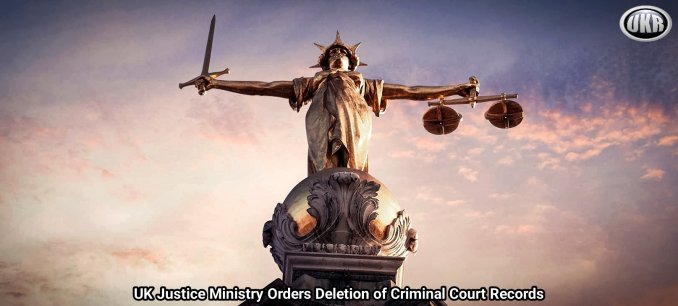
The moment journalists could see how criminal courts actually functioned, the instinct inside the system was to make the visibility vanish rather than fix what it exposed.
RECLAIM THE NET
There are many ways to make a problem disappear. You can fix it. You can ignore it. Or, if you happen to run a government department with a fondness for paperwork and plausible deniability, you can simply order the evidence to be wiped off the face of the earth and then look surprised when people start shouting.
This is the route chosen by the UK Ministry of Justice, which has now instructed a small company called Courtsdesk to delete its entire private archive of criminal court data.
As reported by The Times, its order is simple. Courtsdesk, a small company that built a private archive of criminal court data, must destroy it. Years of records, listings, outcomes, schedules. Everything that showed how England’s criminal courts actually operate when nobody is polishing the press releases.
The archive existed because the government asked for it. In 2021, the lord chancellor authorized a pilot to see whether a “national digital news feed of listings and registers can improve coverage of the courts by the news media.” It was framed as modernization, a polite nod to the idea that courts work better when people can see them.
Courtsdesk took this at face value and built the thing.
More than 1,500 journalists across 39 media organizations used the platform. They used it because the official court information systems famously behave like a drunk uncle: Sometimes present, often wrong, and frequently missing entire days.
Courtsdesk’s analysis laid this bare. Journalists received no advance notice for 1.6 million criminal hearings. Official listings matched what actually happened on only 4.2 per cent of sitting days.
Around half a million weekend cases took place without any notice to the press. Two-thirds of courts routinely processed cases the media never knew were coming. Seventeen courts supplied outcome data after the fact while never publishing a single forward listing during the entire period examined.
This is what passes for visibility inside the criminal justice system. Hearings take place, decisions are made, and defendants are convicted or cleared. The public finds out later, if at all, and often by accident.
Courtsdesk changed that. It allowed reporters to see patterns, prepare coverage, and turn up while proceedings were actually happening. That alone made it disruptive.
Once journalists could see what was going on, they did their jobs. These cases were already in the system. They surfaced because someone finally had a map.
Neil O’Brien, a Conservative shadow minister, spoke with the bluntness of someone who has seen this pattern before. He said to The Telegraph: “The grooming gangs scandal exploded once people were able to read the court reports.
“For Labour there’s only one obvious response: make it harder to get court reports.”
The remark draws power from experience rather than theory. The grooming gangs cases that have impacted Britain became unavoidable only after journalists gained sustained access to court reporting.
Hearing by hearing, judgment by judgment, reporters assembled a picture that no internal review or institutional summary was willing to provide on its own. Public outrage followed visibility, not the other way around.
Katie Lam, a shadow Home Office minister, framed the issue as one of institutional habit rather than party tactics. She said: “To know the truth about the grooming gangs, we must have access to court records at every level.
“The culture of secrecy in many of our institutions helped cover up these crimes in the first place.
“Labour must not be allowed to do this. The public deserves to know the truth.”
Her point rests on how abuse persists when information fragments. Partial records scatter responsibility. Delayed publication drains urgency. Barriers between hearings prevent patterns from being recognized while they are still forming. The result is a system that appears functional while failing the people who depend on it for protection.
But institutions rarely enjoy mirrors that work properly.
In November, the HM Courts and Tribunal Service issued a cessation notice to Courtsdesk. The justification arrived dressed up as “unauthorized sharing” of court data tied to a test feature, with data protection wheeled in as backup. According to the company, repeated requests to involve the Information Commissioner’s Office went unanswered.
The solution moved straight past oversight and landed on erasure.
Officials insist journalists still have access to court information. That access depends on the same fragmented listings, late updates, and missed hearings that Courtsdesk spent years documenting.
Reporters will be told to phone courts, refresh web pages, and put up with it.
The impact will accumulate quietly. Local court reporters, already running on fumes, lose the tools that made their work possible.
The Courtsdesk archive did something deeply unfashionable. It kept receipts. Ordering it destroyed does nothing to repair the failures it revealed. It simply removes the evidence that those failures existed at all.
A justice system earns public confidence through visibility. When records disappear the moment they become uncomfortable, confidence goes with them. What remains is a process that insists everything is open while making sure fewer people can see inside.
This article (UK Justice Ministry Orders Deletion of Criminal Court Records) was created and published by Reclaim the Net and is republished here under “Fair Use”

••••
The Liberty Beacon Project is now expanding at a near exponential rate, and for this we are grateful and excited! But we must also be practical. For 7 years we have not asked for any donations, and have built this project with our own funds as we grew. We are now experiencing ever increasing growing pains due to the large number of websites and projects we represent. So we have just installed donation buttons on our websites and ask that you consider this when you visit them. Nothing is too small. We thank you for all your support and your considerations … (TLB)
••••
Comment Policy: As a privately owned web site, we reserve the right to remove comments that contain spam, advertising, vulgarity, threats of violence, racism, or personal/abusive attacks on other users. This also applies to trolling, the use of more than one alias, or just intentional mischief. Enforcement of this policy is at the discretion of this websites administrators. Repeat offenders may be blocked or permanently banned without prior warning.
••••
Disclaimer: TLB websites contain copyrighted material the use of which has not always been specifically authorized by the copyright owner. We are making such material available to our readers under the provisions of “fair use” in an effort to advance a better understanding of political, health, economic and social issues. The material on this site is distributed without profit to those who have expressed a prior interest in receiving it for research and educational purposes. If you wish to use copyrighted material for purposes other than “fair use” you must request permission from the copyright owner.
••••
Disclaimer: The information and opinions shared are for informational purposes only including, but not limited to, text, graphics, images and other material are not intended as medical advice or instruction. Nothing mentioned is intended to be a substitute for professional medical advice, diagnosis or treatment.
Disclaimer: The views and opinions expressed in this article are those of the author and do not necessarily reflect the official policy or position of The Liberty Beacon Project.


Leave a Reply