

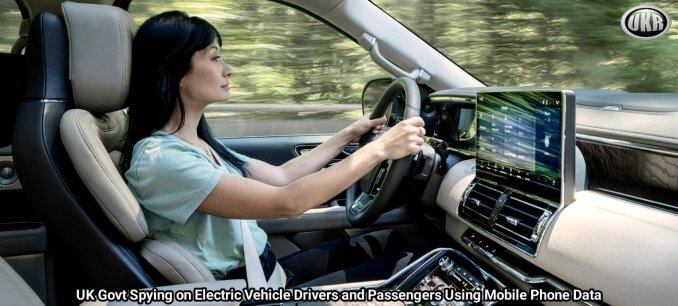
UK government has been spying on electric vehicle drivers and passengers using mobile phone data
RHODA WILSON
For two years, the UK’s Department for Transport was spying on electric vehicle drivers and their passengers, both children and adults, using their mobile phone data to get insights into their behaviour.
Last year, we published an article about the enormous amount of information being captured by electric vehicles (“EV”). We quoted Martin, a cybersecurity campaigner, who said, “Most people today just simply won’t be aware of the data that is actually being captured by a vehicle. They certainly won’t be aware of how it’s being used or how it’s being shared.”
Vehicles are a core component of the Internet of Things (“IoT”). Together with the AI and other technologies, IoT is part of the Fourth Industrial Revolution.
Modern connected cars are equipped with sensors, software and communication technologies that enable them to exchange data with other vehicles, infrastructure, devices and the internet. With 5G connectivity and advanced data analytics, vehicles are evolving into mobile data hubs, making them essential nodes in the broader IoT system. And the integration of IoT in vehicles contributes, in particular, to the development of autonomous driving and smart cities.
As Global Data explains, “While sensors and connectivity are essential enablers for IoT, the real value that is derived from these processes comes from the data. In today’s automotive landscape, data has become a strategic asset … Data has moved from being a byproduct to a core driver of innovation, becoming essential for the progress of autonomous driving, connected cars and AI-enabled features.”
And Gresham Toyota in Oregon, USA, noted in a 2024 blog, “Toyota’s vision extends beyond passenger cars. They are exploring IoT applications in various mobility solutions, including … Smart cities: Toyota collaborates with municipalities to develop connected infrastructure that integrates seamlessly with their vehicles, contributing to smarter and safer urban environments.”
Further reading:
- Sandi Adams: The dangers of smart cities and 15-minute cities
- Technocracy: The system of control that makes reality engineering possible on a global scale
- The influence of the Internet of Things (IoT) on modern vehicles, MD Electronik, 10 July 2024
- How IoT is transforming the automobile industry: main automotive IoT use cases, Effective Soft
Another component of the IoT is smartphones. In fact, smartphones are central to the IoT system as they act as controllers, gateways and user interfaces for countless IoT devices. They are equipped with sensors (GPS, accelerometers, cameras, NFC, Bluetooth), enabling them to collect environmental data, communicate with smart home devices, wearables, vehicles and industrial systems, and provide real-time monitoring and control. Their role as a central hub for managing IoT networks is widely recognised.
Further reading: Smartphone: The Ultimate IoT and IoE Device, Intech Open, 20 December 2016
It is no surprise then that the government is using people’s smartphones to monitor EV drivers – in other words, that one IoT device is being used to track another IoT device, because that has always been the intention.
It was reported yesterday that the UK’s Department for Transport (“DfT”) has been spying on EV drivers using their mobile phone data to get insights into their behaviour.
“Customers of O2, as well as other operators including Tesco and Sky Mobile, had their mobile internet history and app records passed to the government if they visited a site related to electric vehicles (EVs) once a month on at least two occasions,” The Telegraph reported.
DfT commissioned mobile network operator O2 to conduct a two-year study, tracking 25 million mobile devices to analyse EV adoption and usage patterns. “At the DfT’s request, O2 trawled people’s web browsing habits, including those of children, to identify ‘EV users’. This included passengers as well as drivers,” The Telegraph said.
O2 then tracked their physical movements using mobile network data and sent the data to the government.
The project included customers of O2 and networks using its infrastructure – such as Sky Mobile, Tesco Mobile, GiffGaff and Virgin Mobile. It concluded in April 2024, after the DfT found mobile data insufficient for detailed insights like charging behaviour.
The DfT stated that all data sent to them was “anonymised and aggregated,” with no individual identities or locations linked.
The government claims the project was lawful and compliant with data protection laws but it has sparked significant privacy concerns among EV drivers. The scheme was widely criticised as a “surveillance state by stealth” and a “bizarre nanny state” attempt.
The O2 project raises serious questions about the scope of depth of data being captured by mobile phone providers and how it is being used, particularly considering the plans at the time to introduce new taxes on EVs to replace falling income from fuel duties – a pay-per-mile tax for EV drivers was later introduced.
Ginny Buckley, founder of Electrifying, said, “It turns out Big Brother doesn’t need to watch us – he can get the Department for Transport to analyse our data instead … When drivers were encouraged to go electric by the UK government, they weren’t warned that their online behaviour could be used to digitally profile them.”
The government might not have warned EV drivers of how their data would be used, but warnings have been in plain sight for years if people cared to research before they buy. Consider the 2018 report below from China.
“Hundreds of electric vehicle manufacturers are providing location data to the Chinese government, sparking privacy concerns among some car owners in the world’s largest automobile market,” the video description reads.
This article (UK government has been spying on electric vehicle drivers and passengers using mobile phone data) was created and published by The Expose and is republished here under “Fair Use” with attribution to the author Rhoda Wilson
Featured image: MSN

••••
The Liberty Beacon Project is now expanding at a near exponential rate, and for this we are grateful and excited! But we must also be practical. For 7 years we have not asked for any donations, and have built this project with our own funds as we grew. We are now experiencing ever increasing growing pains due to the large number of websites and projects we represent. So we have just installed donation buttons on our websites and ask that you consider this when you visit them. Nothing is too small. We thank you for all your support and your considerations … (TLB)
••••
Comment Policy: As a privately owned web site, we reserve the right to remove comments that contain spam, advertising, vulgarity, threats of violence, racism, or personal/abusive attacks on other users. This also applies to trolling, the use of more than one alias, or just intentional mischief. Enforcement of this policy is at the discretion of this websites administrators. Repeat offenders may be blocked or permanently banned without prior warning.
••••
Disclaimer: TLB websites contain copyrighted material the use of which has not always been specifically authorized by the copyright owner. We are making such material available to our readers under the provisions of “fair use” in an effort to advance a better understanding of political, health, economic and social issues. The material on this site is distributed without profit to those who have expressed a prior interest in receiving it for research and educational purposes. If you wish to use copyrighted material for purposes other than “fair use” you must request permission from the copyright owner.
••••
Disclaimer: The information and opinions shared are for informational purposes only including, but not limited to, text, graphics, images and other material are not intended as medical advice or instruction. Nothing mentioned is intended to be a substitute for professional medical advice, diagnosis or treatment.
Disclaimer: The views and opinions expressed in this article are those of the author and do not necessarily reflect the official policy or position of The Liberty Beacon Project.


Leave a Reply