

GRAHAM LORD
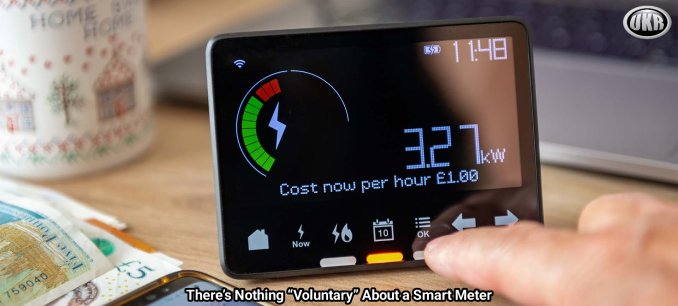
Although I am not on board with Rupert Lowe’s new political party (I remain a loyal ‘Sir Nigel’ band member), I increasingly find myself fielding the same criticism levelled at him. Question anything that sits comfortably within the modern consensus and you are quickly placed in the same bracket, as though mild scepticism is a sign of defect rather than a starting point for discussion. That is where we now are. I do not want a smart meter and I do not currently have one, which seems to be enough to invite suspicion in itself.
My instinct is to question systems that expand quietly while being presented as optional. That instinct was sharpened during COVID-19, when measures introduced with caveats and assurances had a tendency to outgrow both. It is therefore difficult to accept repeated claims at face value when the structure surrounding them suggests a different outcome. The smart meter rollout is a good example of that approach. No law says that you must have one. That line is repeated often and confidently. Think Nadim Zahawi (Reform – why?!) denying the roll-out of vaccine passports only for this to became mandatory in certain settings weeks later. At the point it is parroted it is true but what is not explained with the same clarity is how the system has been constructed so that, in time, most households will end up with one regardless of their initial preference.
The mechanism is not complicated, though it is rarely set out plainly. Electricity meters are not permanent fixtures. Under the Electricity Act 1989 and the Meters (Certification) Regulations 1998, they must be certified and approved for billing purposes and that certification has a defined lifespan. For many homes built in the early 2000s, that lifespan is around 20 years. Once it expires, the meter is no longer compliant and cannot remain in service. At that point, the supplier is required to replace it. That requirement is no longer discretionary. It sits alongside another obligation, this time within Ofgem’s licence conditions, which requires suppliers to take all reasonable steps to install smart meters when replacing existing equipment. Traditional non-smart meters have largely disappeared from circulation. They are not widely manufactured, they are not offered as replacements and they do not form part of the current rollout strategy. When a replacement is required, what is fitted in practice is a SMETS2 smart meter.
While the existing meter remains within certification, there is room to decline. Emails can be ignored, appointments can be refused and the matter can be pushed away. That window remains open only for as long as the meter remains compliant. Once the certification expires, the position changes. The old meter cannot stay and the replacement offered is ‘smart’. There is no alternative presented at that stage. The process does not rely on compulsion in the conventional sense. It works by removing every other option.
The technical framework that follows is not incidental. SMETS2 meters are enrolled onto the Data Communications Company network, a centrally managed system established under the regulatory framework that developed after the Energy Act 2008. Suppliers are required to participate in that system. When a smart meter is installed, it is connected and begins communicating automatically. Consumers are told that they can control how their data are used, which is true up to a point. Billing frequency can be set to monthly rather than daily or half-hourly, marketing can be declined and third-party access can be restricted. Those are real choices, though they relate to how the supplier interacts with the data rather than whether the data exist. The homeowner is simply allowed to decide how much glitter to roll the turd in.
Half-hourly consumption data are recorded regardless of the billing preference selected. Ofgem’s Market-wide Half-Hourly Settlement programme relies on that level of detail to balance supply and demand across the grid and allocate costs within the system. The supplier may only use monthly reads for billing if that is your preference, though the underlying measurement remains far more granular. That distinction is not always made clear. This matters because it shows where control genuinely sits. The customer can influence presentation. The system itself continues to operate at full resolution.
The financial consequences follow naturally from that structure. A system built on granular measurement lends itself to costs that reflect when energy is used. Winter demand is higher, so winter bills rise accordingly. Summer demand is lower and bills fall with it. What had previously been spread across the year becomes concentrated in the months where consumption is greatest. The traditional approach, which relied on a small number of readings and averaged payments over time, allowed households to plan with a degree of certainty. Two readings a year, one in spring and one in autumn, were enough to keep the account aligned while smoothing the extremes. The household paid a steady amount and the variation in usage was absorbed within the system rather than passed directly through.
That arrangement is now being replaced by one that exposes those variations in full. High usage produces high cost at the point it occurs and the financial impact is no longer softened by the structure of the billing system. That may be described as accuracy and in a narrow technical sense it is. It also makes budgeting more difficult, particularly for households that rely on predictability rather than constant adjustment.
It is worth remembering how widely supported this direction of travel has been. The legislative framework begins with the Energy Act 2008, introduced by Gordon Brown’s Labour government. The Conservative and Lib Dem Coalition and later Conservative governments carried it forward, Labour continues it and there has been no meaningful political resistance at any stage. That level of agreement is often presented as strength. To me it screams dodgy. No healthy legislation receives so much untrammelled support.
What exists now is a nationwide infrastructure capable of recording detailed energy usage, transmitting it centrally and feeding it into a regulatory system designed to reshape how electricity is priced and consumed. It is being introduced by stealth via the back door, through certification rules, supplier obligations and the removal of alternatives. The language surrounding it remains careful. The process is described as “voluntary“. The practical outcome is that, once existing meters reach the end of their life, all households will move onto smart metering whether they ever actively chose to or not.
Call it what you like. I call it a con.
And yes, as you’ve probably deduced, my electricity meter’s certification expired a few days ago.
This article (There’s Nothing “Voluntary” About a Smart Meter) was created and published by The Daily Sceptic and is republished here under “Fair Use” with attribution to the author Graham Lord
See Related Article Below
The truth about smart meters
NIALL MCCRAE
A few months moving home four years ago, I received an e-mail from my gas supplier, notifying me of an appointment for an engineer to install a smart meter on the next day. This was unsolicited, and I managed to stop this interference with my property rights. Over the following weeks I was offered an incentive for a smart meter – if I remember rightly, £150 off my gas bill. Occasionally I receive e-mails telling me that one or both of my energy meters is obsolete and in need of replacement, which I studiously ignore.
An acquaintance of mine (pseudonym Gary) has worked in a northern region of England in recent years, for a company that is fitting as many smart meters as it can, through a government-funded scheme.
A fully qualified gas engineer, Gary had previously worked on a heat pump trial as a trainee in Lancashire, and in his experience none of the residents who had received the device wanted to keep it. Many opted to be reconnected to their boiler, as they had been allowed to do as trial participants, because they were not getting the heat they needed to make their homes comfortable and to prevent the pervasive problem of damp. Machines have improved since then, however.
Heat pumps are pushed by Octopus Energy, a company led by Greg Jackson, which forged a partnership with Generation Investment Management (cofounded by celebrity climate alarmist Al Gore and global asset manager BlackRock).
Just as BlackRock has invested heavily in heat pump installation, so it underwrites the smart meter rollout in the UK. Smart meters are marketed to people as cost-savers – quite an incentive given the escalating cost of heating. But as Gary explained, this is disingenuous. Residents will save money only if they reduce their energy use, and that is the real purpose. Smart meters make it easier to impose Agenda 2030 and related curtailments to ordinary people’s consumption. Smart meters are designed for carbon footprint tracking.
Gary was not achieving targets as well as many of his colleagues were achieving. His outlook is expressed by his remark: ‘I’m an engineer, not a timeshare tout’. Performance indicators are focused on optimal number of smart meters fitted by each engineer, but Gary was aware that many customers had not really wanted a smart meter. Instead, they had been made to believe that they had no choice in the matter. Often Gary would remind people that they could decline, and go away leaving their old meters intact.
Under the Smart Metering Installation Code of Practice, customers must not be harassed into accepting a smart meter. Suppliers should act safely and professionally, and installation must have prior agreement of both parties. But in reality customers are put under pressure. If told that their old meter has outlived its usefulness, and they seek a replacement of the same type, the company claims to have nothing but smart meters available. According to Gary, one must make a great fuss to get a classic meter renewal. The customer may be expecting a smart meter to replace whichever meter was becoming defunct, only to find that both gas and electric meters were to be removed.
Ofgem, the energy regulator, prohibits suppliers from cutting a domestic energy supply, but smart meters enable customers to do this to themselves. If payments fall behind, and a series of letters or e-mails fails to resolve the rising debt, a smart meter can be switched remotely to ‘pay as you go’.
The majority of homes have now been fitted with a smart meter. All those new apartment blocks emerging on the skyline in every town and city – they all have smart metering from the outset. But demand is lower than expected, as a hardened minority of homeowners holds out. Companies are now making smart meter fitters redundant, as the taxpayer-funded scheme comes to an end.
Cross-metering has increased since smart meters were introduced. A home installation that is delayed due to inability to link the communication hub to the network could result in the device being erroneously fitted at another home, with billing to the wrong person. There are also concerns about electromagnetic radiation, with safe levels potentially exceeded in blocks of flats containing several smart meters. Gary speculates that smart meter health hazards could become like asbestos –risks suppressed for decades before intervention.

Smart meters are not for customers’ benefit but for the Great Reset project of total digital surveillance. Rationing will be readily applied should there be war or other major event that will give government licence to reduce the flow of electric current into your home. Gas is not so controllable, which is why heat pumps are replacing boilers.
Many engineers who talk to Gary are realising that smart meters – like heat pumps – are for ulterior motives. They are doing the dirty work for the elite, who of course will never feel the cold.
This article (The truth about smart meters) was created and published by Niall McCrae and is republished here under “Fair Use”

••••
The Liberty Beacon Project is now expanding at a near exponential rate, and for this we are grateful and excited! But we must also be practical. For 7 years we have not asked for any donations, and have built this project with our own funds as we grew. We are now experiencing ever increasing growing pains due to the large number of websites and projects we represent. So we have just installed donation buttons on our websites and ask that you consider this when you visit them. Nothing is too small. We thank you for all your support and your considerations … (TLB)
••••
Comment Policy: As a privately owned web site, we reserve the right to remove comments that contain spam, advertising, vulgarity, threats of violence, racism, or personal/abusive attacks on other users. This also applies to trolling, the use of more than one alias, or just intentional mischief. Enforcement of this policy is at the discretion of this websites administrators. Repeat offenders may be blocked or permanently banned without prior warning.
••••
Disclaimer: TLB websites contain copyrighted material the use of which has not always been specifically authorized by the copyright owner. We are making such material available to our readers under the provisions of “fair use” in an effort to advance a better understanding of political, health, economic and social issues. The material on this site is distributed without profit to those who have expressed a prior interest in receiving it for research and educational purposes. If you wish to use copyrighted material for purposes other than “fair use” you must request permission from the copyright owner.
••••
Disclaimer: The information and opinions shared are for informational purposes only including, but not limited to, text, graphics, images and other material are not intended as medical advice or instruction. Nothing mentioned is intended to be a substitute for professional medical advice, diagnosis or treatment.
Disclaimer: The views and opinions expressed in this article are those of the author and do not necessarily reflect the official policy or position of The Liberty Beacon Project.


Leave a Reply