

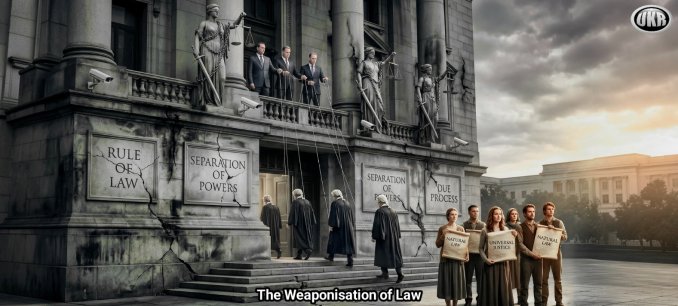
A Structural History of Power Disguised as Justice – and Why Natural Law Offers a Way Out – Part 2 (b)
CONSCIENTIOUS CURRENCY

This is Part 2 (b) of my series “The Weaponisation of UK law”. Please find Part 2 (a) here in case you need to first read it or refer back to it. You will also be able to link back to Part 1 from there.
This Part 2(b) article applies the conceptual groundwork established in Part 2(a) to the doctrine of parliamentary sovereignty and its supposed constitutional limits. Part 2(a) demonstrated that governance by consent is structurally impossible within a rule‑over system, and that legality functions as a cultural mechanism for legitimising hierarchical power. This Part 2(b) examines how these dynamics operate in practice by turning to one of the most frequently celebrated cases in English legal history: Entick v Carrington. The case is often invoked as evidence that the rule of law constrains state power. Yet when understood within the architecture of parliamentary sovereignty – the doctrine that ultimately defines and delimits all legal authority in the UK – Entick reveals something very different: the inherent fragility of legality in a system that claims unlimited law‑making power.
Legal Parliamentary Sovereignty as a Doctrine of Hierarchical Power
Legal parliamentary sovereignty is widely regarded as a core principle of our constitution. Often described as the cornerstone of our uncodified constitutional framework, it underpins our legal and political system.
The English constitution, being uncodified, is not written in a single document but is drawn from statutes, common law, conventions, and authoritative works. Consequently, theoretical disagreements persist regarding the nature of legal parliamentary sovereignty, with various philosophical debates vying to establish their constitutional theories as containing the definitive interpretation.
These debates, however, all share a foundational assumption: that Parliament possesses legitimate authority to impose laws on the population without their voluntary consent. Hence any theoretical disagreements about our constitutional model are internal to the system and none of them confront the structural reality that parliamentary sovereignty is not a democratic principle, but a doctrinal justification for hierarchical rule‑over.
Before turning to Dicey’s classical formulation of parliamentary sovereignty it is necessary to outline the main constitutional theories that attempt to explain or justify this doctrine, and show why none escape its coercive foundations
Competing Interpretations of Legal Parliamentary Sovereignty and Their Shared Assumptions
1.1 Legal Constitutionalism
This theory treats the constitution as a legal framework grounded in statutes, common law, and judicial decisions, such as those from landmark cases (e.g., Entick v Carrington). Parliamentary sovereignty is its central pillar: Parliament may make or unmake any law, and courts cannot strike down primary legislation. Its proponents are legal scholars like A.V. Dicey, who formalised the doctrine of parliamentary sovereignty.
As legal constitutionalism openly entrenches rule‑over, it collapses legitimacy into legality, assuming that obedience is a moral duty. It also ignores the absence of genuine consent.
1.2 Political Constitutionalism
This view holds that constitutional accountability is political, not legal. It presupposes that Parliament is constrained by elections, conventions, and political pressure, rather than by courts and rigid legal rules, viewing our constitution as a political construct, emphasising the role of political institutions over courts.
Its proponents are scholars like J.A.G. Griffith and Adam Tomkins, who argue that political accountability is more democratic than judicial supremacy.
Political constitutionalism merely replaces legal absolutism with political absolutism. It treats elections as consent, (where none exists), and executive dominance as democratic oversight, (which it is not), masking hierarchy behind the language of accountability.
1.3 Common Law Constitutionalism
This theory posits that our constitution is grounded in common law principles developed by judges over centuries. It argues that fundamental rights and constitutional principles (e.g., the rule of law) are protected through judicial decisions rather than solely through statutes, and that the common law may constrain Parliament in extreme cases.
Amongst its key features are that courts can assert constitutional principles, as seen in cases like R (Jackson) v Attorney General [2005], which questioned the limits of parliamentary sovereignty, and that the rule of law is a central pillar ensuring government acts within legal bounds. It also recognises that judges may protect “constitutional statutes” (e.g., European Communities Act 1972, Human Rights Act 1998) as having special status. Its proponents are judges like Lord Bingham and academics like Trevor Allan.
Whilst on the surface this interpretation appears to empower judges, common law constitutionalism still presupposes Parliament’s ultimate authority. Judicial “limits” remain symbolic, not structural, and cannot meaningfully restrain rule‑over. This theory also fails to recognise that judges can be politicised and therefore could be part of the problem.
1.4 Mixed or Balanced Constitutionalism
This perspective sees our constitution as a hybrid, blending legal, political, and historical elements. It acknowledges the interplay between parliamentary sovereignty, the rule of law, and constitutional conventions. Its proponents are scholars like Vernon Bogdanor.
Whilst this theory blends elements of the constitution, it never questions the foundational premise that Parliament may rule without consent. It describes the system only; and fails to challenge its legitimacy.
1.5 Republican Constitutionalism
This theory critiques the monarchical and hierarchical elements of our constitution, advocating for a more republican framework. It questions the role of unelected institutions like the monarchy and House of Lords. Amongst its key features it calls for a codified constitution to clarify rights and limit executive power. Its proponents are reformist groups and some academics.
The structural flaw with this theory is that it seeks to redistribute power within the hierarchy only, not dismantle it. It assumes rule‑over can be made legitimate through reform, rather than recognising that hierarchy itself is the problem – see America and its current problems.
1.6 Traditional/Historical Constitutionalism
This view emphasises the historical evolution of our constitution, rooted in ancient documents (e.g., Magna Carta 1215, Bill of Rights 1689) and customary practices. It values continuity and tradition. Its key features are that the constitution is organic, evolving through precedent and practice, but that institutions like the monarchy and parliament are central due to their historical legitimacy. Its proponents are mainly traditionalists and some conservative scholars.
This view treats inherited hierarchy as natural and legitimate, and therefore this theory sanctifies power rather than scrutinising it. In this way tradition becomes a shield for coercion.
Manner and form constitutionalism
Manner and form constitutionalism is not typically treated as a wholly separate constitutional theory, but it is closely related to some existing theories. It is best understood as a specific perspective or sub-theory within broader frameworks, focusing on how Parliament can impose procedural or substantive restrictions on its legislative process. It is worthy of note because it seeks to modify the traditional doctrine of parliamentary sovereignty and posits that Parliament, whilst sovereign, can impose procedural (manner) or substantive (form) requirements for enacting or repealing certain laws, which future Parliaments must follow for the legislation to be valid. For example, requiring a referendum or supermajority to amend a constitutional statute (e.g., Human Rights Act 1998), or specifying wording or processes, as seen in The Parliament Acts 1911 and 1949, which limit the House of Lords’ veto.
Manner and form theory draws on cases like Attorney-General for New South Wales v Trethowan [1932] (a colonial case upholding procedural requirements) and judicial hints in R (Jackson) v Attorney General [2005], where the UK courts suggested parliamentary sovereignty might respect such constraints.
However, whilst manner and form modifies procedure, it leaves untouched the core assumption that Parliament may impose laws without consent. It therefore only changes the mechanics of rule‑over, and not its nature.
Summary regarding constitutional theories
Despite the differences in all the above constitutional theories, they ultimately share a circular logic: they debate how parliamentary sovereignty should be interpreted but never question why such authority should exist at all. Each theory begins by assuming the legitimacy of rule over and ends by reinforcing it, because none of them confront the foundational myth of governance by consent. Whether framed as legal, political, historical, judicial, or republican, every interpretation of our constitution ultimately preserves the same hierarchical structure in which Parliament claims the right to rule and the people are expected to obey. Our constitution is therefore not a neutral framework but an ideological device that sustains hierarchy, and the competing theories surrounding it serve only to mask, not resolve, the absence of genuine governance by consent at its core. I recognise that this will be uncomfortable for those who look to our constitution as something capable of saving us. However, it cannot do so while its foundational premise remains rule over rather than rule with; and unless this structural flaw is acknowledged, we will always return to the very conditions that created our present crisis.
Political Parliamentary Sovereignty
Alongside legal parliamentary sovereignty sits what is often called political parliamentary sovereignty – the idea that Parliament’s authority depends on public acceptance/consent. But this is not consent in any meaningful sense; it is simply the practical reality that laws cannot be enforced against a population that refuses to obey them. Political sovereignty therefore exposes, rather than resolves, the core problem underpinning our constitution: the system relies on obedience, not consent, and obedience is maintained through a mixture of habit, fear, propaganda, and behavioural manipulation.
Historical moments such as the Poll Tax riots, the English Civil War, or modern mass disobedience show that when obedience collapses, legal parliamentary sovereignty becomes unenforceable. This does not mean, however, that the people are sovereign; it simply means the state’s authority is contingent on mass compliance. The governance structure understands this fragility, which is why it invests heavily in nudging, framing, and fear‑based messaging to manufacture the appearance of consent.
Popular constitutionalism is sometimes invoked to suggest that the people shape constitutional meaning, but this is largely rhetorical. It operates entirely within the same hierarchical framework as every other constitutional theory, and never questions the legitimacy of rule over. It is therefore another narrative device that obscures the absence of genuine consent.
Political parliamentary sovereignty does not, therefore, challenge legal parliamentary sovereignty; it simply reveals its dependence on obedience and the lengths to which the state will go to secure it. It is not a safeguard but a reminder that the system’s stability rests on manufactured acquiescence, not democratic legitimacy.
Dicey’s parliamentary sovereignty
We return now to legal constitutionalism and the classical view of parliamentary sovereignty as articulated by Dicey. His view remains the default framework for Parliament’s own self‑understanding, as reflected in its official publications. MPs and peers operate on the assumption that Westminster has supreme legal authority.
In An Introduction to the Study of the Law of the Constitution (1885), Dicey articulated three propositions:
- Parliament can make or unmake any law whatsoever.
- No person or body, including the courts, can question the validity of an Act of Parliament.
- No Parliament can bind its successors.
Dicey’s doctrine is not a description of democratic authority; it is a legal articulation of hierarchical power. It presupposes obedience, not consent, and treats the population as subjects, not sovereigns. His view therefore suggests that even a law that violates fundamental rights would be valid if it was passed by Parliament, and that no court could overturn it. There is commentary on this below, by examination of the fictitious Blue Eyed Baby problem.
Dicey’s framework has been interpreted to support and install the idea that parliamentary sovereignty is absolute, with no legal limits at all on what Parliament can legislate. This view has been reinforced by cases like Pickin v British Railways Board [1974], where the House of Lords affirmed that courts cannot challenge the validity of primary legislation – an act of parliament.
Dicey’s theory operates on rigid absolutism. It is the clearest expression of rule‑over and it assumes Parliament’s commands are binding simply because they are enacted. It therefore denies any role for the governed in legitimising those commands.
In his book, “The Sovereignty of Parliament: History and Philosophy” (1999), Jeffrey Goldsworthy defends a version of Dicey’s traditional view of parliamentary sovereignty, arguing that it is a legal principle deeply rooted in our constitutional history. However, he accepts procedural constraints as theoretical possibilities but maintains that courts cannot override Parliament. In this way Goldsworthy’s defence only serves to reinforce the doctrine’s hierarchical origins and history becomes a justification for power, not a limit on it.
As somewhat of a small counter to Goldsworthy, in her book: “Parliamentary Sovereignty and the Human Rights Act” (2009), Alison Young does not directly challenge the notion of parliamentary sovereignty as an absolute authority, but she does examine how to reconcile the Diceyan view of parliamentary sovereignty with legal protections afforded by the Human Rights Act. She argues for a “democratic dialogue” model, where parliament and the judiciary share constitutional responsibility, particularly concerning The Human Rights Act, which she posits facilitates dialogue between parliament and the courts, where each institution contributes to the protection of human rights in a way that complements the other’s role.
However, Young’s “dialogue” presupposes mutual respect between institutions, and NOT consent from the governed. She fails to recognise that elections do not constitute genuine consent and that judicial declarations do not limit Parliament’s power. Her model therefore only softens rhetoric and never softens hierarchy.
In “The Sovereignty of Law: Freedom, Constitution and Common Law” (2013), Trevor Allan argues that while parliamentary sovereignty is a key principle of our constitution, it is ultimately subordinate to the rule of law. He posits that the rule of law provides the overarching framework for understanding and interpreting the constitution, including the concept of legislative supremacy. Hence, parliamentary sovereignty is secondary to the rule of law, and the latter is grounded in common law principles upheld by the judiciary. He contends that courts could, in extreme cases, refuse to enforce legislation that fundamentally undermines constitutional values, such as access to justice or democratic rights.
Allan’s theory challenges the notion of absolute parliamentary sovereignty, but in essence it merely relocates supremacy from Parliament to judges WITHIN a hierarchical structure. It therefore replaces one unelected authority with another, and does not address the absence of consent.
The Blue‑Eyed Babies Example – What It Really Shows
Leslie Stephen’s famous hypothetical – a Parliament that orders the killing of blue‑eyed babies (Leslie Stephen, The Science of Ethics, 1882) – is often used to argue that Parliament’s power is limited by morality, public resistance, or judicial refusal.
Consider if Parliament passed a new act, through both houses of parliament gaining royal assent, meaning it became law in the UK. It is called The Blue Eyed Babies Act 2026 and s1 states that any baby born with blue eyes will be subject to destruction at the earliest possible opportunity. This asks us to think about whether such a morally reprehensible law would be disregarded by the people and the judiciary.
I take Stephen’s point in his hypothetical to be not that the people are sovereign, but that legal authority depends on obedience, not legitimacy. This of course reveals that a system that requires the population to refuse obedience to prevent atrocity is not a system grounded in consent. It is instead a system grounded in coercion, where refusal is an act of resistance and not a constitutional safeguard.
Judicial developments around parliamentary sovereignty
Judicial developments may appear to support a more constrained view of legal parliamentary sovereignty. Cases such as Jackson, Thoburn v Sunderland City Council [2002], and R (UNISON) v Lord Chancellor (2017) are often cited as evidence of this, but these interventions:
- do not invalidate Acts of Parliament
- do not bind future Parliaments
- do not create genuine limits
- do not establish popular sovereignty
They are expressions of judicial discomfort, not constitutional power. Hence, whilst judicial dicta may hint at moral limits they cannot impose legal ones and the courts remain subordinate to Parliament in law, even when they resist in rhetoric. Diceyan orthodoxy further enables Parliament to assume unchecked legal authority, ignoring both judicial and public accountability. The tension is clear: Parliament’s belief in its own supremacy inevitably risks overreach. Always.
We see from all of the above that the various constitutional theories and judicial interventions discussed deal only with interpretation of our constitution, never with the foundational flaw of the hierarchical system upon which the constitution itself is built. These debates are therefore always circular: they begin and end within the boundaries of a model that presupposes rule over, and they inevitably reinforce the very structure they claim to analyse. In practice, they are deeply unhelpful because they frame the conversation in a way that excludes the real question – the legitimacy of rule over itself. Anyone engaging in these debates is required, consciously or not, to accept the hierarchical premise as correct before the discussion can even begin. Whether this selective framing is deliberate or simply the product of cultural conditioning is almost beside the point; it functions exactly as behavioural science predicts, keeping people within an Overton window that prevents them from identifying, let alone solving, the root problem.
To help avoid being drawn into this circularity, it is worth remembering the following:
All interpretations of our constitution, despite their differences, share a single foundational assumption: that Parliament possesses legitimate authority, (parliamentary sovereignty), to impose laws on the population without their voluntary consent.
None of the theories address:
- the absence of genuine consent
- the coercive foundations of state authority
- the role of propaganda, fear, and obedience
- the structural impossibility of rule with in a hierarchical system
- that parliamentary sovereignty is not a democratic principle, but a doctrinal justification for rule over
Parliamentary sovereignty is not a neutral constitutional rule but a claim of absolute authority rooted in hierarchy, not consent. Its legitimacy depends on obedience, not moral justification. This is the architecture that Part 2(a) of this article explored and I have tried to show above how all constitutional theories, embody this. Below I discuss Entick v Carrington to reveal how constitutional myths are constructed to disguise this reality.
Entick V Carrington (1765): Its Supposed Constitutional Legacy
In 1765, the case of Entick v Carrington emerged as a defining moment in English legal history, cementing the principle that the state’s power is not absolute but must be grounded in clear legal authority. A dispute arose when Nathan Carrington, a messenger of the King, and three others broke into the home of John Entick, a radical writer and publisher, in Stepney, London. Acting under a warrant issued by the Earl of Halifax, the Secretary of State, they searched Entick’s property, seized his papers, and caused significant damage. The warrant, issued to investigate seditious libel, was general in nature, lacking specificity about the place to be searched or the items to be seized. Entick sued for trespass, arguing that the search was unlawful and that the state had no legal authority to invade his private property.
The case was heard in the Court of King’s Bench before Lord Camden, the Chief Justice, whose judgment is often presented as a foundational statement of constitutional principle, despite it operating entirely within a hierarchical framework. Camden ruled in Entick’s favour, awarding him £300 in damages. His reasoning was unequivocal: the state, even through its highest officials, could not act without express legal authority. The warrant issued by Halifax was invalid because it lacked statutory or common law backing. Camden famously declared, “If it is law, it will be found in our books. If it is not to be found there, it is not law.”
This statement is often taken to express the principle of legality, though in reality it merely requires the executive to act within the boundaries of laws made by the sovereign power itself. Hence, it can only ever regulate how power is exercised, not whether that power is legitimate. It is therefore crucial to recognise that Camden’s judgment, for all its principled clarity, operated entirely within the hierarchical structure of our constitution. It restrained the executive, but it did not – and could not – restrain Parliament. Entick therefore represents the outer limit of judicial protection in a system where ultimate authority rests not with the people, but with the sovereign legislature. It was a remedy within a flawed system, not a challenge to the system itself.
Lord Camden’s judgment rested on two key findings. First, he rejected the government’s claim that ‘state necessity’ could justify the search, dismissing the idea that executive convenience could override individual rights. Second, he emphasised that the state could not invade private property without clear legal authority. His language about the ‘great end’ of society securing property reflected the political philosophy of his time, but it did not establish any genuine social contract between governance and the people. It simply articulated the limits of executive power within the legal framework created by Parliament. The ruling invalidated general warrants and curtailed one form of arbitrary executive action, but it did not – and could not – challenge the sovereign power that could authorise such intrusions if it wished to, via primary legislation.
Entick exposed the tensions of an era in which the government sought to suppress dissent, and Camden’s judgment imposed a legal check on one form of executive intrusion. But it did nothing to restrain the sovereign power that could authorise such intrusions in the first place. Parliament remained free, (and still does), to legislate away the very protections Entick articulated and this is the real lesson of this case: its principles endure only for as long as, and at the pleasure of, a doctrine that claims unlimited law‑making authority.
Entick did, of course, leave us with a legacy – that government (the executive) cannot intrude upon private property without explicit legal justification. This precedent has therefore shaped subsequent legal protections against unlawful searches and seizures, in both British and American legal traditions. Entick underscored the necessity of judicial oversight in preventing government overreach – a doctrine that remains relevant in contemporary legal disputes. Yet this is precisely where the deeper structural problem emerges. Entick’s protections were always contingent, always vulnerable, and always subject to erosion. A hierarchical system can tolerate judicial pushback only so long as it does not conflict with sovereign power. Parliament retains the ability to override, narrow, or abolish the very principles that Entick articulated. This is why Entick cannot be understood as a constitutional safeguard, but rather as a constitutional myth – a story we tell ourselves to believe that the system contains limits, even though those limits evaporate whenever the state decides they must.
The conditions that led to the Entick ruling are observable in today’s modern society, particularly in cases involving the arrest of journalists and the confiscation of their recording and writing equipment. A recent legal battle in May 2025 illustrates this. Journalist Asa Winstanley faced police raids that resulted in the seizure of his computers, phones, and other devices – an act widely criticised as an infringement on press freedom. However, in a judgment reminiscent of Camden’s decision, London’s Central Criminal Court ruled on 13 May 2025 that the search warrants used in the raid were unlawfully issued. The court ordered the return of all seized devices, reaffirming Entick’s legal protections against arbitrary searches.
The similarities between the Entick and Winstanley cases demonstrate the ongoing tension between state authority and individual rights. In both instances, judicial intervention played a role in upholding the principle that government actions must be justified within the bounds of the law. In this sense the 2025 ruling serves as a modern-day affirmation of Camden’s doctrine: the state cannot violate legal protections against unwarranted intrusion, especially when such actions threaten press freedom. However, the parallel between these cases, one in 1765 and one 260 years later, only serves to reveal the same structural truth: judicial victories occur only at the margins of power, and only when they do not threaten the complete architecture of rule‑over. The point being that the state’s power to legislate away such protections remains intact and Entick’s principle survives only at the pleasure of a Parliament regarded as fully sovereign and able to legislate what it likes.
Another notable example of Entick’s influence in the modern era is R (Gillan) v Commissioner of Police for the Metropolis [2006], where the House of Lords considered the legality of stop-and-search powers under the Terrorism Act 2000. The claimants argued that the broad discretion granted to police violated the principle of legality, echoing Entick’s rejection of vague executive authority. Although the House of Lords upheld the powers, the European Court of Human Rights( ECtHR) later ruled in Gillan v United Kingdom [2010] that the measures were insufficiently precise, affirming the need for clear legal limits on state power. The ECtHR criticised the broad discretion granted to police officers, noting that the powers allowed searches without reasonable suspicion, creating a risk of arbitrariness. The ruling reinforced the principle that state power must be clearly defined and subject to legal constraints, echoing the concerns raised in Entick about vague executive authority.
Entick has also been invoked in cases involving surveillance and privacy. In R (Catt) v Association of Chief Police Officers [2015], the Supreme Court considered whether the retention of personal data by police was lawful. The court’s analysis drew on Entick’s principle that state intrusions into private life must be justified by law, highlighting the case’s relevance to modern issues of data protection and surveillance. The Supreme Court ultimately upheld the police’s retention of data, ruling that it was proportionate and necessary for public safety. The judgment emphasised, however, that data collection must be lawful, necessary, and proportionate. Interestingly, the case later reached the European Court of Human Rights (ECtHR) in Catt v United Kingdom [2019], where the court found a violation of Article 8, ruling that the retention of data was not justified – particularly information relating to peaceful protest – lacked sufficient safeguards, was not necessary in a democratic society, and created a “chilling effect” on the individual’s freedom of expression.
Taken together, these cases reveal a pattern: Entick’s principle is invoked when convenient, narrowed when inconvenient, and can be overridden whenever Parliament chooses. This is not a failure of the courts; it is a feature of a hierarchical system in which legal protections exist only at the pleasure of sovereign power. Entick therefore demonstrates not the strength of constitutional safeguards, but their fragility – and the inevitability of their erosion in a system built on rule over rather than rule with.
Entick demonstrates to us that even the most principled judicial decisions cannot cure the structural flaws within a hierarchical system: particularly the inevitable drift toward authoritarianism whenever the state deems it necessary. The judgment may have restrained executive excesses of its day, and continues to be relevant in this sphere in modern times, but it could not, and can never, restrain sovereign power to legislate without true consent, whether by Monarch or Parliament. This then reveals a deeper truth: Entick exists only because the system that produced it also produces the abuses it seeks to remedy. It is a corrective within hierarchy, not a challenge to hierarchy itself. In a system grounded in genuine consent rather than rule over, a case like Entick would be unnecessary, because the power to invade, seize, and coerce would never be claimed in the first place. The very necessity of Entick is in fact proof of our constitutional model’s failure, not its success.
So, although Entick is often celebrated as a triumph of the rule of law, this celebration reveals a deeper problem. The rule of law in a hierarchical system does not restrain sovereign power; it restrains only the executive’s methods of exercising that power. Parliament can override, narrow, or abolish the very principles that Entick articulated, and modern statutory frameworks – from surveillance laws to Henry VIII powers – demonstrate how easily legality can be manufactured to justify intrusion, or whatever else is desired. Entick is invoked as proof that the system contains safeguards against this, even as those safeguards are steadily eroded. Therefore, its status as a “cornerstone” of liberty must be viewed as part of constitutional myth‑making that obscures a structural reality: in a system built on rule over, legality can always be rewritten to authorise the very abuses Entick sought to prevent.
This is a truth that runs through every part of our constitutional architecture: even the most celebrated judicial victories operate entirely within a system built on dominance. Entick’s protections will always be contingent, vulnerable, and subject to erosion by a body that claims the right to legislate without genuine consent. The case is not, therefore, evidence of a constitution that safeguards liberty, but evidence of a system that periodically needs to correct its own abuses in order to preserve the appearance of legitimacy.
This pattern is not unique to Entick. It is woven into the very fabric of our constitutional design. The doctrines most often invoked as safeguards – the rule of law, the separation of powers, judicial review, constitutional conventions – all operate within the same hierarchical framework. They regulate the manner in which power is exercised but never question the authority that makes such power possible. They are internal mechanisms of control, not external checks on legitimacy, and their existence reflects the system’s capacity for overreach, not its capacity for restraint.
In the next article in this series, I will turn to two of the most revered constitutional principles: the rule of law and the separation of powers. Both are widely believed to protect the public from arbitrary authority. Both are treated as constitutional cornerstones. And yet both contain the same structural flaw exposed here: they assume the legitimacy of rule over and attempt only to moderate its excesses. When examined closely, they reveal not safeguards against authoritarianism, but the mechanisms through which a hierarchical system maintains itself while claiming to protect those it governs.
Understanding this is essential. Without confronting the structural reality that power in this country flows downward, not upward, we will continue to mistake temporary restraints for genuine limits, and constitutional myths for genuine protections. My next article will show why these myths endure, how they function, and why they must be dismantled if we are ever to imagine a system grounded in true consent rather than obedience.
Part 3 of this series will be published shortly with a link back to this article. In the meantime, thank you for taking the time to read this article. This is a complex subject and I have done my best to simplify it and present it in plain English so that readers can better understand matters and come to their own conclusions
If you found this article valuable or learned something new, you can support my work by buying me a coffee – if you wish to and can afford it. The link is Buy Me a Coffee, or you can copy and paste the URL directly: https://buymeacoffee.com/claredwillb
You can also subscribe to this Substack for free to access all my previous and future work.
See you all again soon!
This article (The Weaponisation of Law) was created and published by Clare Wills-Harrison and is republished here under “Fair Use”

••••
The Liberty Beacon Project is now expanding at a near exponential rate, and for this we are grateful and excited! But we must also be practical. For 7 years we have not asked for any donations, and have built this project with our own funds as we grew. We are now experiencing ever increasing growing pains due to the large number of websites and projects we represent. So we have just installed donation buttons on our websites and ask that you consider this when you visit them. Nothing is too small. We thank you for all your support and your considerations … (TLB)
••••
Comment Policy: As a privately owned web site, we reserve the right to remove comments that contain spam, advertising, vulgarity, threats of violence, racism, or personal/abusive attacks on other users. This also applies to trolling, the use of more than one alias, or just intentional mischief. Enforcement of this policy is at the discretion of this websites administrators. Repeat offenders may be blocked or permanently banned without prior warning.
••••
Disclaimer: TLB websites contain copyrighted material the use of which has not always been specifically authorized by the copyright owner. We are making such material available to our readers under the provisions of “fair use” in an effort to advance a better understanding of political, health, economic and social issues. The material on this site is distributed without profit to those who have expressed a prior interest in receiving it for research and educational purposes. If you wish to use copyrighted material for purposes other than “fair use” you must request permission from the copyright owner.
••••
Disclaimer: The information and opinions shared are for informational purposes only including, but not limited to, text, graphics, images and other material are not intended as medical advice or instruction. Nothing mentioned is intended to be a substitute for professional medical advice, diagnosis or treatment.
Disclaimer: The views and opinions expressed in this article are those of the author and do not necessarily reflect the official policy or position of The Liberty Beacon Project.


Leave a Reply