

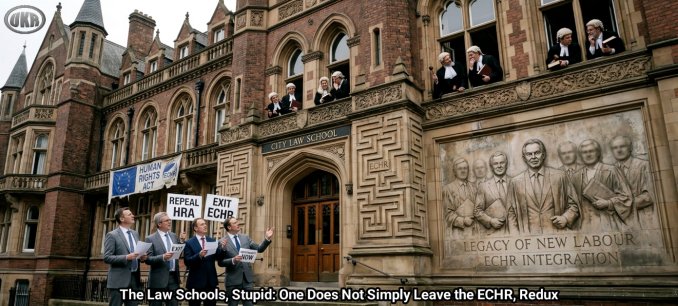
The Law Schools, Stupid
One does not simply leave the ECHR, redux
DAVID MCGROGAN

‘Law’s empire is defined by attitude, not territory or power or process.’
Ronald Dworkin
It has been a week or two of great political excitement here in the UK, as a third of the country has been busy electing which set of people gets to organise bin collections and make life difficult for motorists in their local area for the next however-many-years.
Buried beneath all of the flim-flam surrounding these events was a report issued by the Reform-adjacent think-tank the Prosperity Institute on the subject of leaving the European Convention on Human Rights (ECHR) and repealing the Human Rights Act 1998 (HRA). Precisely because it was rather buried, it received little attention that I can see; this is a shame, as it makes a sensible, good faith attempt to set out in black and white what a centre-right Parliament might do to legislate its way out of the human rights settlement brought in by Blair and his lawyerly cronies in 1998.
The problem with sensible, good faith attempts to set out in black and white what a centre-right Parliament might do in respect of anything, however, is that what such a Parliament will do will involve law-making, and the people interpreting and applying the laws that are made will be doing it not in good faith, but in bad. This is nowhere more true than in relation to human rights law, as I will explain later. And this brings us to one of the biggest problems in British public life – one almost entirely ignored in mainstream political discussion – which is the radicalisation of law schools. This is a process which really began in earnest in the 1960s but came to full fruition in recent decades, and it is set to bedevil any future government which seeks to unwind its effects.
The full story behind these developments is waiting to be told (and, indeed, if there are any publishers reading this and willing to pay me a handsome fee – I will settle for an unlimited tab at the Springbank distillery shop – I am happy to tell it), but in essence the problem is that generations of law students have been educated in a system which has been defined by its adherence to the daft notion that there is a connection between law and what the American legal scholar Ronald Dworkin called ‘principles’.
Dworkin, by some distance the most influential legal philosopher of the second half of the 20th century, fixated – like most jurisprudes of his era – on the question of law’s authority. Why do people obey the law? Well, it must be because they consider it to be legitimate. But where does legitimacy come from? Remember, to the 20th century liberal mind, it cannot be because law derives from natural right, much less from underlying custom or tradition (or ‘nomos’). It has to be for some other reason. For Dworkin, the answer came in the form of what he called ‘integrity’, which, roughly translated, means everybody thinking like a New York Times-reading East Coast liberal.
The idea, you see, is that law’s legitimacy derives from its accordance with certain fundamental, reasoned-out values (the aforementioned ‘principles’) which are those which underpin and inform the society in question. Law is not mere rules, and actually rules could and should be departed from where necessary to find accordance with the deeper ‘principles’ on which society was founded. Thinking of law as a ‘rule book’ would be to result in something ‘shallow and attenuated’, as it would be based only on ‘negotiation’ through the political, legislative process. What Dworkin envisaged was rather a ‘society of principle’ in which individuals ‘accept that they are governed by common principles, not just by rule hammered out in political compromise’.
Dworkin portrayed himself as mild-mannered and reasonable. When you read his (at times impenetrable but always carefully spelled-out) prose, you are lulled into thinking that no right-thinking person could possibly disagree with the perfect good sense that is on display. It is only when you consider this idea for a moment that you realise how both simultaneously stupid and sinister it is. Judges are arrogant tossers (if you pardon me stating the matter so plainly) at the best of times. Now imagine telling them that their task is not to apply rules ‘hammered out in political compromise’, but to think of themselves as engaging on a quest to identify and give effect to fundamental ‘principles’ that form the very foundations of their society, and that they are to ignore consistency so as to be (as Dworkin put it) ‘wide ranging and imaginative’ in making their decisions.
The result is not so much Law’s Empire, as Dworkin’s most famous book (published in 1986) was called, but something more like a Judicial Empire, in which judges get to think of themselves as rising above mere politics to discover overarching values which are not just moral, but upon which their very society is founded. This is a recipe for sheer kritarchy or rule-by-judges, and is just about the most profoundly anti-political and anti-democratic way of looking at government as can possibly be imagined. In terms of family resemblance it is not actually all that far removed from the ideas of the Khmer Rouge (who abolished rules altogether in the name of giving judges free rein to pursue the imperatives of revolutionary justice) – the main difference being that, thankfully, Dworkin’s disciples were a bit more polite and a bit more comfortable, in their book-lined offices on university campuses, than the Cambodian peasantry of the 1970s.
Judges, then, are supposed not to get themselves too caught up in abiding by silly, piffling rules dreamed up by legislators carrying out political horse-trading. That risible ‘shallowness’ is just a sideshow. What judges are supposed to do is give ‘wide ranging’ and ‘imaginative’ judgments founded on their enlightened understanding of fundamental principles. And Dworkin ultimately seemed to be of the view that if only everybody was sensible and reasonable they would agree not only on what those fundamental principles were (these would, he thought, inevitably be what he called ‘equal concern and respect’), but also what they meant. And, as it of course turned out, this agreement would align very closely – in fact identically – with his own view of the world.
The picture that emerges from Dworkin’s work is a society whose founding value is ‘equal concern and respect’, but which cannot leave the realisation of this value to politicians, and definitely not to legislators or rules. It is, rather, expert judges, inculcated with a profound understanding of what ‘equal concern and respect’ means and blessed with insights into how to achieve it in any given case, who are to take the lead. It is grudgingly conceded that it is is helpful to have written rules for people to follow in their daily lives, but ultimately it is judges who are in charge, if I can put it this way, of actualising what is potential in a society founded on ‘equal concern and respect’, and bringing about complete concordance between – or integration of – law and principle.
Dworkin was immensely influential on both sides of the Atlantic. His work is perhaps slightly less widely read than it would have been, say, twenty or thirty years ago, having been transcended by more radical movements making the same case in a more extreme way. And he spawned surprisingly few successors. But this hardly matters: legal scholars, and more importantly the students they taught and who have now gone on to become lawyers and judges themselves, lapped up his doctrine. And it is not hard to see why. Lawyers, and especially judges, are terribly fond of imagining themselves to be wise and important. What Dworkin did was to give them license to think of themselves not as quotidian resolvers of disputes between litigants, but as ‘imaginative’ knights-errant in the service of ‘principle’, riding out on horseback on a quest to integrate law with the foundational values of their society – as determined by themselves. And they loved the idea.
Human rights law in general and the Human Rights Act 1998 are of course imbued with the Dworkinian understanding of the role of the judge. The quintessence of the entire project is that political decisions, and the rules that political leaders make, are always contingent on what judges think of them. Rules are made and then judges implement them in ‘wide-ranging and imaginative’ ways, or don’t really implement them at all. They interpret them as they see fit, sometime by flying in the face of what the text actually says. And, when even the most strained interpretation cannot achieve the desired result, they either strike the rules down as unlawful (in the case of delegated legislation) or declare them ‘incompatible’ with human rights. The judiciary gets to decide what the law should be. And in doing so they assume the mantle of shaping society – it is they, not politicians, who guide us towards unity around the values which we purportedly share.
The idea that repealing the HRA would solve this problem is, sadly, implausible, for the simple reason that judges do not see it as a problem at all. And we know this because of what they were doing before the HRA was enacted, and what they have been doing throughout the course of its existence, which is giving effect to so-called ‘common law constitutionalism’. The idea behind this is that the common law contains, and has contained since time immemorial, a list of fundamental rights that are akin to those found in the HRA anyway – and that, since this is the case, even if the HRA had never been enacted, or were to be repealed, the common law would do the same job in the end.
There is not sufficient space here to write at length about the development of this concept – I have written about the idea of common law rights elsewhere in any event (and these posts may also be enlightening) – but you will understand the import. If the HRA is repealed, the judiciary will not lose their Pharisaical intoxication with the vision of themselves as guardians of principle. They will just find other means to give effect to the type of ‘wide-ranging and imaginative’ judgments they wish to hand down. They will not use the language of human rights. Instead they will say things like, ‘It is a long-standing principle of the common law that x reason means law y must be interpreted in fashion z’, and achieve their desired ends in that way. They will convince themselves that in doing so they are speaking truth to power. And they will do this on the implicit, Dworkinian assumption that they are ultimately applying not rules, but principle.
Anybody doubting this simply needs to cast their minds back to the heady days of September 2019, when Brexit fever was at its height and it felt like political war had broken out over the fate of the country. Boris Johnson, recently chosen as Tory leader and therefore Prime Minister, took the decision to prorogue Parliament for a month (from somewhere between 9th-12th of September to 14th October) as a way to break out of a Parliamentary deadlock caused by a concerted mass of MPs who were determined to engage in any kind of shenanigans possible to thwart the UK’s exit from the EU. It was a quintessentially political decision and, constitutionally, decisions about prorogation of Parliament are always political in that they are taken by the Crown, which in our country really means the government. This means that up until 2019, they had never even been touched with a barge pole by judges.
But in the case of R (on the application of Miller v The Prime Minister [2019] UKSC 41 the ‘legality’ of Johnson’s decision to prorogue fell to be determined by the Supreme Court nonetheless. A group of what Lord Denning would have called ‘meddlesome busybodies’, led by Gina Miller, made the claim that the prorogation was unlawful because it had been exercised to avoid Parliamentary scrutiny of Ministerial decision-making over Brexit. And the Supreme Court agreed. Despite the fact that the decision to prorogue was a self-evidently political decision, and despite the fact that there was literally no precedent of prorogation having ever been a justiciable matter in Parliamentary history, the Court found that Johnson to have acted unlawfully.
But crucially, it did not find his actions unlawful by applying rules – there were none to apply. (The House of Commons library had only two months prior informed interested observers that ‘[the prorogation] process has been a formality in the UK for more than a century: the Government of the day advises the Crown to prorogue and that request is acquiesced to’, and that was that.) Rather, the Supreme Court applied principle in a (shall we say?) ‘wide-ranging’ and ‘imaginative’ way. British readers will remember Brenda Hale appearing on TV screens in a bizarre and gigantic spider brooch to hand down the judgment of the Court, and may also remember some of the words she used [at Paras. 38-39]:
38. In principle, if not always in practice, it is relatively straightforward to determine the limits of a statutory power, since the power is defined by the text of the statute. Since a prerogative power is not constituted by any document, determining its limits is less straightforward. Nevertheless, every prerogative power has its limits, and it is the function of the court to determine, when necessary, where they lie. Since the power is recognised by the common law, and has to be compatible with common law principles, those principles may illuminate where its boundaries lie. In particular, the boundaries of a prerogative power relating to the operation of Parliament are likely to be illuminated, and indeed determined, by the fundamental principles of our constitutional law.
39. Although the United Kingdom does not have a single document entitled “The Constitution”, it nevertheless possesses a Constitution, established over the course of our history by common law, statutes, conventions and practice. Since it has not been codified, it has developed pragmatically, and remains sufficiently flexible to be capable of further development. Nevertheless, it includes numerous principles of law, which are enforceable by the courts in the same way as other legal principles. In giving them effect, the courts have the responsibility of upholding the values and principles of our constitution and making them effective. It is their particular responsibility to determine the legal limits of the powers conferred on each branch of government, and to decide whether any exercise of power has transgressed those limits. The courts cannot shirk that responsibility merely on the ground that the question raised is political in tone or context.
You will not have missed the nakedly Dworkinian nature of that reasoning. Judges do not apply rules. They ‘uphold values and principles’. This conveniently situates them as the arbiters of what those ‘values and principles’ are, of course. And you will also not have missed the pompous, self-aggrandising portrayal of the judiciary as taking on a great ‘responsibility’ in adopting this role, as if Hale and her cronies were not positively slavering at the lips at the prospect of taking such an apparently momentous political decision as they were. To reiterate: this is the judiciary imagining themselves not as rule-enforcers or even rule-interpreters but as the driving force behind law-as-integrity. Their job is not to apply rules. It is to give effect to ‘principle’ – as determined by themselves, and in light of what they think is the appropriate way to make it real.
What this will ultimately means is that when a centre-right government is eventually in power and Parliament begins to try to legislate its way out of the New Labour constitutional settlement, it will simply not be enough to change the law as it exists on paper. What exists in paper is rules. Principles exist in the ether – or, perhaps I should say, in judges’ minds. And this means that law as it is decided will be bent to serve interests entirely outside of the political or legislative process. It will be bent towards the service of ‘principle’. And you can be sure, as eggs are eggs, that it will very, very often be found that fundamental principles of the common law mean that centre-right governments cannot have nice things.
And this will force, or should force, people at think-tanks like the Prosperity Institute to confront more important questions. Clearly, governments have to do things in the short-term and it is crucial to think those decisions through. But the UK judiciary of 2026 is the product of decades upon decades of inculcation by law students into the belief that – simply put – judges are both more important than they really are, and that lawyers as such are blessed with superior insight to that of the hoi polloi because they happen to have an LLB. This issue far transcends, in importance, the matter of what the law actually ‘says’. But I can see nobody devoting any serious attention to it in the circle where it matters most.
This is partly, no doubt, because it is all a bit difficult. Legislative change is easy. Turning around the mindset within an academic discipline is not. But it is what has to happen to achieve meaningful change. And since meaningful change is what the country desperately needs, it is about time that thinking people devoted more thought to the deeper issues underlying the predicament we find ourselve in.
This article (The Law Schools, Stupid) was created and published by News from Uncibal and is republished here under “Fair Use”

••••
The Liberty Beacon Project is now expanding at a near exponential rate, and for this we are grateful and excited! But we must also be practical. For 7 years we have not asked for any donations, and have built this project with our own funds as we grew. We are now experiencing ever increasing growing pains due to the large number of websites and projects we represent. So we have just installed donation buttons on our websites and ask that you consider this when you visit them. Nothing is too small. We thank you for all your support and your considerations … (TLB)
••••
Comment Policy: As a privately owned web site, we reserve the right to remove comments that contain spam, advertising, vulgarity, threats of violence, racism, or personal/abusive attacks on other users. This also applies to trolling, the use of more than one alias, or just intentional mischief. Enforcement of this policy is at the discretion of this websites administrators. Repeat offenders may be blocked or permanently banned without prior warning.
••••
Disclaimer: TLB websites contain copyrighted material the use of which has not always been specifically authorized by the copyright owner. We are making such material available to our readers under the provisions of “fair use” in an effort to advance a better understanding of political, health, economic and social issues. The material on this site is distributed without profit to those who have expressed a prior interest in receiving it for research and educational purposes. If you wish to use copyrighted material for purposes other than “fair use” you must request permission from the copyright owner.
••••
Disclaimer: The information and opinions shared are for informational purposes only including, but not limited to, text, graphics, images and other material are not intended as medical advice or instruction. Nothing mentioned is intended to be a substitute for professional medical advice, diagnosis or treatment.
Disclaimer: The views and opinions expressed in this article are those of the author and do not necessarily reflect the official policy or position of The Liberty Beacon Project.


Leave a Reply