

Steel blues
The Government’s new steel strategy is stupid and destructive
ANDY MAYER
The Government’s new steel strategy will not save the industry, but will cause long-term harm.
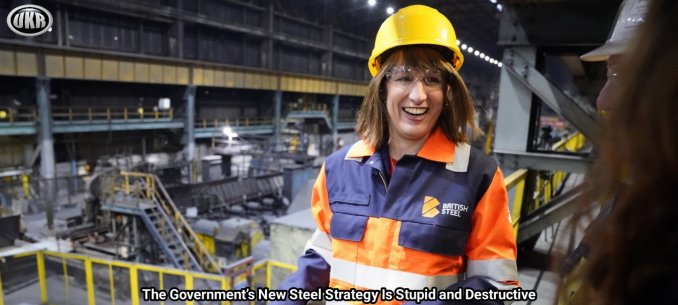
Their intervention will ensure that the main sites stay open and there will be photographs — hard hats, sparks, hi-vis jackets, national pride — they practically stage themselves. Yet none of this alters the underlying reality: that steel is a globally traded commodity business where costs decide everything, and Britain has chosen, quite deliberately, to make itself a high-cost place to produce it.
Consider energy. UK industrial electricity prices are among the highest in the developed world — often multiples of those in the United States and well above much of Europe. Add in relatively expensive labour, land use constrained by regulation, and a rising cost of capital driven by persistent government borrowing, and you have a simple truth: British steel is uncompetitive because Britain is uncompetitive.
Ministers know this. Which is why the strategy does not attempt to fix those costs. Instead, it attempts to hide them. The centrepiece is tariffs of up to 50 per cent on imported steel. This is presented as a way to “level the playing field”, yet it does no such thing. It tilts the entire pitch against British industry.
A tariff does not make domestic production cheaper. It makes everything using steel more expensive. Since the UK imports most of the steel it uses, the immediate effect is to raise costs across the economy — construction, manufacturing, infrastructure, defence. Every sector that uses steel becomes less competitive overnight.
Maybe this isn’t like tilting the playing field. Maybe it’s like breaking most of the players’ legs.
At this point, defenders of the policy reach for a familiar line: we must save strategic industries. Possibly, although when the French define yoghurt as strategic, the Italians handbags, and the Chinese have strategic pork reserves, it isn’t the most compelling argument.
If, further, your definition of “saving” an industry is to make all of its customers poorer while leaving its underlying cost base untouched, then this is a triumph. If, however, you mean making it capable of competing without permanent protection, then this policy does the opposite.
There is no shortage of evidence here. The Trump-era steel tariffs in the United States did protect some domestic capacity. They also raised input costs for manufacturers and are widely estimated to have destroyed more jobs in steel-using industries than they preserved in steel production. Britain, being smaller and more open, is not likely to escape that arithmetic.
Another defence follows quickly: other countries do this too. They do. And they pay for it too! The existence of bad policy elsewhere is not a compelling case for making the same mistake. If anything, it should prompt the opposite conclusion: that a relatively open economy like Britain benefits more than most from resisting the temptation.
The Government’s second move is to subsidise the industry directly, with £2.5 billion from the National Wealth Fund — an institution more accurately described as a National Debt Fund, which is borrowing money from future taxpayers. This, mind you, is only the beginning. Subsidies create dependencies, dependencies create expectations, and expectations create lobbies.
Here the strategy becomes circular. Lobbies demand tariffs. Tariffs raise prices. Higher prices weaken downstream industries. Weakened industries demand support. Support is financed through borrowing. Borrowing pushes up interest rates. Higher rates weaken investment. And so on — we call it “ratchet intervention” and it’s a major cause of the British cost disease.
The policy is soaked in a technological illusion. Ministers insist that the future lies in electric arc furnaces and “green steel”. Electric arc furnaces have their place, but they recycle scrap. They do not, in any meaningful sense, replace primary steelmaking based on iron ore. A country that moves entirely to EAF production is not securing sovereign steel capacity. It is becoming dependent on past production — and on global scrap markets.
Besides, electric arc furnaces are electricity hungry. To insist on EAF-led renewal while maintaining some of the highest industrial electricity prices in the world is contradictory and self-defeating.
If ministers wished to support steel seriously, they would start with costs — particularly energy. That would mean confronting the accumulation of net zero policy costs embedded in UK electricity prices, from levies to network charges, and rethinking the constraints on domestic energy supply, from North Sea production to onshore fracking, and possibly mining for coking coal.
None of this is easy but it is at least relevant. Instead, we have chosen what looks like the smoother path: subsidise the symptom, ignore the cause, and declare success.
There is precedent here. In the 1970s, governments across the developed world attempted to preserve industrial capacity through protection and subsidy. The results were consistent: industries that survived, but did not improve; jobs that were delayed in their disappearance, but not saved; and public finances that carried the cost.
Eventually, as always, reality reasserted itself. The only question is whether adjustment happens early and gradually, or later and abruptly. The steel strategy opts firmly for the latter. It will preserve a version of the industry — smaller than advertised, more expensive than acknowledged, and permanently dependent on political support. A zombie sector animated by policy rather than competitiveness.
Zombies, as a rule, are hard to kill. They require constant feeding, and they have a habit of biting the rest of the economy.
Alas, Britain can have a competitive economy, or it can have the appearance of a protected steel industry. It cannot, on these terms, have both.
This article (Steel blues) was created and published by The Critic and is republished here under “Fair Use” with attribution to the author Andy Mayer
See Related Article Below
Tariffs will not save Britain’s steel industry
ELIOT WILSON
The Government’s approach to the UK’s steel industry has always looked like a cross between inveterate, unshakeable optimism and the panicked thrashings of a drowning man clutching for a flotation aid.
An extremely charitable observer would argue that the Government had always had a very clear aim: to preserve Britain’s steel industry in order to safeguard employment in the sector and to provide resilience in manufacturing a product vital for growth and security.
A more cynical mind might counter that someone who makes a wish as a penny is flipped down a well has a very clear aim. Without a practical, sustainable and realistic plan to achieve that aim, such airy, wouldn’t-it-be-nice ambitions are politically worthless at best.
This week the Business and Trade Secretary, Peter Kyle, unveiled Labour’s latest gambit. From July, import quotas for tariff-free steel will be reduced by 60%, and imports above those levels will be subject to a 50% tariff. In other words, when facing a crisis, the Government’s response is protectionism.
It is not alone in this. The exclusionary regime brings the UK broadly into line with the United States, the EU and Canada. That does not necessarily mean it is the right approach, but we should not underestimate the challenge facing the Government. It had already agreed to provide £500 million towards the expected total cost of £1.25 billion of Tata Steel building electric arc furnaces at its steelworks in Port Talbot.
At the same time, under the Steel Industry (Special Measures) Act 2025, last April ministers took control of Jingye-owned British Steel and its steel plant at Scunthorpe to save it from imminent closure. That has come at an enormous cost: as of the end of January, the Government had spent £359 million in nine months on ‘working capital, covering items such as raw materials and salaries’ – in other words, simply keeping the facility open. It is not difficult to see that figure rapidly reaching half a billion pounds.
Here is the fundamental problem. The Government is guided by a declaration of what it wants to be the case. As Kyle put it:
‘We are closing the decades-long chapter of destructive deindustrialisation and committing instead to strengthening and sustaining Britain as a steelmaking nation.’
That does not mean it is an achievable end. Fundamentally, as the United States Supreme Court has recently indicated to President Trump, tariffs are a form of taxation and sooner or later the financial burden will fall on the domestic consumer. Tariffs artificially insulate industry from the reality of market forces, which can drive up costs, discourage efficiency and act as a deadweight on innovation and progress. If the government is hobbling your competitors with financial levies, why try harder?
It is clear that the UK’s steel industry cannot compete on the global stage without state assistance – or, to use a less niminy-piminy phrase, taxpayer-funded subsidies. That means every taxpayer is being charged to keep the industry alive. Under those circumstances, it is necessary to ask why UK steel is uncompetitive, and whether it is right to keep the sector afloat artificially.
Business energy costs in Britain are among the highest in the world, and, especially with blast furnaces, steelmaking has a ravening hunger for energy. Tariffs do nothing to address that, but instead attempt to balance an existing disadvantage for the UK sector with a newly introduced artificial one for its competitors abroad. But this only levels prices upwards: it does nothing to make British steel more affordable or more efficiently produced, merely penalising the lower costs borne by foreign manufacturers (and, in some cases, offsetting the subsidies they are granted by their own governments).
The traditional counterargument is that steel has a particular strategic value and necessity in ‘defending critical industries and national security’, as Gareth Stace, Director General of trade body UK Steel, phrased it. This presupposes that the UK could in extremis find itself unable to import steel of the required kind, both for infrastructure projects and for defence programmes. It is an argument that has potency but is not a slam-dunk, and its acceptance begs another question: if we must retain a sovereign steel industry free from outside intervention, is there therefore no ceiling on what we must be prepared to pay for it?
This is not so much a strategy as a sticking plaster. Rather than address the reasons underlying UK steel’s relative inability to compete with international producers, the Government is heaping heavier costs on their overseas rivals in the hope it will lead to some kind of equilibrium. But in the final analysis, the sector will either be competitive or it won’t. If it is unable to compete on the world stage, for whatever reason, then we cannot adopt a goal – allowing it to survive financially – without some notion of the limits of that.
When means follow declaratory policy, it can become very expensive very quickly. After all, the declaration need not compromise: it sets a non-negotiable destination and demands that a route be found. But the Government is lurching from one holding position to another.
Every day, solely to make sure British Steel’s Scunthorpe plant does not close, we are spending more than £1.2 million. That is expensive stasis. But it is no more simplistic or extemporising than the rest of the Government’s steel strategy. This crisis will not pass simply by asking consumers to pay more, at however many removes it may be. Yet that appears to be the extent of Whitehall’s thinking. It is not enough.
Click here to subscribe to our daily briefing – the best pieces from CapX and across the web.
CapX depends on the generosity of its readers. If you value what we do, please consider making a donation.
This article (Tariffs will not save Britain’s steel industry) was created and published by CapX and is republished here under “Fair Use” with attribution to the author Eliot Wilson


Leave a Reply