

PATRICK BENHAM-CROSSWELL
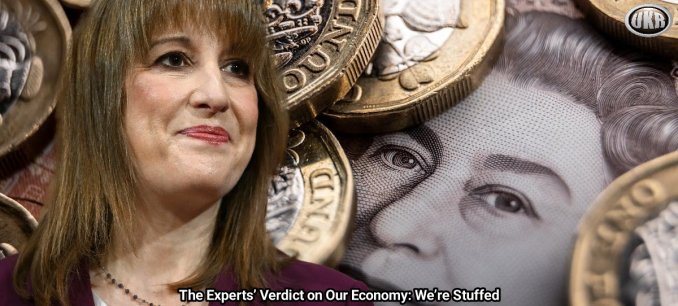
THE OLD joke runs that if you ask two economists a question you will get at least three answers. That wasn’t the case at a Growth Commission conference on ‘Mending Britain’s Broken Economy’ at the University of Buckingham. The unanimous view of the many eminent economists there (who included TCW writer Ewen Stewart) was that the UK’s economy is stuffed (industry term). There is no way the current economic trajectory can succeed, as illustrated below.

.
In last quarter-century the state’s employee headcount has increased by 20 per cent. That, of course, means an increased demand on the public purse (your taxes) to cover the payroll and the pensions. In 1999 government spending was 35 per cent of GDP; today it is 46 per cent. That spending comes from taxation or government borrowing. Successive governments have increased both. Of the £14billion of government debt issued last month, a staggering £13billion was spent on debt interest.
The government is taking more money and employing more people to deliver less stuff. The tax take has increased to the point of being a brake on the economy. Rachel Reeves’s policies have triggered capital flight and a worker exodus. The UK’s lamentable growth is amongst the lowest in G20 and G7. Were the UK a company it would have called in an administrator long ago.
The economists at the conference saw three routes out of the UK’s debt hole. Good luck, which they rated a 10 per cent probability, runaway inflation (50 per cent) or some financial crisis triggering default or an International Monetary Fund (IMF) intervention. They noted that the IMF lacks the funds to bail the UK out.
The solution to the problem is for the UK to start growing its economy. Rachel Reeves purports to understand this. But delivering growth requires investment capital and bank finance, above all for the UK’s small and medium enterprises (SMEs) which provide some 60 per cent of employment and 50 per cent of private sector turnover in the UK. And less regulation.
Unfortunately, as the speakers revealed, SMEs are being starved of capital in general and bank lending in particular. Since the 2008 financial crisis, UK bank lending to SMEs has fallen from 2 per cent of GDP to about 0.5 per cent. At the same time the banks’ holdings of UK gilts have risen massively and unhealthily.
Over-regulation was one of the key reasons cited for the poor performance of the UK. One American banking expert, Professor Jill Cetina, suggested that the UK needed more smaller banks rather than a few monoliths too big to be allowed to fail, plus a handful of challenger banks. She pointed out that Texas has many small banks (termed ‘community banks’) which are fundamental to the Texan oil-boom economy. Small banks can be allowed to fail as there is no risk of systemic collapse.
The new banking regulations won’t, can’t, remove emerging systemic risks. Worse, regulation protects market incumbents who can afford lobbyists and PR machines to maintain the status quo and stifle competition.
Make no mistake, the UK’s dire economic situation stems from a consistent lack of growth. That in turn comes from denying the engine room of the economy access to capital, a consequence of ill-considered regulations, for which the responsibility ultimately lies with Parliament. As most modern careerist politicians have little experience of finance (or much else for that matter), they rely heavily upon their civil servants for briefing on the decisions they must make.
Unfortunately those civil servants almost invariably lack experience of banking or the commercial world as they too are careerists – there is very little churn of non-civil servants into top jobs. While various quangos that run our lives, including the City of London and the finance industry, their masters remain in the Treasury. Despite the evidence, the civil service and the whole public sector believe in prescriptive regulation. (So of course does most of Westminster, politicians exist to pass laws and laws become regulations).
The economic orthodoxy has become one of seeking a managed economy, with a large state machine, concomitantly high taxes, low growth and ever more regulation. The conference was pretty much unanimous that this means the UK is in a self-inflicted death spiral. The actions required to change the UK’s trajectory are straightforward, a smaller state (requiring less tax) and a balanced budget (meaning no more borrowing). The last person to attempt this trajectory change in the UK was Liz Truss.
She gave a frank and forthright presentation on the dysfunctional split of the UK economy’s managers: the Bank of England, the Treasury and the Office of Budgetary Responsibility (OBR). They operate in splendid isolation from each other. Thus on the eve of the Truss mini-Budget the Bank blithely announced a £40billion quantitative tightening (QT) programme without first notifying the Treasury. QT is generally loss-making, so the Bank’s actions would have needed cash from the Treasury, who knew nothing of it. It also transpired that the Bank was aware of the Liability-Driven Investment (LDI) problem but had not deigned to share that information with the Treasury. (The LDI scheme got itself into a doom loop when the bond markets started to adjust to the new budget. That doom loop triggered forced sales of UK bonds, which the bank had to hoover up while the bond yield soared.) While the Bank is independent of the Treasury and Westminster, it’s exceptionally strange that it didn’t consider the implications and timings of its actions.
The Bank is independent. There was some disagreement between the assembled economists as to whether this was true, was a good thing or was fixable. After so much agreement, watching veteran economists going at each other hammer and tongs was entertaining. There was no consensus on whether changing the management structure of the Bank or giving it more or less autonomy would fix the UK’s economic problems.
That those problems derive from an incompetent, unaffordable large state is self-evident to anyone who can count. Reducing the size of the state is, unfortunately, politically difficult – not least because the ‘progressives’ (as some socialists now style themselves) have captured the vocabulary. Any attempt to cut the wasteful state is trumpeted as ‘austerity’, which is treated as a synonym of inhumane.
Worse, progressivism is embedded in British universities, with some 60 per cent to 80 per cent of staff ‘left wing’ or progressive. The general population is thought to be about 10 per cent progressive activist. As the civil service and large companies recruit graduates, it seems inevitable that the progressive agenda, already deeply embedded in industry, media and government, will become the majority view in the key organs of the economy, but not the population.
Whether the economically literate parties (those of the right) can win power in such an environment is an open question. Whether they could then force through the necessary changes is equally unknown.
The certainty is that if they don’t the UK’s future is bleak.
A longer version of this article appears on Views From My Cab and is republished by kind permission.
This article (The experts’ verdict on our economy: We’re stuffed) was created and published by Conservative Woman and is republished here under “Fair Use” with attribution to the author Patrick Bentham-Crosswell
See Related Article Below
Why a major crisis is about to hit the UK
(and how this could easily push us into an early general election)
MATT GOODWIN
Aside from watching my new book Suicide of a Nation rocket to Number 2 in the Amazon bestseller list – making it the second biggest selling book in Britain behind a children’s Easter book about a fluffy chick – I also spent this weekend watching something else.
Mounting evidence that Britain is about to be plunged into a major financial and political crisis, which could clear the way for an early general election.
I remember Nigel Farage telling me six months ago that he thought the next general election could arrive much sooner than 2029, potentially as early as next year.
I was sceptical.
But now, amidst the ongoing War in Iran and an intensifying energy crisis, I not only think Farage was right but am also coming to the view it could arrive even sooner.
Just look, for example, at the clearest warning sign of all: government debt.
Britain is currently spending somewhere around £140 billion a year just servicing our national debt – just paying off the interest on our country’s credit card.
Though you won’t hear much about it in Westminster, Britain is now spending more money each year servicing the interest on our national credit card than we are on things such as education, the Home Office, and even national defence.
It really is a disgrace and reflects decades of political mismanagement.
It is not normal. It is not sustainable. And it is now getting a lot worse.
Because the cost at which the state borrows has been soaring.
Last week, amid War in Iran, the UK government’s borrowing costs jumped above 5 per cent – the highest level since the global financial crash erupted in 2008.

And, no, this is not happening everywhere.
As one journalist noted yesterday, Britain’s ten-year gilt yields have risen by roughly twice as much as their equivalents in Germany and America, and by more than any other major country in Europe – except Italy. The Greeks can borrow money more cheaply than the Brits, which is really saying something.
Also, put this in domestic context.
When the BBC, Westminster, and much of the ruling class had a complete meltdown about the frenzied reaction to Liz Truss’s infamous budget, in autumn 2022, the rate was 4.54. Today, it’s just short of 5 per cent.
Yet where is the same meltdown?
In fact, the rates have consistently been higher than they were during the Liz Truss era for a long time. Back then, in 2022, we were repeatedly told the soaring cost of our debt represented a major and unique loss of market confidence in the economy.
Things could not possibly go on, they said. There must be a change of direction. There must be new leadership. So, if that was a crisis – then what is this?
Britain is currently nearly £3 trillion in debt – £3 trillion. And the blunt reality is that we are simply too weak to carry this amount of debt comfortably.
Our country is now trapped in an ever-tightening economic ‘doom-loop’ – with low or non-existent rates of growth and productivity resulting in high spending, high borrowing, the highest tax burden since World War Two, soaring energy prices that are fuelling stubbornly persistent inflation, and the spiralling cost of managing our very large pile of debt, which is making everything worse.
It is genuinely difficult to see how we get out of this.
Things were bad before the War in Iran; but now soaring energy bills, as a result of those supply chain shocks, are pushing us ever closer to a major financial crisis.
Last week, the consultancy Oxford Economics predicted that the British people’s household energy bills, already at historic highs, will surge by another 14 per cent from July, as higher oil and gas prices filter through to the domestic economy.
Because our hapless leaders in Westminster, captured by the Net Zero religion, refuse to make use of our own oil and gas supplies, we have become deeply and dangerously exposed to international fluctuations in energy prices, leaving our economy and the British people extremely vulnerable to any and every external shock.
Meanwhile, next month, the British people’s council tax, water, mobile phone, Internet, car tax, and even the cost of passports and stamps will all rise, too.
It really is not hard to see how this mounting financial crisis could soon push us into a major political crisis, too, colliding with trends that are already visible.
Keir Starmer’s Labour government is imploding. It’s not just that the prime minister is in office but no longer in power, as everybody can already see, from one backbench Labour rebellion to the next, from the departure of one advisor to the next.
It’s that the structural foundations that underpin the Labour Party are also rapidly giving way, setting the stage for even more political chaos.
I was pleased to have played a small role in this, defeating Labour as a Reform candidate in Greater Manchester, in one of their strongest heartlands.
Losing to the Greens and Reform in Gorton and Denton not only forced Labour MPs to acknowledge their party’s weakness but revealed how the deeper tectonic plates in British politics are now also on the move.
Our entire political system is now rapidly fragmenting, with the two old parties, Labour and the Tories, facing unprecedented pressure from a new politics.
Look, too, at the national polls.
Keir Starmer is not only the most unpopular prime minister since records began, and incredibly unpopular among his own Labour MPs; but public support for the Labour government has also collapsed, reflecting a broader loss of confidence.
In recent days, Labour slumped to 16 per cent with pollsters Find Out Now, 15 per cent with Verian, and 19 per cent with YouGov. These are truly dismal numbers.
More than one in three Labour voters have now fully decamped to other left progressive parties, mainly the Greens, while Labour is now also being taken apart by Reform in its working-class heartlands.
Alongside the looming financial crisis in the markets, this mounting political crisis will also intensify as we head towards a crucial set of local elections, on May 7th.
According to one academic forecast this week, Labour will lose nearly 2,000 local councillors – more than three in five that are up for election – while Nigel Farage and Reform will gain more than 2,200 and the Greens make modest gains.
It is difficult if not impossible to see how Keir Starmer hangs on after these losses.

Yet it is just as difficult to see how a successor to Starmer from within the Labour ranks, say Angela Rayner or Wes Streeting, would make much of a difference.
Financial markets do not just look at numbers; they look at political stability and the extent to which a government is able to take difficult decisions and do what needs to be done to deal with the underlying structural weaknesses in the economy.
If and when Starmer goes, the markets will inevitably demand major cuts to spending and borrowing, while many will call for a radically different approach to energy.
But none of this will be accepted by the vast majority of Labour MPs who, now faced with a populist Green opponent on their left-wing flank, will firmly oppose what they will no doubt call “austerity” and see as a climbdown from their Net Zero fanaticism.
Amid this chaos, I do not think it is entirely impossible that many Labour MPs will simply conclude that it makes more sense to bring down the Starmer regime and even go to the country than be seen by their own constituents, friends, and family to have to oversee a “right-wing economic agenda” they firmly oppose.
While the next general election does not have to be called until summer 2029, I just do not see how we continue along this path for much longer without the financial markets, alongside voters, calling time on not just Starmer but the Labour government.
Weak growth. Soaring debt costs. Repeated external shocks. And Labour politicians who are obviously unable to inspire public confidence and trust.
Put all these things together and you have the ingredients for something far more serious than a routine downturn or a “difficult set of local elections”.
You have the beginnings of a full-blown systemic crisis. A collapse of public confidence and public trust in not just a prime minister but an entire system.
And when that happens – triggered, for example, by the reaction to an auction in the financial markets, another spike in energy prices, a surge of inflation, another set of dismal growth figures, or a political crisis in and around Number 10 – then things will start to move very, very quickly and much faster than many people expect.
This is why I genuinely believe that an earlier-than-expected general election is already leaving the realm of speculation and entering reality. All the warning signs are flashing red. We are hurtling towards a financial crisis. Our economic model no longer makes any sense at all. And it is not hard to see, in the coming weeks or months, how the markets decide to call time on the Labour government.
As I said at the outset, when Nigel Farage took the stage at a conference last year and predicted a general election as early as 2027, I told him I was sceptical. I just couldn’t see the path to one. But now, I think he was, once again, ahead of the curve …

This article (Why a major crisis is about to hit the UK) was created and published by Matt Goodwin and is republished here under “Fair Use”


Leave a Reply