

JENNIFER CAWTHORNE
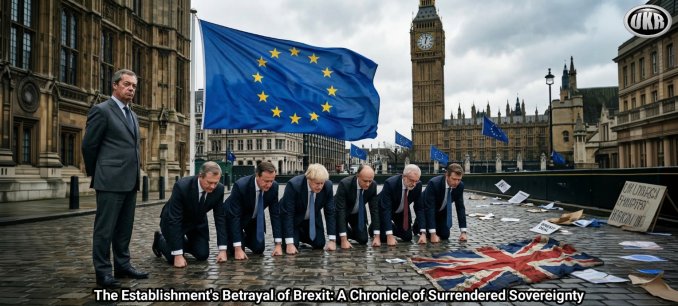
In June 2016, the British people delivered a resounding mandate for sovereignty. With 52 per cent voting to leave the European Union, despite a ferocious, highly mendacious Remain campaign by the State, the referendum was a rejection of supranational control over borders, laws, and trade. Brexit promised the restoration of parliamentary supremacy, control over immigration, and the freedom to forge independent global partnerships. Yet, since that historic vote, the Establishment has systematically undermined this democratic will. From Theresa May’s dilatory negotiations to Boris Johnson’s flawed, submissive, deal, and now Keir Starmer’s insidious “reset,” the trajectory has been one of betrayal.
From the perspective of British sovereignty, each step has eroded the UK’s independence. And now Labour’s current drive towards reunion in all but name, including the perilous military entanglements, threatens total submission, even though the EU’s declining vitality, growing unpopularity across the continent, the prohibitive costs of any re-engagement apparent to all except the wilfully blind, as is the fact that binding UK to a faltering globalist entity rendered obsolete by the rise of Trumpian nationalism and Chinese assertiveness is a malicious act of betrayal.
The betrayals began almost immediately after the referendum. Theresa May, who assumed the premiership in July 2016, invoked Article 50 in March 2017, ostensibly to commence withdrawal. However, her approach was marked by concessions that prioritised EU demands over British interests. The Chequers plan of July 2018 proposed a “common rulebook” for goods, effectively aligning UK regulations with EU standards indefinitely. This would have shackled Britain to EU rules without influence, undermining sovereignty by subordinating domestic law-making to Brussels. Worse, the Irish backstop in the Withdrawal Agreement trapped Northern Ireland in the EU customs union, creating a regulatory border in the Irish Sea and fracturing the UK’s territorial integrity. May’s deal, defeated thrice in Parliament, represented a profound betrayal: it preserved EU oversight on trade and borders, negating the referendum’s core promise of “taking back control.”
Parliament itself compounded this treachery. Between 2017 and 2019, a Remain-dominated House of Commons obstructed Brexit through procedural machinations. The Benn Act of September 2019 forced an extension of Article 50, delaying departure and allowing EU leverage to extract further concessions. This parliamentary sabotage, often framed as “democratic scrutiny,” was in reality an elite effort to dilute or reverse the vote. Sovereignty, meant to reside in the people via referendum, was usurped by MPs who prioritised personal ideologies over the electorate’s directive.
Boris Johnson’s ascension in July 2019 promised renewal. Campaigning on “Get Brexit Done,” he secured a landslide in December 2019. Yet, his Withdrawal Agreement, ratified in January 2020, retained the Northern Ireland Protocol, which subjected Northern Ireland to EU customs rules and checks on goods from Great Britain. This internal border compromised UK unity, allowing the European Court of Justice jurisdiction over parts of British soil—a direct assault on sovereignty. Johnson’s Trade and Cooperation Agreement (TCA) of December 2020, while tariff-free, imposed non-tariff barriers and regulatory alignment in key areas, limiting divergence. Fisheries, a symbol of reclaimed sovereignty, saw only modest quota increases, far below promises, leading to accusations of betrayal from coastal communities.
Under Rishi Sunak, who became Prime Minister in October 2022, the Windsor Framework of February 2023 purported to resolve Protocol issues. It eased some checks but preserved EU law’s application in Northern Ireland, with the Stormont Brake offering limited veto power. This tinkering failed to restore full sovereignty; Northern Ireland remained partially integrated into the EU single market, eroding the UK’s constitutional coherence. Sunak’s government also pursued regulatory alignment in sectors like chemicals and data, stifling opportunities for independent policy-making. These actions perpetuated a half-Brexit, where Britain paid lip service to independence while clinging to EU structures.
The Establishment’s duplicity extended beyond Westminster. Civil servants, many with pro-EU leanings, influenced negotiations towards softer outcomes. Media outlets and think tanks amplified narratives of Brexit “chaos,” fostering public doubt and paving the way for reversal. Economic forecasts, often exaggerated, were weaponised to undermine confidence in sovereignty. By 2024, polls showed shifting sentiments, not due to inherent flaws in Brexit, but from relentless elite framing of post-referendum challenges as Brexit-induced.
Keir Starmer’s Labour government, elected in July 2024, has accelerated this erosion. Starmer, a former Remain advocate, pledged no rejoining but has pursued a “reset” that amounts to reunion in all but name. Bilateral deals with France and Germany in 2024-2025 deepened ties, while the May 2025 UK-EU summit yielded agreements on agriculture, emissions trading, and electricity markets—each entailing regulatory convergence. Labour’s manifesto promised to “deepen ties,” but actions reveal intent: exploring a youth mobility scheme, akin to free movement for the young, and aligning with EU rules in select sectors. Chancellor Rachel Reeves has signalled openness to “further integration” via sectoral alignment, while cabinet figures like Wes Streeting hint at a customs union. This incremental creep subordinates British policy to EU norms, without democratic input.
Most alarmingly, Labour’s military entanglements pose a sovereignty trap. The Security and Defence Partnership (SDP) signed in May 2025 opens doors to UK participation in EU defence initiatives, including the Security Action for Europe (SAFE) fund. Initial talks for SAFE collapsed in November 2025 over financial demands, but Starmer has expressed willingness to join future rounds, potentially committing billions. This “military trap” integrates UK forces into EU structures, risking subordination to Brussels’ command and eroding NATO primacy. Starmer’s ambition for a UK-EU security pact, including joint procurement, would entwine British defence with EU policy, leading to total submission. Sovereignty demands independent military decision-making; Labour’s path cedes this to a supranational entity, betraying Brexit’s ethos.
The 2026 TCA review looms as a pivotal betrayal. Labour views it as an opportunity for deeper ties, potentially including customs union elements, despite manifesto denials. Starmer’s January 2026 openness to alignment “in the national interest” signals reversal. A “Farage clause” in negotiations, compensating the EU for potential UK withdrawal, underscores the punitive nature of re-engagement. This reset, framed as pragmatic, is a stealthy surrender, aligning Britain with EU rules without veto or voice.
Such moves ignore the EU’s dire condition. Despite Eurobarometer claims of 74 per cent perceiving benefits from membership, nationalist parties surge across the continent. In 2025 elections, Germany’s AfD gained dramatically, Portugal’s Chega became parliament’s second-largest force, and Czechia’s far-right triumphed. Approval ratings mask disillusionment: a 2025 Pew survey showed favourable EU views at 62 per cent median, but declining in key nations. The EU grapples with legitimacy crises, as seen in France’s governance woes and Romania’s far-right setbacks. Economically stagnant, it faces deindustrialisation from Chinese overproduction and US protectionism.
Re-engaging would cost Britain dearly. Estimates suggest a customs union could forfeit £40 billion annually in lost output, preventing independent trade deals. Full rejoining might reverse some Brexit losses—allegedly 6-8 per cent GDP since 2016—but at the price of billions in contributions and regulatory shackles. The EU’s divorce settlement alone cost £30.2 billion; re-entry would demand similar outlays. This binds Britain to a “globalist corpse,” obsolete amid Trump’s “America First” tariffs and China’s trade dominance. Trump’s policies push allies towards Beijing. China, naturally, exploits this, reshaping trade blocs while the EU stagnates. Surveys show global perceptions of China’s rise, eclipsing a ruptured Western order.
The Establishment’s betrayals have transformed Brexit from liberation to limbo. Labour’s reunion push, veiled as reset, risks total capitulation. Britain must reject this, reclaiming true sovereignty against a decaying EU and a multipolar world.
This article (The Establishment’s Betrayal of Brexit: A Chronicle of Surrendered Sovereignty) was created and published by Free Speech Backlash and is republished here under “Fair Use” with attribution to the author Jennifer Cawthorne

••••
The Liberty Beacon Project is now expanding at a near exponential rate, and for this we are grateful and excited! But we must also be practical. For 7 years we have not asked for any donations, and have built this project with our own funds as we grew. We are now experiencing ever increasing growing pains due to the large number of websites and projects we represent. So we have just installed donation buttons on our websites and ask that you consider this when you visit them. Nothing is too small. We thank you for all your support and your considerations … (TLB)
••••
Comment Policy: As a privately owned web site, we reserve the right to remove comments that contain spam, advertising, vulgarity, threats of violence, racism, or personal/abusive attacks on other users. This also applies to trolling, the use of more than one alias, or just intentional mischief. Enforcement of this policy is at the discretion of this websites administrators. Repeat offenders may be blocked or permanently banned without prior warning.
••••
Disclaimer: TLB websites contain copyrighted material the use of which has not always been specifically authorized by the copyright owner. We are making such material available to our readers under the provisions of “fair use” in an effort to advance a better understanding of political, health, economic and social issues. The material on this site is distributed without profit to those who have expressed a prior interest in receiving it for research and educational purposes. If you wish to use copyrighted material for purposes other than “fair use” you must request permission from the copyright owner.
••••
Disclaimer: The information and opinions shared are for informational purposes only including, but not limited to, text, graphics, images and other material are not intended as medical advice or instruction. Nothing mentioned is intended to be a substitute for professional medical advice, diagnosis or treatment.
Disclaimer: The views and opinions expressed in this article are those of the author and do not necessarily reflect the official policy or position of The Liberty Beacon Project.


Leave a Reply