

LAURIE WASTELL
Should the Equality Act 2010 be scrapped? Last week, Reform UK set the cat among the pigeons in the Leftie Blob by pledging to do just that. Suella Braverman, Reform’s new Shadow Education and Skills Secretary, said Britain is being “ripped apart by diversity, equality and inclusion” and promised to “build a country defined by meritocracy not tokenism”. Readers will not be surprised to hear that I heartily agree, and I set out some reasons why in the Spectator:
For one thing, it has encouraged untold vexatious complaints in the workplace. A recent report by Don’t Divide Us found a seven-fold increase in employment discrimination claims around race between 2016-17 to 2023-24, despite just 5% of claims being successful over the whole period. The Act’s focus on personal identity and victimhood encouraged a grievance culture, it found, which far from easing racial tensions was only exacerbating them further.
In particular, it is the Act’s Public Sector Equality Duty and “positive action” wheezes which have made it a vehicle for systematic discrimination against less politically favoured groups – whites and men. While the Act outlaws ‘positive discrimination’, where minorities are explicitly hired preferentially, it doesn’t outlaw “positive action”, where minority groups get special outreach programmes, which we’re supposed to think is fair and unobjectionable. But as those would-be airmen know, this is really a distinction without a difference. If you’re giving a leg-up to some groups to increase ‘diversity’, you’re not giving them to others. “Institutions should be held accountable for treating people fairly rather than hitting artificial demographic targets’” says James Orr, Reform’s new head of policy.
I added:
While critics will no doubt try to paint Equality Act reform as extreme, the policy hits a healthy middle ground. Orr explains: “The Equality Act consolidated pre-existing legislation on disability, sex and race discrimination. Reform UK supports the predecessor legislation and unequivocally opposes discrimination based on protected characteristics.”
Much as I predicted, Keir Starmer himself furiously waded into this debate with nasal sound and fury, denouncing Reform’s plan as “shocking” and against “basic values”, and even suggesting that wanting to repeal it was un-British.
Typical Starmerite intellectual dreck. This damaging, unpopular law, rushed through Parliament at the fag end of the Brown premiership, is hardly Magna Carta.
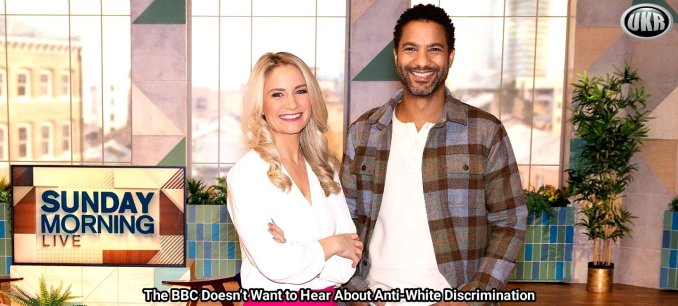
Still, the comment gave the debate extra legs, and so it was that I found myself invited onto BBC One’s Sunday Morning Live, a “faith and ethics debate show” which airs after Laura Kuenssberg’s politics programme.
I would be debating Nels Abbey, who once wrote a book called Think Like a White Man, and Sharan Dhaliwal, a journalist. On my side would be Alka Seghal Cuthbert, director of the campaign group Don’t Divide Us. This was nice, as I had sourced a quote from Alka in my Spectator piece, while readers will recall her appearance on the Sceptic last year on DDU’s report on the Equality Act and the problems with it.
I was the only guest joining down the line. In my first answer this may have helped, as I was able to explain at some length and without interruption that contrary to Starmer’s suggestion that Reform wanted to rip up protections going back “decades”, the “Public Sector Equality Duty” and “positive action” mean the Equality Act is a whole new ball game.
The Equality Act encourages public bodies to socially engineer their workforce to make it more ‘diverse’. The effect has been widespread and persistent discrimination against white males. Prospective RAF airmen were called ‘useless white male pilots’. How is this fair?@bbcsml https://t.co/m43Wym7BJ2 pic.twitter.com/styYH1qDkh
— Laurie Wastell (@L_Wastell) February 22, 2026
It took a little while for the discussion to return to me – I had no real opportunity to butt in over Zoom – so I had to bide my time for my next (and final) comment. Alka had mentioned that diversity targets cut against meritocracy, which Abbey objected to.
But this is true, and so in my second comment I explained that public sector diversity drives had undermined recruitment processes in many public sector institutions. This is a very serious problem, undermining operational competence and more in the very institutions that have power over us and are expected to serve and protect us. Perhaps the most glaring example is in the Metropolitan Police, which has been carrying out obsessive diversity drives in recent years.
As former Met officer Paul Birch explained in Daily Sceptic last year:
Police forces nationwide shout from the rooftops about the proportion of BAME recruits being successfully enrolled. Numbers and percentages are declared like Soviet tractor production figures. But they’re much more reticent to publish the disciplinary and misconduct statistics which result from this lack of diligence in the vetting procedures.
I pointed to three examples: last month, it emerged that the Met had hired through a diversity scheme a suspected child rapist who had failed vetting.
As the Telegraph explained:
More than 100 applicants who initially failed vetting procedures were later allowed to join after their cases were referred to a special panel set up to scrutinise rejected applications from ethnic minority candidates, and help the force meet diversity targets.
They included PC Cliff Mitchell, who was recruited despite having being accused of raping a child. His application was initially rejected, but this decision was overturned. He was later convicted of 13 counts of rape, including six against a child.
In 2023, no less an authority than the police inspectorate found that having lowered standards as part of a diversity drive, the Met had serving officers who were “functionally illiterate”. And like many forces, the Met has significantly lowered its fitness requirement, principally to allow more women into the force (of course, this also allows in more unfit men).
Unfortunately, though I had been allowed to set out my stall in my first answer well enough while I remained in the technical details of the act, I wasn’t to be allowed to get away with noting something so outrageous to BBC sensibilities, albeit so demonstrably true. Thus presenter Shaun Fletcher, far from chiding Abbey not to interrupt me, followed his lead by demanding to know what “evidence” I had. I told him I had just produced some (the point about vetting), and then went on to list the other two examples. But Fletcher jumped in again and threw it over to Abbey, the bulk of whose response was a rather bizarre disquisition about the Financial Crisis being the fault of white men. What this had to do with the Met’s hiring standards was not altogether clear.
All in all, I was pleased to be invited on and to be able to strike a note of dissent that I daresay is rare at the national broadcaster. For her part, Alka sensibly noted how divisive the notion of “protected characteristics” is and how the legislation had caused employment grievance complaints to spiral. But the quality of the respondents felt rather low. As my mother, excited to see me on the BBC, nevertheless remarked: “It felt as though you and your colleague [Alka] were on Newsnight and the other two were on the One Show.”
Stop Press: For a deep look into Reform’s Equality Act proposals, readers may enjoy my discussion with the Prosperity Institute’s Fred de Fossard for the Sceptic, out Friday.
This article (The BBC Doesn’t Want to Hear About Anti-White Discrimination) was created and published by The Daily Sceptic and is republished here under “Fair Use” with attribution to the author Laurie Wastell


Leave a Reply