

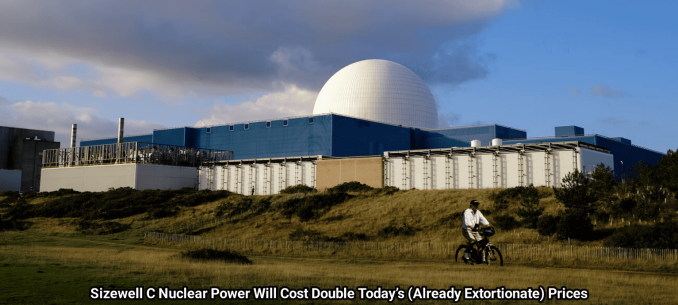
Electricity sourced from UK nuclear power at Sizewell C will cost DOUBLE today’s (already extortionate) prices
also-costs twice as much and takes twice as long as Korean nuclear reactors with less output
PETER HALLIGAN
From here:
Sizewell C power to cost almost double today’s prices
“Estimates suggest that the power Sizewell C produces will cost £120 per megawatt hour (MWh) in today’s prices, compared with the current wholesale price of about £60 to £70. The extra costs will be added to energy bills.
“It is understood to be the first time Sizewell C’s power output has been costed. It refers to the so-called “strike price”, which is likely to be awarded to the nuclear power station under the contracts for difference system. This is where generators get a guaranteed minimum price for electricity, whatever the market value.
The cost is then covered by a levy on consumer bills, meaning it effectively acts as an energy subsidy.
“However, critics have raised concerns that prices for nuclear will continue to rise, arguing that early estimates for constructing power stations are always significant underestimates.”
“They have pointed to Sizewell C’s predecessor, Hinkley Point C, where original costs of £18bn have soared to £50bn – a figure announced last week – with start-up delayed from 2026 to 2031.
“The report also warned that consumers were likely to be charged more than the £120 per MWh rate because the strike price was calculated net of all the tax, business rates and other payments to the Government.
“Prof Stephen Thomas, the editor-in-chief of Energy Policy, an academic journal, said: “Sizewell is an appalling waste of electricity consumers’ and taxpayers’ money. If you want to justify a premium price for nuclear, you have to estimate the costs of achieving the same factors – energy security and reliability.
“Alison Downes, of Stop Sizewell C, a local campaign group, said: “Hinkley’s cost has soared to £50bn with completion dates slipping and five years still to go. Sizewell C’s costs will rise higher still when it inevitably overruns its £40bn construction budget.”
Let’s grab some context from Brave AI:
“Hinkley Point C construction began in March 2017, following the final investment decision by EDF in July 2016 and UK government approval in September 2016. The first concrete was poured on the site in March 2017, marking the official start of construction. The project, which involves building two EPR reactors, is now expected to be completed around 2030, with Unit 1 projected to come online by the end of the decade.”
Two EPR reactors…3.2 gigawatts, .1.6 gigawatts each.
“Hinkley Point C nuclear power plant in the UK, with a capacity of 3.2 gigawatts, 1. Gigawatts each
A comparison with Korean nuclear power stations:
“Hinkley Point C has seen its projected cost rise dramatically, with estimates now reaching £48 billion (€51.4 billion, $64.7 billion), more than triple the original £18 billion forecast. This cost increase stems from delays, inflation, complex engineering challenges, and regulatory hurdles, with construction now expected to begin generating electricity between 2029 and 2031.
“In contrast, South Korea’s APR-1400 reactors, such as those built at the Barakah Nuclear Power Plant in the UAE, demonstrate significantly lower costs and faster construction.
“ The Barakah plant, consisting of , was completed in less than eight years, with a total cost of approximately $32 billion—a per-megawatt cost much lower than Hinkley Point C due to standardized design, mass production, established supply chains, and lower regulatory and labor costs.
“Key differences include:
- Construction speed: South Korea builds APR-1400 reactors in 48 months, while Hinkley Point C has faced over 15 years of delays.
- Cost efficiency: Korea’s standardized approach reduces costs by 10–20% compared to earlier designs, and fuel costs are 23% lower than the EPR used at Hinkley.
- Operational reliability: South Korean reactors operate at 93.4% capacity, higher than the UK’s or France’s, due to highly standardized and reliable design and procedures.
“The main reasons for Hinkley’s cost overruns are lack of experience in building new reactors in the UK, complex regulatory processes, NIMBY opposition, and higher labor and material costs, compared to Korea’s mature, industrialized nuclear program.
“The four APR-1400 units at the Barakah Nuclear Energy Plant in the United Arab Emirates collectively generate 5,600 megawatts of electrical power (MWe), producing a net electrical output of 1,400 MWe per unit.
Four units generating 5.6 gigawatts – 1.4 gigawatts each v 1.6 gigawatts each for the t wo units at Hinkley C.
Eight years and £25 billion v 13 years (at least) and£50 billion.
That is the cost of bureaucracy in the UK. now factor in he extra consumer costs.
“The average residential electricity price in the United Arab Emirates is AED 0.293 per kWh (approximately USD 0.080), as of June 2025.
“Electricity: £947 per year (27.69p per kWh (approximately USD 0.40).
UK Household electricity costs 5 TIMES that of the UAE.
You cannot fix STUPID!
PLEASE take a (paid or unpaid) subscription or forward this article to those you think might be interested
You can also donate via Ko-fi – any amount from three dollars upwards. Ko-fi donations here:
https://ko-fi.com/peterhalligan
This article (Electricity sourced from UK nuclear power at Sizewell C will cost DOUBLE today’s (already extortionate) prices) was created and published by Peter Halligan and is republished here under “Fair Use”

••••
The Liberty Beacon Project is now expanding at a near exponential rate, and for this we are grateful and excited! But we must also be practical. For 7 years we have not asked for any donations, and have built this project with our own funds as we grew. We are now experiencing ever increasing growing pains due to the large number of websites and projects we represent. So we have just installed donation buttons on our websites and ask that you consider this when you visit them. Nothing is too small. We thank you for all your support and your considerations … (TLB)
••••
Comment Policy: As a privately owned web site, we reserve the right to remove comments that contain spam, advertising, vulgarity, threats of violence, racism, or personal/abusive attacks on other users. This also applies to trolling, the use of more than one alias, or just intentional mischief. Enforcement of this policy is at the discretion of this websites administrators. Repeat offenders may be blocked or permanently banned without prior warning.
••••
Disclaimer: TLB websites contain copyrighted material the use of which has not always been specifically authorized by the copyright owner. We are making such material available to our readers under the provisions of “fair use” in an effort to advance a better understanding of political, health, economic and social issues. The material on this site is distributed without profit to those who have expressed a prior interest in receiving it for research and educational purposes. If you wish to use copyrighted material for purposes other than “fair use” you must request permission from the copyright owner.
••••
Disclaimer: The information and opinions shared are for informational purposes only including, but not limited to, text, graphics, images and other material are not intended as medical advice or instruction. Nothing mentioned is intended to be a substitute for professional medical advice, diagnosis or treatment.
Disclaimer: The views and opinions expressed in this article are those of the author and do not necessarily reflect the official policy or position of The Liberty Beacon Project.


Leave a Reply