

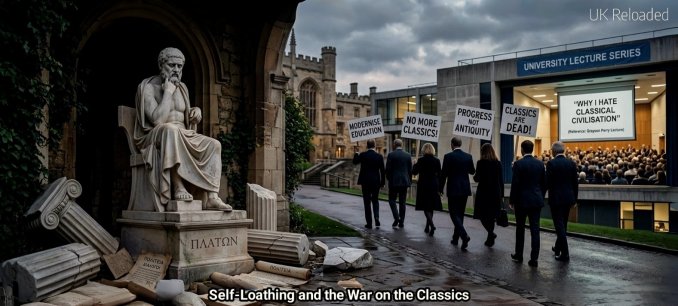
Self-loathing and the war on the classics
David Perks, convenor of the Classical Philosophy Reading Group, on why we need to embrace the great classical thinkers – especially when politicians and academic leaders are seemingly rejecting them.
DAVID PERKS
Whenever I come across ideas from classical philosophy within contemporary social and political contexts, I try to make a point of highlighting them and explaining the link to Ancient Greece, especially in discussions on Plato’s work. Recently, the government’s announcement of plans to reduce the number of trials by jury, alongside the recent lecture named ‘Why I hate Classical Civilisation’ by Sir Grayson Perry at Kings College London, have highlighted the continued tilt away from Greek civilisational ideas in modern politics.
This leads me to a series of questions posed in the next session in our Plato’s Republic series at the Classical Philosophy Reading Group. (You can watch our previous sessions on YouTube.) These questions relate to the state of civilisational values today. What is the nature of justice in the abstract? How can you live a moral life? What kind of legal and political framework guides you in living a moral life?
Taking it back to Ancient Greece, Plato was not the first to engage with the problem of laws and morality in Athens. In The Republic, Glaucon recalls the tale of the Ring of Gyges, in which a shepherd finds a ring of invisibility and uses it to kill the king and seduce his wife. The challenge put to Socrates is how can he say the moral life is the better and more rewarding life? Would he refuse temptations put before him? [1] This had already provoked questions about the nature of justice in ancient Athens. Historically, how did the system of laws arise?
The realisation of a need for clear laws seemed to start with Drako’s laws. These were ‘draconian’, to say the least. Most minor infringements were to be met with the death penalty. Thus, they were later reformed to be more humane and, to some extent, equitable.
The Athenian statesman Solon tried to re-draft these laws so that they could, to some extent, be accepted by the entire community. Solon, who was recognised as one of the ‘seven sages of Athens’, left little behind, but his story is to be found in Plutarch’s Greek Lives. [2] His laws were formulated to bring about social peace and prevent social unrest between the elite and the lower castes. His most famous reform was to abolish the enslavement of farmers who went into debt, attempting to give everyone a stake in society and to challenge the highly rigid social hierarchy of the time.
More lastingly, Solon enshrined in the constitution the right to trial by a jury of your peers, albeit that his jury would consist of between 200 and 6,000 citizens. Socrates himself was tried before such a jury. According to Aristotle, Solon’s laws were the whole basis of Athenian democracy. [3] So, trial by jury was a foundation stone of democracy. Perhaps David Lammy, the justice secretary, should be reminded of this as he attempts to reduce the number of trials by jury. It would seem our government has a thing or two to learn from the ancient Athenians in this regard if they want to continue to call themselves democrats.
On the theme of the erosion of respect for the democratic principles of which Western civilization was founded, the second thing that struck me recently was the notice I received of the Kings College London (KCL) Classics department’s annual Rumble Fund lecture, This year’s lecture on 12 March was given by Sir Grayson Perry (the 2003 Turner Prize winner). The lecture was entitled ‘Why I hate Classical Civilisation’ and was devoted to illuminating Perry’s ‘grievance’ with the classics.
There seems to be a clear mismatch between Perry’s thoughts and the purpose of the Rumble Fund and KCL’s Classics department, but apparently not. KCL treated its audience to the insights of Perry who said: ‘There’s a ghost of classical civilisation that is haunting me in the back of my mind.’ He could hardly have been more explicit:
My dislike of ancient Greece and Rome is not necessarily aligned to any fashionable ideological causes. The classics are often used to bolster or lend credibility to a right-wing, authoritarian, patriarchal, Eurocentric, white-supremacist view of the world, but that is not principally why I dislike them. For me, it is more personal, more irrational, more enjoyable. I love a good grievance.
Surely this should have been seen as an affront to the KCL Classics department, as what was supposed to be a ‘thoughtful, provocative and personal lecture’, according to Will Wootton, professor of Classical Archaeology and Art at Kings, was actually more akin to a two-hour struggle session.
Perhaps this is not surprising, it feels like just the same trite messaging as Perry’s own art. I remember seeing Perry’s pottery in the run up to his winning the Turner Prize. His pottery looks beautiful from a distance (and undoubtedly has artistic merit). But when you get up close, the pots are emblazoned in ‘shocking’ images and slogans like ‘Never have kids’ and ‘All men are bastards’. [4] Being hectored by his ‘political’ art is not very illuminating at all, except for promoting explicitly arguably anti-civilisational messages.
But while an eccentric artist may be free to have his opinion on the ‘outdated’ ideas of classical philosophy, it was KCL’s decision to highlight this position over a more nuanced discussion – which suggests that even those seemingly most invested in promoting ancient philosophy seem to be retreating from some of its core ideas and principles.
Shockingly, not only was Perry’s invitation a potential intellectual betrayal, but it was also the last of the annual lectures put on by the Rumble Fund. This was the sign off. That’s the last word on the subject. In a context of broader focus in relation to the teaching of the classics – that they should be decolonised and deconstructed – KCL’s decision to put Perry’s hatred of classical civilisation centre stage, along with banal political messages from the elite’s playbook, seems like yet another insidious, passive-aggressive attempt at undermining Western culture, sweeping it under the carpet to be forgotten, driven by a self-loathing war on the classics.
Luckily, the Academy of Ideas, amongst others, will resist.
David Perks is convenor of the Classical Philosophy Reading Group. The next discussion is Plato’s Republic Session 4 – Stephanus number 376 to 412 – on Sunday 17 May, 18:00 to 19:30 (UK) via Zoom. Find out more and book via Eventbrite. David will be speaking at Leeds Salon on Saturday 6 June on the topic ‘Why Read Plato’s Republic Today?’, part of Leeds Lit Fest 2026. Find out more here.
Notes
[1] Plato, Republic, p47, translated by Robin Waterfield, 2008, Oxford World’s Classics
[2] Plutarch, Solon in Greek Lives, p47-77, translated by Robin Waterfield, 2008, Oxford World’s Classics
[3] Constitution of Athens, Aristotle, The Complete Works of Aristotle, edited by Jonathan Barnes, 1995, Princeton University Books
[4] Grayson Perry, We’ve Found the Body of Your Child, 2000, glazed earthenware
This article (Self-loathing and the war on the classics) was created and published by David Perks and is republished here under “Fair Use”

••••
The Liberty Beacon Project is now expanding at a near exponential rate, and for this we are grateful and excited! But we must also be practical. For 7 years we have not asked for any donations, and have built this project with our own funds as we grew. We are now experiencing ever increasing growing pains due to the large number of websites and projects we represent. So we have just installed donation buttons on our websites and ask that you consider this when you visit them. Nothing is too small. We thank you for all your support and your considerations … (TLB)
••••
Comment Policy: As a privately owned web site, we reserve the right to remove comments that contain spam, advertising, vulgarity, threats of violence, racism, or personal/abusive attacks on other users. This also applies to trolling, the use of more than one alias, or just intentional mischief. Enforcement of this policy is at the discretion of this websites administrators. Repeat offenders may be blocked or permanently banned without prior warning.
••••
Disclaimer: TLB websites contain copyrighted material the use of which has not always been specifically authorized by the copyright owner. We are making such material available to our readers under the provisions of “fair use” in an effort to advance a better understanding of political, health, economic and social issues. The material on this site is distributed without profit to those who have expressed a prior interest in receiving it for research and educational purposes. If you wish to use copyrighted material for purposes other than “fair use” you must request permission from the copyright owner.
••••
Disclaimer: The information and opinions shared are for informational purposes only including, but not limited to, text, graphics, images and other material are not intended as medical advice or instruction. Nothing mentioned is intended to be a substitute for professional medical advice, diagnosis or treatment.
Disclaimer: The views and opinions expressed in this article are those of the author and do not necessarily reflect the official policy or position of The Liberty Beacon Project.


Leave a Reply