


Curtain Opens on the Dress Rehearsal for the Net Zero Calamity as Hormuz Threats Cut Hydrocarbon Supply by a Quarter
CHRIS MORRISON
The closure of the Strait of Hormuz is a missile on course to blow the neo-Malthusian death cult of Net Zero to smithereens. The reduction of up to 25% in the global supply of hydrocarbons is a serious dress rehearsal for the full Net Zero calamity. Hard lessons are about to be learnt across the world, particularly in already de-industrialising countries in Europe, that reliable energy is just one crucial use of hydrocarbons. Fertiliser, medicines, plastics, construction materials – it might be quicker to list products that do not rely on hydrocarbons. Yet the UK has an Energy Minister in power who, if reports are to be believed, will refuse any gas to be drawn from a new North Sea field that could increase supply from British sources by around 6% in only a few months. ‘Mad’ and ‘Sinister’ are names often attached to Edward Miliband; now more people are calling it out for what they say it really looks like: Treason.
Treason is defined as a citizen betraying the state by aiding its enemies. It has become crystal clear that pursuing a path to true Net Zero will destroy a country’s industrial base (in the UK that process is well under way), reduce food supplies to starvation levels (hydrocarbon-based fertiliser has doubled crop yields around the world in the last few decades) and cause the deaths of thousands of people in only intermittently warmed houses. A country weakened in this fashion would be prey to stronger tribes whether it be the Caliphate or a frisky Boris the Bear. The best outcome might be to become a protectorate of a pitying power such as the USA.
The excuse that this unfolding tragedy is required because the climate is in crisis looks thinner by the day. As the full implications of Net Zero start to dawn, proof from the scientific process about atmospheric carbon dioxide is replacing imaginative ‘settled’ opinions from rigged computer models. The Greta madness – autism on stilts – is fading into history, although many would argue that the process is still not fast enough.
Is this all a headline-grabbing exaggeration of the effects of Net Zero? Maybe, one might hope so, but let us recall the horror show that unfolded in the British Parliament last year when around 200 MPs were prepared to vote for a private bill that would have reduced the use of all hydrocarbons, domestic and imported, to 10% within less than a decade. You surely didn’t need to be Brain of Britain to work out that this would have led to mass starvation, death, disease and societal collapse in the near future. Yet all the LibDems, all the Greens, 90 Labour MPs from the governing party and two crackpot Conservatives were in favour.
Perhaps some of these Honourable Members have IQs near plant-watering levels, perhaps some were uniformed, uneducated and uninterested, perhaps some, perish the thought, are ideologues determined to remake the British state according to their own warped political and social views. It is difficult to forget when dealing with some of these people that they believe a woman can have a penis. The Mastermind UK Justice Minister David Lammy not only thinks King Henry VII came after Henry VIII, but has noted that it is “not accurate” to state that only women can have a cervix. Whatever the reason for their manifest stupidity, it would seem a matter of great electoral urgency that these muppets be removed from controlling any lever of political power.
There is no excuse for not knowing about the vital role that hydrocarbons play in manufacturing artificial fertiliser. The Daily Sceptic, along with many others, has been reporting about the Net Zero effects on world food supplies for a number of years.

Last September, the journalist Ella Whelan interrupted the BBC Radio 4 Moral Maze waffle-fest by noting that billions of people will die under Net Zero 2050, since half the world’s food is created using fossil fuels. There was a short embarrassed pause as if someone had thunderously broken wind in the pulpit before another guest lamely chipped in with the suggestion that “billions of people are at risk from climate change”. In the mainstream wackadoodle media world of Net Zero and climate change, supposition has always trumped fact.
While Miliband tries to shut off the gas, Britain will be scrambling to import increasingly expensive artificial fertiliser from abroad. Prices in the last month have risen by up to 40% for nitrogen products with competition for diminishing supplies increasing around the world. Of course, high energy prices have already reduced the UK’s ability to make its own fertiliser, and the country now imports about 60% of its needs. As with a full Net Zero scenario, supplies in the next weeks and months will be taken by richer countries desperate to keep food in their shops at almost any price. With luck, halo-polishing elites may still be able to buy new season Jersey Royals and asparagus for a while in Waitrose; those in the developing world could face mass hunger, if not starvation.
In 2013, Sir David Attenborough made the appalling comment that it was “barmy” for the United Nations to send bags of flour to famine-stricken Ethiopia. Too little land, too many people, was his considered judgement. In 2009, he told the Guardian that: “I’ve never seen a problem that wouldn’t be easier to solve with fewer people.” Under a full Net Zero programme, Britain’s national treasure can thankfully spare us his neo-Malthusian thoughts. There will be no export of bags of any foodstuffs whatsoever to any country.
Or medicines. In a Net Zero future with befuddled climate headbangers still sitting on the gas taps, many common medicines will be in very short supply. Useful and at times life-saving drugs such as paracetamol, aspirin and antibiotics rely on hydrocarbons. Carbon-based chemistry is at the heart of the medical supply business, whether it be drugs or all the various cheap, strong plastics used in medical facilities. Like fertilisers, so with medicines – the maniacs calling for hydrocarbon exploitation to stop have little idea how a modern industrial society stays healthy and feeds itself.
It can only be hoped that the curtain is starting to close on Net Zero but heroic efforts to keep the farce going are still being made. None more so than in the Guardian where the retired UCL Professor of Climate Impacts Bill McGuire recently said it was important that the UK Government “holds its nerve and leaves North Sea oil and gas in the ground”. Exploiting North Sea oil and gas would “send entirely the wrong message to the rest of the world”, he claimed. McGuire’s article concentrates on energy and it is as if the thousands of other uses for hydrocarbons do not exist. The climate “breakdown” is said to be getting worse by the day, something he seems to deduce from a number of recent floods. Wales was said to have had its warmest February on record but, alas, the claim is nowhere to be found in the Met Office record. This shows that the month was the fifth warmest since 1918 when the temperature tied at 6.2°C. An identical average temperature was also declared in 1961.
Regular readers, of course, will recall that McGuire has speculated in the past on other interesting ways that global emissions could be cut. In May 2024, he tweeted the following.
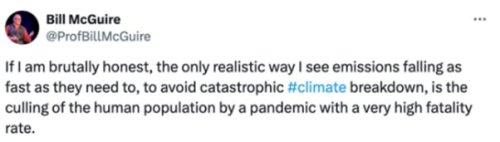
Predictably, there was a bit of a fuss and McGuire subsequently withdrew his post – “not because I regretted it”, but because people took it the wrong way, he explained.
It seems that Professor McGuire is not in favour of a mass cull of the human race. On that we can all agree – stop Net Zero now before it is too late.
Chris Morrison is the Daily Sceptic’s Environment Editor. Follow him on X.
This article (Curtain Opens on the Dress Rehearsal for the Net Zero Calamity as Hormuz Threats Cut Hydrocarbon Supply by a Quarter) was created and published by The Daily Sceptic and is republished here under “Fair Use” with attribution to the author Chris Morrison
See Related Article Below
Gavin Rice: The North Sea is Miliband’s fossil fuelled wake up call
GAVIN RICE

••••
The Liberty Beacon Project is now expanding at a near exponential rate, and for this we are grateful and excited! But we must also be practical. For 7 years we have not asked for any donations, and have built this project with our own funds as we grew. We are now experiencing ever increasing growing pains due to the large number of websites and projects we represent. So we have just installed donation buttons on our websites and ask that you consider this when you visit them. Nothing is too small. We thank you for all your support and your considerations … (TLB)
••••
Comment Policy: As a privately owned web site, we reserve the right to remove comments that contain spam, advertising, vulgarity, threats of violence, racism, or personal/abusive attacks on other users. This also applies to trolling, the use of more than one alias, or just intentional mischief. Enforcement of this policy is at the discretion of this websites administrators. Repeat offenders may be blocked or permanently banned without prior warning.
••••
Disclaimer: TLB websites contain copyrighted material the use of which has not always been specifically authorized by the copyright owner. We are making such material available to our readers under the provisions of “fair use” in an effort to advance a better understanding of political, health, economic and social issues. The material on this site is distributed without profit to those who have expressed a prior interest in receiving it for research and educational purposes. If you wish to use copyrighted material for purposes other than “fair use” you must request permission from the copyright owner.
••••
Disclaimer: The information and opinions shared are for informational purposes only including, but not limited to, text, graphics, images and other material are not intended as medical advice or instruction. Nothing mentioned is intended to be a substitute for professional medical advice, diagnosis or treatment.
Disclaimer: The views and opinions expressed in this article are those of the author and do not necessarily reflect the official policy or position of The Liberty Beacon Project.


Gavin Rice is head of political economy at Onward.
Scarcely a week goes by without Ed Miliband, Britain’s zealous Energy Secretary, insisting that it is only by unshackling ourselves from fossil fuels that we can escape the headwinds of global energy shocks such as that occurring as a result of the war in Iran.
By continuing to throttle the North Sea with taxes and exploration restrictions, and by doubling down on renewables subsidies, we can evade the fate otherwise doled out to us by capricious oil and gas markets and the whims of foreign leaders.
Yet reality may yet be dawning even for Miliband, with the Government refusing to rule out approving new North Sea drilling at Jackdaw and Rosebank, in breach of Labour’s 2024 manifesto pledge not to explore new fields in UK waters. The fact is Britain is no less reliant on fossil fuels as a proportion of national energy consumption than in Tony Blair’s day, according to data from the Department for Energy Security and Net Zero (DESNEZ). In 2025, oil and gas continued to supply three-quarters of the UK’s power. This is unsurprising given 86 per cent of households rely on gas for home heating, most cars remain petrol-fuelled and gas is needed as a source of electricity generation on the grid 97 per cent of the time.
We are constantly told that the North Sea is pointless to continue exploring as it’s a mature basin. But the evidence from the sector tells us the opposite. There are 51 new fields energy companies could be exploring in British waters, held back only by policies that make the sites unviable, according to a report by Offshore Energy UK, the trade body. And 60 extensions to existing sites would be possible but for the punitive tax regime – amounting to a 78 per cent effective rate – current policy imposes on producers. Joe Swinney, the SNP leader, Octopus CEO Greg Jackson and even Renewables UK boss Tara Singh have all backed an expansion of domestic drilling.
How can the UK still be so reliant on natural gas in particular, if we have decarbonised further and faster than almost any other developed country (which we have)? The answer lies in offshoring: the UK now imports well over half its gas supply through Liquid Natural Gas (LNG). This is a more expensive, more carbon-intensive and necessarily less securely available form of gas, shipped around the world in tankers from America – where gas is one quarter of the price – or the Middle East. In the Miliband worldview this is fine, since the emissions created by LNG and transporting it don’t count towards our national target. Global emissions and domestic energy security don’t matter, since it’s the terrestrial political target that matters.
It’s true that radically expanding Britain’s domestic supply of gas won’t immediately cut wholesale prices, since these are fixed by a Europe-wide marginal pricing system; so long as we need some imports, this will be set by the price of imported LNG. It’s insane that we got ourselves into this position in the first place, given our domestic reserves, but there you have it – “you wouldn’t start from here”. But what expanding North Sea drilling would achieve is significantly greater security of supply, leaving us far less exposed to geostrategic shocks like Iran choosing to blockade the Straits of Hormuz. And right now, the Exchequer is missing out on all the potential tax revenue from greater North Sea production – revenues collected instead by the Norwegian government, which drills the same sites we refuse to exploit before selling the gas back to us.
However, when it comes to electricity, it’s a different story. The Climate Change Committee itself has admitted that Britain will need fossil fuels – including for power generation – for decades. On any given day, depending on the weather, gas may be providing half of the electricity on the grid. This is due to Britain’s chronic underinvestment in baseload nuclear power and the as yet unsolved problem that wind and solar power is inherently intermittent, requiring a firm, dispatchable fallback (in our case, gas). The price of gas-generated power almost always determines the wholesale price of electricity due to this country’s auction system. But that price is itself artificially inflated in several ways.
First, gas generators are forced to operate in a highly inefficient way. Because they always get the last bite of the cherry in our half-hourly energy auctions, there is uncertainty about how much power to generate – and what can be sold – literally from one minute to the next. Secondly, the Government chooses to impose taxes on gas generators designed to disincentivise gas use – despite the fact that we need the suppliers’ generation. If you add together the effect of Carbon Price Support – a tax introduced to kill off coal – with the UK carbon pricing system and VAT, the state is adding 15 per cent to a typical household bill in gas levies alone. The Conservatives have called for VAT to be slashed from consumer bills altogether – a laudable but expensive move. A good first step would be cutting VAT – together with carbon taxes – on Britain’s essential gas generated electricity.
Zooming out further, is it even true that gas is really driving electricity bills? The truth is wholesale costs only count for around one-quarter of a typical bill. Even if wholesale costs fell to zero, bills would barely fall at all – because most of the costs to consumers come from the assortment of policy levies imposed on suppliers that get passed on to you and me. This includes network charges, grid upgrade and expansion costs, balancing costs and curtailment payments – when renewables companies are actually paid to take excess power we can’t transmit, off the grid – and Contracts for Difference (the subsidy mechanism for wind and solar developers).
Taking together the costs that could plausibly be reversed by the state, Onward calculates that 30 per cent of a typical bill – or £285 per year – is due to policy choices. Our recent report, Cooking on Gas – the first in our major commission on overhauling UK energy policy – makes the case for rolling back these imposed costs, starting with the carbon taxes on gas power.
Offshoring energy production to tick domestic decarbonisation boxes is leaving Britain dangerously exposed. By making ourselves more reliant on shipped LNG we are increasing global CO2 emissions, increasing costs and leaving ourselves at the mercy of global events. With pipelines that go straight to the UK shore, the North Sea is a gift horse we are choosing to slap in the mouth. And at the same time we are driving up bills through our policy choices – whether through our energy pricing mechanism, renewable subsidies or carbon taxes on energy.
It’s easy for Miliband to blame Iran, or Donald Trump, or global markets. But it would be open to him to change path – we have the domestic supply and the policy levers to do so.