

Safety study did not test protection devices installed in most households and of most concern to professionals and was produced by an apparently unqualified person.
DAVID TURVER
Introduction
The Government announced it was keen on plug-in solar back in June 2025, committing to conducting a safety study in that year. The government went further in March of this year, committing to make plug-in solar available within months, even though the safety study had not yet been completed. Earlier this month, the Government obviously desperate to launch plug-in solar panels, made another announcement saying they can be transformative for renters or those on lower incomes. The announcement also launched a consultation about amending the regulations to enable the safe and legal use of plug-in solar products in the UK. The consultation was accompanied by the results of the electrical safety study announced last year.
The industry has raised concerns about the safety of plug-in solar and it appears the safety study was supposed to address those fears. However, it looks like the safety study was carried out by someone with no discernible engineering or electrical safety skills. There are also obvious flaws in the scope of the safety study and some alarming test results. Time to dig into the plug-in solar safety shocker.
Professional Concern About Plug-In Solar
Various professional bodies in the industry have sounded the alarm about the safety of plug-in solar. Back in March the Institution of Engineering and Technology (IET) urged people to check the electrical safety of their homes before using plug-in panels. They were concerned about ageing, modified or poorly maintained electrical installations, in particular old-style protection devices, called Residual Current Devices (RCDs), that were never designed for electricity flowing back into the circuit.
In June, a joint statement was issued by the National Inspection Council for Electrical Installation Contracting (NICEIC), Electrical Safety First (ESF), the IET and others that warned explicitly about installing plug-in solar in older properties where wiring may have deteriorated. They too were particularly concerned about the impact the bi-directional flow of current might impact the operation of RCDs. This warning came despite the IET being listed as a stakeholder in the safety study.
In a statement the day after DESNZ published the safety study, ESF made a statement saying: “Whilst we welcome the progress made on researching potential safety issues by the Government, we remain concerned the research published is limited in its scope.” They went on to warn “any negative impact on an RCD could mean people are more exposed to a serious electric shock in the home.”
Plug-In Solar Safety Study
The contract for the plug-in solar safety study was awarded by DESNZ on 20 October 2025. A small company called Arceio Limited was the only company to submit a tender so of course won the £80,309 contract.
Arceio’s website says it focuses on policy and economic strategy; capital and financial markets; corporate and market development; energy and infrastructure systems. Apparently, Arceio “works alongside partners to frame opportunities, align realities, structure pathways and support real-world progress.” Not much sign of a deep expertise in solar panels or electrical safety.
Companies House records that Arceio was incorporated on 1 July 2024. The company has filed only one set of accounts for year ended 31 July 2025 where it was self-described as a dormant company. The balance sheet consists of 10,000 unpaid shares. The sole director and shareholder of Arceio is Antony Chiwoko. According to his LinkedIn profile, Mr Chiwoko has worked for blue chip companies like Global Data Energy as a commercial development analyst, BP as a strategic marketing analyst and Accenture as a strategic account leadership manager. He also has two degrees, a BSc from Plymouth in oil and gas management and an MSc from UCL in natural resource economics. The skills listed are commercial strategy and financial acumen. Even though it is clear Mr Chiwoko is an intelligent man, there is no evidence he has any engineering qualifications or any background electrical safety.
Now call me old fashioned, but when respected industry bodies have raised concerns about electrical safety, it would seem appropriate for the safety study to be conducted by an engineer, preferably a chartered electrical engineer with years of experience in electrical safety. Indeed, the ITT for the study specifically called for expertise in electrical engineering as a core skill, experience in laboratory testing, familiarity with standards, strong understanding of solar PV systems and experience in safety and risk management.
But it appears that someone in DESNZ who did not know what they were doing awarded a contract to the sole bidder who has no qualifications to do the work. This is scandalous for a project assessing the safety of a new product that could be bought by potentially millions of households if take-up rates in Germany are repeated in the UK.
It should also be noted that in the acknowledgments section of the study, it says the views expressed in the report are those of Arceio and do not necessarily reflect the views of the UK Government or the organisations acknowledged as partners or stakeholders. In effect, the Government has disowned its own safety report.
Problems with the Plug-in Solar Safety Study
The executive summary of the safety study says it “supports the conclusion that plug-in PV is compatible with UK domestic electrical systems, and that a controlled deployment framework is both achievable and justified based on the evidence.” The report goes on to say, “based on the evidence, the study recommends that plug-in PV be enabled for consumer deployment within a clearly defined product and notification framework.”
It is not clear from the study that the evidence in the study supports this conclusion, because there are several problems with the study:
- Scope of Testing
- Devices Tested
- Failure Rate
Scope of Testing
The first problem is with the scope of the test as shown in Figure 1 below that reproduces Figure C.1 from the report.

It is notable that households with additional dedicated generation circuits, like for instance roof-mounted solar, standalone generators or batteries are excluded from scope. Hybrid units, where plug-in solar is integrated with a battery are also excluded. The safety record of plug-in solar in Germany is good, but there has been an incident of a fire likely caused by a faulty battery inverter in one of these hybrid units. It is odd that this specific type of unit is excluded from the safety study.
Households with alterations to the consumer unit such as adding an EV charger are likewise excluded. These types of households might be expected to be early adopters of plug-in solar.
It is also noteworthy that this study specifically excluded consideration of the cumulative effects of widespread adoption of plug-in solar on the electricity distribution network.
Devices Tested
The safety study shows an image and description of the test rig used as shown in Figure 2.
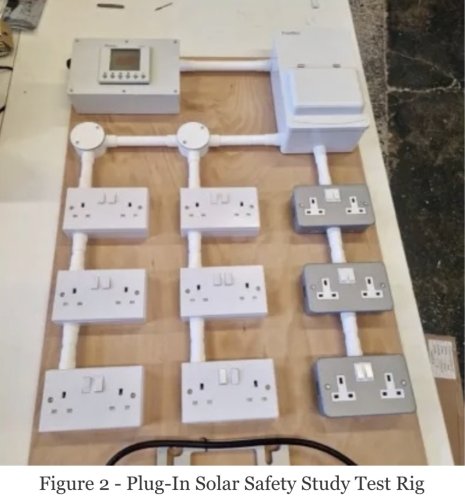
The main ring A (right) and the two spurs B and C (centre and left) are all described in the main text as being protected by modern Residual Current Breakers with integrated Overcurrent protection (RCBOs). However, Appendix C appears to contradict the main text saying Spur C was protected by a 32A mini-circuit breaker (MCB) and 30mA residual current device (RCD). It is therefore not entirely clear what was tested. It is also noteworthy that the circuit length is noticeably short and it is my understanding the RCB performance may well be impacted by circuit length.
Using data from the English Housing Survey and Electrical Safety First, Grok helped compile a table of the types of consumer units in British households as shown in Figure 3.
Up to 45% of households could have no RCD protection at all with up to a quarter still relying on old-fashioned fuses. Up to half of households have split-load boards. None of these devices were designed to cope with reverse current from plug-in solar. These are the types of devices the industry bodies are most concerned about, but they have been excluded from the scope of the testing.
At most, only a quarter of households have full RCBO boards as described in the main text of the safety study. Therefore the conclusion that “plug-in PV is compatible with UK domestic electrical systems” is not supported by the evidence because most types of consumer unit installed in UK households, and those of most safety concern, were not tested.
The meter used in the test-rig is described as a Modbus meter. Modbus is a very niche technology for domestic installations in the UK. About three quarters use DCC smart meters and a quarter have non-smart meters. This means that potential export to the grid if electricity demand in the home is lower than solar output has not been tested with almost all the meter types installed in the UK.
It should also be noted that the testing did not include a scenario where someone buys and installs more than one of these devices are their home. That means the dynamic interaction of several devices in the same home has not been tested.
Failure Rate
Examination of the detailed test results in Appendix A of the safety study show some results with cause for significant concern. All five tested devices failed the over- and under-voltage disconnect tests (A13). They operated normally in normal voltage range, but none of them cut-off at the right low or high voltage threshold. This is a 100% failure rate to cut off properly when the voltage goes out of the prescribed range. All six devices failed the electromagnetic compatibility tests (A6) producing more electromagnetic noise in various frequencies outside of the limits. Another 100% failure rate.
Two of the five devices tested are recorded as producing more power than the maximum rated output (A11). However, Device 2 is shown as having an output capacity of 600W, yet exported over 761W at 252V, so even though it is recorded as a pass, it should be a fail. That is a 60% failure rate on maximum power output.
The summary results for test A2/A3 show of 31 tests, 26 pass, 1 fail and 4 incomplete. This does not match the detail further down with 32 tests and the total inconclusive tests recorded as 5, but the total of the entries in the column adds up to 4. Three incomplete results in the live-earth testing represents a definite pass rate of just 81.3%. One failure and one inconclusive result from 15 live-neutral tests represents a definite pass rate of just 86.7%.
One device failed thermal extreme behaviour (A8) testing and one other device was not tested. One device failed the over-frequency test (A9). Notably the data labels in Figure A.4 Devices 3, 4 and 6 do not match the values indicated by the y-axis.
It should be noted that all devices passed some of the tests such as Endurance (A1), startup and shutdown transients (A10) and dynamic grid behaviour (A12).
The restricted scope, limited devices and alarming failure rate on some safety critical tests does not suggest that these plug-in panels are ready for widespread adoption by consumers with little electrical knowledge.
Conclusions
It looks like the Government is desperate to launch plug-in solar and has taken shortcuts on safety by appointing a company with no apparent experience in solar panels or electrical safety to produce its safety report.
The scope of the testing leaves a lot to be desired. The types of domestic equipment used by people who may well be early adopters of this technology were not included in the scope of testing. Moreover, the combined effect the millions of these devices might have on the wider grid.
The testing also focused only on the most modern type of protection devices, covering at most a quarter of UK homes. Consumer units and protection devices used by about three quarters of households, those of most concern to professionals, were not included in the test.
Even with these shortcomings, the devices tested had alarming failure rates in some safety critical tests such as under- and over-voltage disconnection. All tested devices also failed electromagnetic compatibility tests and more than half produced more power than their rated output.
The Government’s approach to the safety study and the results reveal a shocking ignorance, complacency and indifference to public safety. Net Zero targets should not be prioritised over safety. The plug-in solar rollout should be paused until the safety report has been re-done by properly competent chartered engineers.
Eigen Values now has well over 5,400 subscribers and is growing fast. If you enjoyed this article, please share it with your family, friends and colleagues. Please consider signing up for or gifting a paid subscription.
This article (Plug-In Solar Safety Shocker) was created and published by David Turver and is republished here under “Fair Use”

••••
The Liberty Beacon Project is now expanding at a near exponential rate, and for this we are grateful and excited! But we must also be practical. For 7 years we have not asked for any donations, and have built this project with our own funds as we grew. We are now experiencing ever increasing growing pains due to the large number of websites and projects we represent. So we have just installed donation buttons on our websites and ask that you consider this when you visit them. Nothing is too small. We thank you for all your support and your considerations … (TLB)
••••
Comment Policy: As a privately owned web site, we reserve the right to remove comments that contain spam, advertising, vulgarity, threats of violence, racism, or personal/abusive attacks on other users. This also applies to trolling, the use of more than one alias, or just intentional mischief. Enforcement of this policy is at the discretion of this websites administrators. Repeat offenders may be blocked or permanently banned without prior warning.
••••
Disclaimer: TLB websites contain copyrighted material the use of which has not always been specifically authorized by the copyright owner. We are making such material available to our readers under the provisions of “fair use” in an effort to advance a better understanding of political, health, economic and social issues. The material on this site is distributed without profit to those who have expressed a prior interest in receiving it for research and educational purposes. If you wish to use copyrighted material for purposes other than “fair use” you must request permission from the copyright owner.
••••
Disclaimer: The information and opinions shared are for informational purposes only including, but not limited to, text, graphics, images and other material are not intended as medical advice or instruction. Nothing mentioned is intended to be a substitute for professional medical advice, diagnosis or treatment.
Disclaimer: The views and opinions expressed in this article are those of the author and do not necessarily reflect the official policy or position of The Liberty Beacon Project.


Leave a Reply