

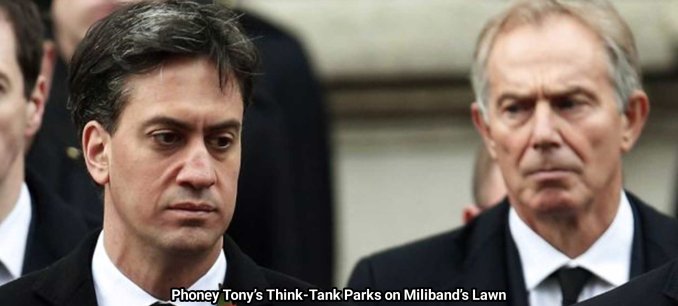
Phoney Tony’s think-tank parks on Miliband’s lawn
But it’s all just a game…
BEN PILE
I have been writing a lot recently about the fake war “against” Ed Miliband’s ideological zealotry. The shots fired in this performative conflict are, invariably, fired from those who instigated the agenda.
While it may be somewhat satisfying to watch this green-on-green violence, we must remember, as I tried to explain in the previous post here, that what we are seeing is performative. Peeking behind the scenes reveals that the politics has not changed. Even the Tories’ offering, which looks like a Net Zero U-turn is instigated, it turns out, by the people who carried the policy agenda for much of the other limb of the ‘U’. If it needs more explanation, the danger here is that the ‘U’ can therefore continue to develop into an ‘O’, because the politics hasn’t changed. There remain, in the Tory fold, many who are committed to Net Zero, and who would happily see Badenoch and Coutinho sat on the backbench, while the Gummer-Goldsmith faction reasserts its control over the party, on so many green blob blandishments. The U-turn cements nothing.
Another danger in taking this battle at face value is that the individuals and organisations that have for a long time been pointing out the problems of aggressive climate and energy policy, and anticipated the crisis that we are now facing, get side-lined. The GWPF and NZW, for examples, stand head and shoulders over those who are now dominating media commentary, who piloted a course to this disaster. The performance might be seen as precisely an exercise in using their remaining purchase over civil society and news media to exclude those who can say, with technical expertise and historical depth, “told you so”.
One of those outfits is of course Tony Blair’s Institute for Global Change, which has produced yet another “report”, which is yet another cascade of spin and fibs, which is about saving Net Zero on behalf of his clients, even if it does rightly land a punch on the Miliband camp’s nose. I’ve written a piece for the Daily Sceptic, copied below, which outlines its core errors.
But there is more. Another ersatz “civil society” outfit has entered the ring. Calling itself The Labour Growth Group (LGG), it is seemingly a response to the economic torpor that Labour’s flagship policies since the turn of the century have created, as though someone else imposed them on the country. It is furthermore defensive, highlighting the danger of “populism” — i.e. the Reform Party — which has the sheer audacity of capitalising on the democratic and policy failures of legacy parties to offer the public an alternative.
In the past, I think it was Joel Kotkin who pointed out that the battle lines of the climate wars and US politics were roughly equivalent to old, heavy industry and new “tech” — brown and green. The asset bubble, moreover, which for some reasons (discussed elsewhere) disfavoured the old, unleashed countless $billions from Silicon Valley and adjacent centres of business, towards the “civil society” blobs. This, explained Kotkin, was creating a new feudalism — the blobs armies of wonks being the new clergy.

The arrival — such as it is — of Artificial Intelligence has somewhat altered that dynamic. There is an AI boom, which, according to analysts such as Liam Halligan, is creating an extremely dangerous bubble, as $trillions of mindless investment seeks a return on hype.
Kotkin’s formulation of old-vs-new, brown-vs-green no longer holds in quite the same way, because of the energy intensity of AI. AI is as energy-hungry as steel and cement production. And there’s no use arguing that it can become more efficient, because the more efficient it becomes, the more that it will turn efficiencies into greater processing power. But Kotkin’s observation that the sector pushes just a slither of its abundant cash towards “civil society” stands.
So now the tech sector is split. And so are green “civil society” grantors. Because whereas ESG hedge funders had made vast amounts of money available to organisations that lobbied and campaigned to Make Energy Expensive Again, now this agenda undermined the spectacular growth of AI, the processors of which would be starved of electrons, if they were to be constrained by the weather.
The synthesis that blobs have found is to rescue the words “abundance” and “growth” from the dustbin. And that is why I am suspicious of their deployment.
LGG is chaired, according to its website, by Chris Curtis MP — 32 year old with no experience outside of politics, such as in industry or even ‘tech’. Earlier this year, Curtis was appointed to chair the newly-formed All Party Parliamentary Group (APPG) on Data Centres.
“MPs launch data centres group to balance growth & net zero” explained Data Centre News — a trade magazine.
The group said it will examine the role of data centres in economic growth, digital infrastructure resilience and net zero ambitions. It said it will also scrutinise challenges and opportunities facing the sector, including energy and planning considerations.
According to the APPG Registry, The APPG’s secretariat is London PR consultancy, In-House. There’s nothing particularly unusual about that — APPG secretariats are often private sector companies. But while it may not be unusual, I do wonder why this institutionialised cosiness between our representatives and special interests goes without much comment. Were In-House engaged to support the APPG, or was the APPG convened to support In-House’s clients? Moreover, what moved the very young MP, with no experience of the sector, to instigate his projects?
I have written before about this preoccupation with high-tech. It seems bizarrely myopic. Says Curtis:
“Data centres are a vital part of the UK’s digital economy, and it is essential that we remain an attractive destination for the investment that drives growth and creates high-skilled jobs. As Chair of the APPG, I want to ensure Parliament has the evidence and understanding it needs to shape a balanced approach. One that supports development, delivers real economic benefits, and works for local communities, while recognising wider considerations. Getting this right will be critical to securing the UK’s long-term digital future.”
The myopia is the notion that only the cutting edge sector can “drive growth”. My go-to counter-example is the cake shop. And here I declare a dis-interest. I have no particular attachment to cake shops. I like food. I sometimes like cake. I choose cake shops for their total neutrality. They are not part of the the conflicted and maligned heavy industry sector. But they are not the glossy high-tech. Nor are they Fintech or whatever. They are humble. They depend on footfall and customers. They can’t be spun out of investor hype. And so on.
Why aren’t cake shops “a vital part of the economy”? Why don’t cake shops “support development, deliver real economic benefits, and work for local communities”? Why isn’t there an APPG on cake shops, which will “secure the UK’s long-term cake shop future”? Is it because there are no cake shop billionaires? Is it because Big Cake Shop doesn’t fund civil society? (Unless you count the WI.)
And by “cake shop” I mean any company that uses energy — which is probably every company.
Anyway, the LGG, which now has a parallel in the APPG, has produced a report, which calls itself “an honest day”, and promises “A new economic settlement for Britain.” Big claims.
An even bigger claim in the report is this:
Britain has built clean generation, but it has not yet achieved cheap power. That failure does not come from the laws of physics. It comes from state incapability: a state that could not build the grid fast enough, could not reform planning fast enough, could not design a market for a renewables‐heavy system, could not discipline legacy costs and has not struck a balance between speed, cost, carbon and sovereignty.
The words were written by Curtis’s recently-departed “Communications Lead”, who is chair of the LGG, Mark McVitie. McVitie also has no experience in heavy industry or tech, and has only a background in PR.
I therefore doubt that McVitie really knows what it means to say that the failure to achieve the green sector’s promise of “cheap power” is not a constraint imposed by the material universe. And I begin to wonder if McVitie and his former boss, and the LGG group’s membership have any grasp of even basic arithmetic.
I grow tired of pointing it out, but even at today’s elevated natural gas prices — and gas is not the only energy source available to us at relatively low prices — the price of power from gas is less than the strike prices agreed by the government paid to renewable energy generators. So no amount of grid infrastructure — much of it would by necessity be redundant for much of the time — could carry power from offshore wind farms to consumers with the effect of reducing consumer prices. You do not need even a physics GCSE to understand the point. The technically-achievable price of gas has been proven. A wind turbine that would require less by way of land, material resources, labour, and capital investment than a drilling rig and a turbine, to produce power at a lower price has yet to be produced.
The constraint is physics. There is no magic formulation of policy that can undo physics — and chemistry and economics, for that matter.
It is telling that these claims are coming from the PR and communications wonkosphere, not from… you know… physics departments. It is the claim of such an industry that perception is reality. And so, so many “reports” that are now being produced are being produced to alter perception. And the magic spell is sheer cakeism:
The political debate is increasingly presented as a false choice. One side says the transition justifies almost any cost and the public must accept higher bills now because the future will be cheaper. The country has heard this for a decade and the bills have not come down enough. Trust in the premise that clean power is cheap power is now being damaged at a level that should alarm progressives. The other side says the transition itself is the problem and Britain should retreat to fossil fuels, tear up contracts and let the world decarbonise without it. That would lock the country into gas‐price volatility, destroy investor credibility and leave British industry permanently uncompetitive – wrecking Britain’s energy future in pursuit of climate denial zealotry.
Climate denial zealotry?
Where is the Climate denial zealotry? Who authored it? What are its claims? Just as the laws of physics exploited by the LGG’s magic formulation, to enable cheap green power are not enumerated, neither are the putative enemies of LGG’s mystical cakeism. Thus there is no debate about what laws of physics do or do not pertain to energy economics. There is merely the expulsion from the debate of anyone who would assert material reality over PR and comms, to ask that a policy or a technology be demonstrated before it is implemented. But the PR and comms tendency is one that eschews debate, and demands that we hold our tongues.
The real solution being offered here, I would venture, is that laws and regulations will be relaxed such that datacentres will be allowed to use their own nuclear and gas power generating plant, on “energy islands”. That is the cake in the cakeism — the synthesis of the distinct limbs of the green blob. The consumer will be left with the old grid. “Growth” and “abundance” will be limited to the sectors which made grants to “civil society”.
And the LGG’s report has received praise from other parts of the blob:
“A serious piece of work…”
This article (Phoney Tony’s think-tank parks on Miliband’s lawn) was created and published by Ben Pile and is republished here under “Fair Use”


Leave a Reply