

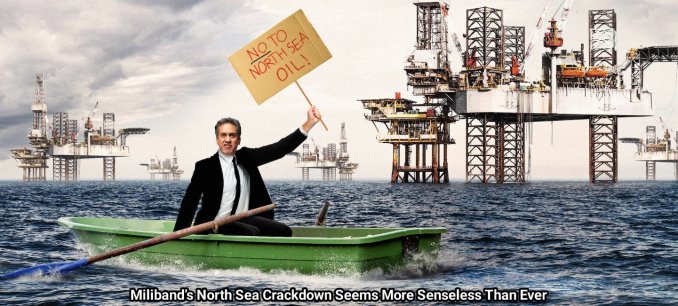
As war in the Middle East sends energy prices soaring, Ed Miliband’s North Sea crackdown faces mounting criticism, even from his usual green allies, say Matt Oliver and Jonathan Leake in the Telegraph. Here’s an excerpt:
Ed Miliband and Donald Trump have never been political bedfellows. But on the North Sea, it is no longer just the American President who is at odds with the Energy Secretary.
As the war in the Middle East convulses global oil and gas markets, Labour’s crackdown on home-grown production is facing mounting opposition from all sides – including from people once sympathetic to Miliband’s Net Zero cause.
The Government’s ban on new drilling licences and its swingeing windfall tax have been blamed for crippling the UK’s domestic industry while also reducing tax revenues and pushing up carbon emissions.
It’s a self-inflicted blow that is now prompting opposition from surprising directions – leaving Miliband looking increasingly isolated.
Among those advocating a “drill, baby, drill” approach are not just Kemi Badenoch, the Conservative leader and Nigel Farage, the Reform leader, but also Sir Tony Blair, the former Labour Prime Minister – who has described the current position as “climate theatre”. …
In recent weeks, even green energy evangelists – such as the bosses of Octopus Energy and wind farm trade body RenewableUK – have backed greater North Sea production. …
The Energy Secretary insists that boosting domestic production is pointless because it cannot make a “material difference” and won’t bring down household energy bills. “Our reliance on fossil fuels is costing us,” he said in a recent interview.
Trump has attacked Britain’s strategy, saying the UK is making a “big mistake” by turning its back on the North Sea.
Yet at the heart of the debate are also questions about energy security, tax revenues, jobs and carbon emissions, issues that experts say have been relegated in the name of dogma.
After the outbreak of war in Iran plunged global energy supplies into chaos and with Britons facing up to the prospect of soaring household bills, Miliband’s personal crusade seems more destructive than ever.
About 75pc of the UK’s primary energy still comes from oil and gas (70 million tonnes of crude oil and 65 billion cubic metres of gas) and this will take time to undo, with most of the existing demand stemming from transport and gas heating.
But even if the UK gets close to Net Zero by 2035, it will still consume nearly 40 million tonnes of oil and 30 billion cubic metres of gas.
Yet one key difference will be where it comes from. Over the next decade, imports are expected to rise steadily as domestic North Sea drilling finally runs out of steam.
By 2035, a scenario sketched out by the National Energy System Operator suggests two fifths of our gas supplies will probably come from Norway.
The other three-fifths will be split more or less evenly between domestic production and foreign shipments of liquefied natural gas (LNG), which mainly comes from the US, Qatar and Australia. …
Iran’s attacks on energy facilities in the Gulf are making matters even worse. The Iranian regime hit Ras Laffan this week, a large Qatari facility that produces around a fifth of the world’s supply of LNG, with missile strikes.
Saad al-Kaabi, the Qatari energy minister, said the attacks knocked out roughly 17% of the Gulf state’s export capacity and warned the impact would last up to five years.
Yet LNG is not a straightforward substitute for domestic gas.
It is both more expensive and results in higher carbon emissions. The carbon footprint of North Sea gas is probably around 15% lower overall, according to analysis by the website Carbon Brief.
Many experts and industry figures argue that producing more oil and gas at home would, ironically, be better for the planet.
Between now and 2050, the North Sea’s output is expected to fall by about two fifths, down from 3.6 billion barrels to just 2.1 billion barrels, according to investment bank Stifel.
That is a direct result of the Government’s crackdown. Its tax – known as the Energy Profits Levy – was introduced in 2022 after Russia’s invasion of Ukraine. The current 38% rate means total tax for the sector is 78% – which many producers say is unsustainable. …
EnergyUK, a trade body, has warned that household bills could jump by £250 a year from July as a result of the Iran war. It has urged the Government to “immediately step up efforts” to support those who would struggle most when energy costs rise.
Worth reading in full.

••••
The Liberty Beacon Project is now expanding at a near exponential rate, and for this we are grateful and excited! But we must also be practical. For 7 years we have not asked for any donations, and have built this project with our own funds as we grew. We are now experiencing ever increasing growing pains due to the large number of websites and projects we represent. So we have just installed donation buttons on our websites and ask that you consider this when you visit them. Nothing is too small. We thank you for all your support and your considerations … (TLB)
••••
Comment Policy: As a privately owned web site, we reserve the right to remove comments that contain spam, advertising, vulgarity, threats of violence, racism, or personal/abusive attacks on other users. This also applies to trolling, the use of more than one alias, or just intentional mischief. Enforcement of this policy is at the discretion of this websites administrators. Repeat offenders may be blocked or permanently banned without prior warning.
••••
Disclaimer: TLB websites contain copyrighted material the use of which has not always been specifically authorized by the copyright owner. We are making such material available to our readers under the provisions of “fair use” in an effort to advance a better understanding of political, health, economic and social issues. The material on this site is distributed without profit to those who have expressed a prior interest in receiving it for research and educational purposes. If you wish to use copyrighted material for purposes other than “fair use” you must request permission from the copyright owner.
••••
Disclaimer: The information and opinions shared are for informational purposes only including, but not limited to, text, graphics, images and other material are not intended as medical advice or instruction. Nothing mentioned is intended to be a substitute for professional medical advice, diagnosis or treatment.
Disclaimer: The views and opinions expressed in this article are those of the author and do not necessarily reflect the official policy or position of The Liberty Beacon Project.


Leave a Reply