

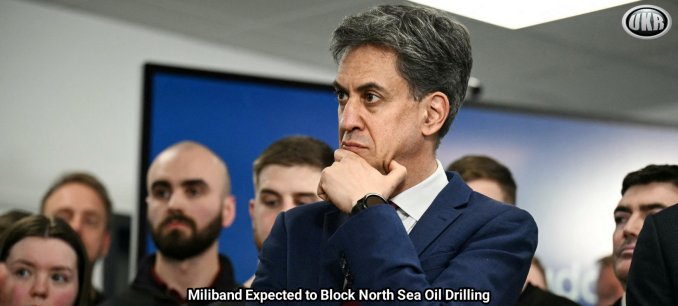
Ed Miliband is expected to block fresh oil drilling in the North Sea despite growing pressure to resume production to combat the energy crisis sparked by the Iran war. The Telegraph has the story.
The Energy Secretary is understood to be resisting the development of Rosebank, the UK’s largest untapped oil field, estimated to contain up to 300 million barrels of oil.
He is against new drilling licences despite concerns over impending fuel shortages, surging oil prices and diminishing stocks.
Despite growing pressure from opponents and his own Cabinet, including Rachel Reeves, the Chancellor, Miliband has also delayed a decision on a licence to drill at the Jackdaw gas field, which it is estimated could produce the equivalent of 6% of the UK’s future gas supply.
The move delays the decision until after the May local elections, which could trigger a Labour leadership battle where he has been mooted as a potential contender. On Friday, Miliband’s aides dismissed as “unfounded” suggestions that he was minded to approve Jackdaw.
Any block on North Sea drilling puts him at odds with not only Kemi Badenoch, who this week launched a “Get Britain Drilling” campaign, and Nigel Farage’s Reform, but also the SNP, whose leader, John Swinney, on Thursday reversed the nationalist party’s opposition to further oil and gas exploration in the North Sea.
Swinney said the Iran war had changed the “balance of the arguments”. Speaking at a Holyrood election hustings, the Scottish First Minister said “energy security” had to be taken into account when deciding whether developments such as Rosebank oilfields and the Jackdaw gas project were allowed to proceed.
Robert Jenrick, Reform’s Treasury spokesman, told the Telegraph: “Keir Starmer needs to grow a backbone, overrule Ed Miliband and open up both Jackdaw and Rosebank immediately. It is completely mad that we are choosing not to exploit our own resources in the middle of an energy crisis.”
There is also a growing split within Labour. Unions led by the GMB have been vocal in their calls for the Government to give the go-ahead to both fields.
The Chancellor has also indicated that she supported increased drilling in the North Sea, saying this week she would be “very happy” to support extraction at Rosebank and Jackdaw because of the positive effect on “jobs and tax revenue”.
Anas Sarwar, the Scottish Labour leader, said he believed the licences should be approved. Asked whether he believed Mr Miliband, who is seen as hostile to fossil fuels, was doing a good job, Sarwar said: “Yes, but there’s work to do.”
He added: “We made a commitment before the election that we would honour licences that were granted. The licences then have come into question – we should honour those licences.”
Sir Keir Starmer has refused to comment on the Jackdaw scheme, citing the fact that it is a quasi-judicial decision for Miliband.
However, Downing Street is said to be acutely aware that public opinion on further drilling has been shifting as a result of the crisis in the Middle East.
Worth reading in full.

The lost gas fields that could power Britain for decades
Ed Miliband’s ban on exploration has put the UK’s wealth of unexploited energy assets in limbo
Far out under rough Atlantic waters lies the Glendronach gas field.
[…]
Despite being one of the largest unexploited energy assets in UK waters, Glendronach’s fate is far from secure.
The gas is there, as is the technology to extract it.
But Britain’s politicians have pushed Glendronach and others like it into a limbo that could prove permanent.
Facing rising taxes and windfall levies – imposed by the Conservatives and increased by Rachel Reeves – investors are pulling their money out of the North Sea. Ed Miliband’s ban on exploration has only made matters worse.
Glendronach is just one of dozens of gas and oil fields lying under British waters that are now at risk.
Hundreds of miles away in the southern North Sea, the Glengorm gas field – which could provide Britain with millions of cubic metres of gas – has also faced difficulties. Today, its economics are too uncertain for it to be progressed.
Jackdaw and Rosebank, the UK’s most controversial virgin fields, are similarly in doubt. Last week, Miliband put operator Adura’s permit applications on hold. Jackdaw is capable of providing 6pc of the UK’s gas within months.
According to Offshore Energies UK, there are 51 known fields in British waters that could feed gas into UK pipes. Their progress has been halted not by geology but by politics and taxes.
Another 60 projects – mostly extensions to existing fields – have been held back for the same reason, says Ben Ward, market intelligence manager at the trade body.
It means, in total, an equivalent of 3.25 billion barrels of oil have been left to languish in the ground, accounting for both oil and gas projects.
Oil is largely exported, so its main benefits are in jobs and taxes. However, the gas would be flowing straight into our pipes, supporting us through the latest energy crisis. So how much are we missing out on from those frozen fields?
Ward’s estimate is 1.5 billion barrels’ worth, equating to 250 billion cubic metres of gas, or between three and four years of UK needs. That lost production, he points out, does not mean we use less gas – it just means we have to import more.
“UK domestic gas production could be sustained at 140 million barrels of oil equivalent a year,” Ward says. “But projections from the North Sea Transition Authority (NSTA), the industry regulator, now suggest it will fall to around 40 million by 2035.
“This matters a lot to the UK. The gas in those fields could reduce our reliance on imported liquefied natural gas (LNG) from the 25pc predicted by 2030, under current policies, to single digits.”
The blocked projects are just one part of the picture. There are many more potential sources of gas and oil lying under UK waters, industry experts say.
Last month, Chris Cox, the chief executive of Serica Energy, now one of the UK’s largest gas and oil producers, suggested that the waters west of Shetland may hold five trillion cubic feet of recoverable gas.
[…]
In reality, opening new gas fields will do little to benefit households and businesses. This is partly because wholesale prices are set by the European markets, but mainly because the biggest factor controlling UK energy bills is the taxes added to gas by the British Government.
The Telegraph: continue reading


Leave a Reply