

MARK NIGHTINGALE
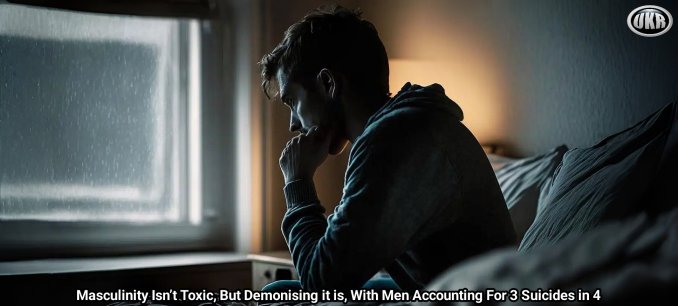
The Office for National Statistics put the male suicide rate at 17.6 per 100,000 in 2024, with men accounting for roughly three suicides in four. Suicide remains the leading cause of death for any British man under 50. Those are the stark figures. We hear all about knife crime, gang culture, drug-related deaths and murder, and yet the most alarming statistic is the suicide rate among men under 50.
Why are so many men killing themselves? And what on earth would we be doing about it if it were women dying at three or four times the male rate?
Writing this, I notice I’m numb. Why am I not outraged, demanding answers, looking into what can be done to bring the number down? Is it because I view suicide as a kind of failure, and failure makes me uncomfortable? Or is it because I’ve been conditioned to believe that men should be strong, that they should provide and protect, and that if they check out they have failed to live up to my idea of how men ought to be? I don’t think 50 years of being told men are patriarchal oppressors, and that our gender is ‘toxic’, is helping either.
Men carry the burden of performance. We are heavily invested in raising families, protecting those families and providing for them, even in these times of so-called gender equality. Most notably, it is men in their late forties who are most likely to take their own lives, according to the ONS. This is the age group most associated with divorce, relationship breakdown and job loss. Men are particularly vulnerable when there are court battles or conflicts over access to their children. The result is depression, self-hatred, a sense of failure and despair.
Younger men are not far behind. The pattern is consistent across age groups: boys and men killing themselves at three to four times the rate of women. It is not hard to conclude from these numbers that society cares rather less about the wellbeing of men and boys than it lets on. When it comes to the methods, women tend toward pills and slipping away. Men, more often, choose methods that leave no chance of being talked back from the edge.
Why are men doing this? In the last 50 years feminism has pushed harder and harder on its message that women are the victims of male oppression, and with it has come the message that men are bad, cold, dangerous and not to be trusted. The 2021 Census marked the first time in our history that fewer than half of people in England and Wales described themselves as Christian, and with the quiet retreat of that faith went the framework that gave the average man his place in the world. Imagine growing up with the message that your very God-given nature is toxic and needs to be corrected in a culture that no longer believes in the God who gave it to you. The inclination is to want to fit in, and if that means throwing your own nature overboard, so be it.
Too many men have walked into this trap blindly, not knowing the true consequences of trying to be acceptable on terms that require them to disappear. Masculinity at its core is the energy that protects and provides in any thriving society. When it’s attacked and men agree with their attackers, the outcome is chaos.
Because men have largely agreed with the narrative that our nature needs correcting, we now have nearly three generations of confused, medicated and quietly angry males. From the Gillette advert in 2019 lecturing men on toxic masculinity to a Violence Against Women and Girls strategy that speaks of “men and boys” wreaking havoc, the institutions that shape modern life have reached the same conclusion: strong men are the problem. It is a message men have absorbed without resistance, and the male suicide rate are what that absorption looks like in practice.
It’s worth remembering what the word patriarchy actually means. As Stephen Jenkinson points out, it comes from patros (father) and arche (foundation): literally, the fathering of a culture. You cannot have a matriarchy without a patriarchy first. One creates the conditions for the other. Most people do not understand this and have bought into the idea that one is bad for society and the other is the answer. What the last 50 years have shown is not that the fathering of a culture is oppressive. It’s that a culture which dispenses with the fathering does not become free. It becomes lost.
That is the work we do at Integral Man. We invite men to stop apologising for their nature and to recognise they’ve been lied to. A weekend in the company of other men. Phones off, conversation honest, the hill in front of you. Prayer, silence, story, and the slow work of remembering who you were before the culture told you who to be. The next weekend runs in West Sussex this September.
Mark Nightingale co-runs Integral Man, which is a UK Community Interest Company. Details, dates and bursary information can be found at integralman.org.
This article (Masculinity Isn’t Toxic, But Demonising it is, With Men Accounting For Three Suicides in Four) was created and published by The Daily Sceptic and is republished here under “Fair Use” with attribution to the author Mark Nightingale


Leave a Reply