

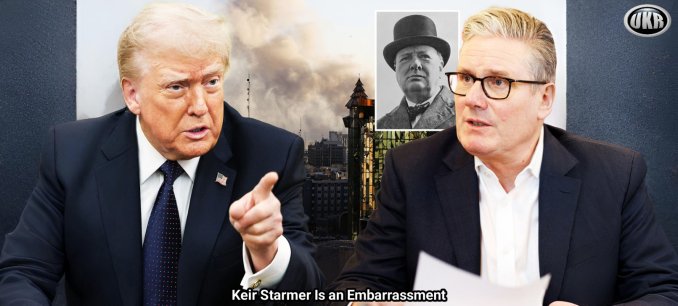
Keir Starmer is an embarrassment.
What the Iran fallout tells us about Britain
MATT GOODWIN
There was a time when Britain stood alone as the defender of the free world.
In 1940, after the fall of France, Britain was the only country in Europe that was willing to defy the rise of Nazi Germany.
Against overwhelming odds, we stood firm — not because it was legally convenient or politically easy, but because it was necessary.
Today, Britain finds itself standing alone once again. But for all the wrong reasons.
When President Trump said this week that Keir Starmer is “not Winston Churchill”, the remark stung precisely because it rang so true.
Under Starmer’s hapless leadership, Britain looks weaker, more hesitant and more uncertain of itself than at any time in living memory.
The deeper problem is not just Starmer himself, although the fact that he is now the most unpopular prime minister in the history of opinion polls speaks volumes.
The real problem is the worldview that now dominates Britain’s governing class — a worldview that is shaped by international lawyers, activist judges and ideological dogma rather than strategic realism and national interest.
And nowhere is that more obvious than in Britain’s relationship with the United States of America.
For more than eighty years the “special relationship” was the cornerstone of Britain’s national security.
Ever since Franklin D. Roosevelt brought the United States into the Second World War, Britain’s security and global influence have been tied to our transatlantic alliance.
From the Cold War to the post-9/11 War on Terror, British governments of all parties understood a simple reality: Britain is strongest when it stands alongside America.
Yet under Keir Starmer and the worldview of our new governing class, that special relationship is now beginning to fray.
During the current crisis over Iran, when the United States requested access to British bases for military operations, Starmer initially refused.
He hid behind legal advice from his Attorney General, Lord Hermer, and the supposed constraints of “international law”.
Only later – too late – did he reverse course.
But by then the damage had been done.
In Washington, the message was unmistakable: Britain is simply no longer a reliable ally. We cannot be trusted to be there when it really matters.
In fact, the Americans had already been approaching this conclusion for some time, pointing out how Westminster’s insane policy of mass uncontrolled immigration and appeasement of radical Islamism was undermining their confidence in Britain.
And now America’s loss of confidence is unavoidable. It says something, for example, when a President of the United States is going out of his way to praise France over Britain.
And this episode is not an anomaly. It reflects a broader shift that has taken place in Britain’s foreign policy under Starmer — one that is shaped less by geopolitical reality and more by legal activism, ideological signalling and the Labour Party’s domestic political sensitivities.
Consider the extraordinary decision to hand the Chagos Islands to Mauritius — effectively surrendering one of Britain’s most strategically important territories in the Indian Ocean.
That was not forced upon Britain by military defeat or geopolitical necessity.
It was a voluntary act, driven largely by a legalistic, woke worldview that dominates our political class and the foreign office.
The result is that Britain has weakened its own strategic position while strengthening the hand of China in one of the most important regions of the world.
It is difficult to imagine previous British governments behaving with such casual disregard for their own national interest.
But this is what happens when the people who are shaping a country’s foreign policy prioritise moral posturing and international approval over their own national interest.
At the same time, under Starmer, Britain’s foreign policy is increasingly influenced by domestic electoral calculations, mainly Labour’s growing reliance on Muslim votes.
Much like we saw with the grooming gang scandal, Keir Starmer and Labour MPs appear deeply anxious about alienating certain activist groups and Muslim voters in Labour-held seats (an anxiety that will now be fuelled by the rise of the Greens).
Wasn’t it revealing, for example, that after letting down the Americans Keir Starmer went straight to a gathering of Muslims in Westminster Hall to assure them Britain would not be taking direct military action against a crackpot Islamist regime in Iran?
The result is a foreign policy that appears hesitant, cautious and reluctant to take a firm stance on conflicts that really do matter to the future of the West.
I don’t want a nuclear Iran. I don’t want Iran emboldening dangerous, extremist proxies like Hezbollah, the Houthis, militias in Iraq and Syria, and countless other Islamists who quite literally want to destroy our entire way of life. I don’t want an Islamist regime being able to plot some 20 terrorist attacks on British soil.
And, most of all, I don’t want to send a big, loud message to the likes of China and Russia that Britain is a soft touch – although I fear we are too late for that.
Instead of acting with courage and clarity about Britain’s national interests, Starmer and the Labour government try to balance competing domestic pressures while hiding behind legal arguments.
The result is what is fuelling so much irritation in Washington: paralysis. Our allies see hesitation and an unwillingness in Westminster to deal with the real threats that we face. Our adversaries see weakness. Britain’s voice on the world stage grows quieter. And slowly but surely our national interest is sidelined by sectarian concerns.
This drift comes at precisely the wrong moment. The world is visibly becoming more dangerous. Russia is waging war in Europe. Iran continues to destabilise the Middle East. China is expanding its influence across Asia and the Indo-Pacific. Islamism is resurgent.
In this environment, alliances matter more than ever. Yet Britain’s armed forces are smaller than at any time since the Napoleonic Wars. Defence spending remains woefully inadequate. And now we cannot even appear to move our ships around the globe in time to deal with conflicts that were entirely predictable.
Large parts of Britain’s political class now treat hard power as something that is embarrassing — a relic of a past they would either rather forget or feel ashamed of.
Meanwhile, public confidence in national defence has collapsed. Alarmingly, recent polling found that nearly half of all Britons say there are no circumstances under which they would fight for their country, while close to half of all young Brits plan to vote for the Greens at the next general election — a party that wants to abandon our nuclear deterrent, leave NATO, embolden Islamists, and whose senior leaders have been spotted at pro-Iran demonstrations.
What all this tells us, what the Americans can see more clearly than Keir Starmer and our useless leaders in Westminster, is that we are not just facing a security crisis: we are facing a cultural crisis.
A civilisation that loses confidence in itself eventually loses the ability to defend itself.
And a civilisation that does not inspire confidence among its closest allies will soon have no friends at all.
Britain once understood this instinctively.
In moments of danger our leaders spoke clearly about freedom, courage and national survival. They did not hide behind legal advice, woke ideology, or international committees.
But today Britain is governed by a political class that is more comfortable debating the technicalities of international law than confronting the realities of geopolitical power.
Instead of Churchill’s defiance, we have something closer to legalistic paralysis. Instead of resolve, we have embarrassing hesitation. Instead of leadership, we have constant equivocation.
Which is why Britain increasingly looks like a country that is drifting into irrelevance.
The United States does not need Britain. But Britain really does need the United States.
If a major conflict erupted tomorrow, Britain could simply not defend itself without American military power. That is the geopolitical reality.
Lawyers will not save us. Politicians in Westminster will not save us. Brussels will not save us. The United Nations will not save us. Only America will.
And yet Britain’s Labour government, under Keir Starmer, now appears determined weaken the alliance that has underpinned our security since 1941.
Like millions of my fellow Brits, I find Keir Starmer’s leadership of our once great country to be utterly embarrassing and humiliating.
In 1940, Winston Churchill rallied Britain with the promise that we would fight on the beaches. Under Starmer, Britain seems more likely to check the legality of fighting on the beaches, consult lawyers about the landing grounds, and defer to activist courts before defending our interests.
At a time when the world is becoming more dangerous, that is not just weak. It is dangerous. And unless Britain rediscovers the confidence to defend its interests, stand firmly alongside its closest allies and reject the timid legalism that now dominates its foreign policy, then the slow erosion of our power, influence and security will only continue.
This article (Keir Starmer is an embarrassment.) was created and published by Matt Goodwin and is republished here under “Fair Use”
See Related Article Below
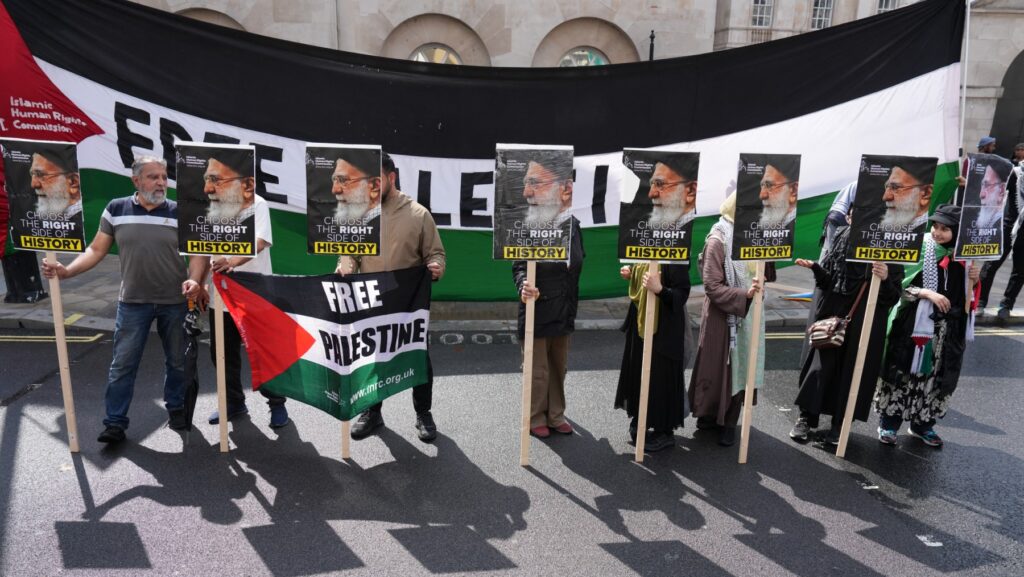 Activists from the Islamic Human Rights Commission hold a banner and placards showing the face of Iranian Supreme Leader Ayatollah Ali Khamenei on Downing Street in central London, on July 19, 2025, as they join a ‘National March for Palestine’ organised by the Palestine Solidarity Campaign.


Leave a Reply