

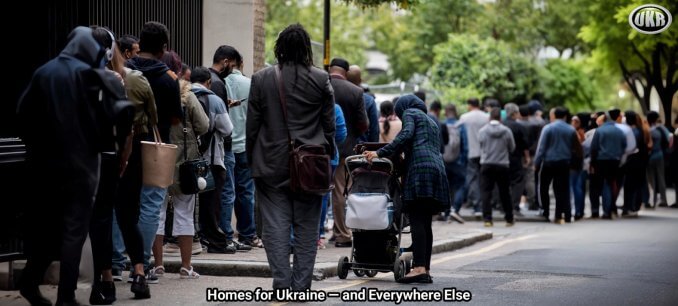
Homes for Ukraine — and everywhere else
Why were some non-Ukrainians far more likely to enter Britain under a scheme meant for Ukrainians?
ALP MEHMET
Dr. Excel Ezeh is a Nigerian-born gynaecologist, cancer specialist, and resident of Stroud in Gloucestershire, who was featured in several BBC articles in 2022. Dr Ezeh arrived in Britain legally; there’s no evidence to suggest he has done anything wrong or untoward. But the way he was able to move to Britain is noteworthy: Dr Ezeh came to the Cotswolds via Ukraine, through the Homes for Ukraine Sponsorship Programme.
The Sponsorship Programme was one of two visa routes established by the British government as Russia’s illegal war of aggression against Ukraine escalated in February 2022, the other being the Ukraine Family Scheme (now discontinued).
In the wider context of UK immigration schemes over the last few years, allowing Ukraine women and children to wait out the conflict in Britain seems unobjectionable. Certainly, it’s far better than the secretive Afghanistan Response Route, flying thousands of Afghans (including former Taliban militants) into Britain, or the hundreds of thousands who arrived via the Health and Social Care visa route, and whose dependents alone are estimated by the Centre for Migration Control to have a lifetime net cost of over £30 billion to the British taxpayer.
But, despite their names, both the Ukraine Family Scheme and the Homes for Ukraine Sponsorship Programme are not limited just to Ukrainians. The government helpfully publishes detailed tables of the visa grants, refusals and withdrawals here, which allows us to see a full breakdown by applicant nationalities. 278,529 visas have been granted; 3,464 of those visas were granted to non-Ukrainian nationals.
Which brings us back to Dr Ezeh. He is one of 408 Nigerian nationals issued a visa allowing him to come to Britain via a Ukrainian refugee pathway, alongside 294 Afghan nationals, 124 Indian nationals, 22 Sudanese nationals, and, bizarrely, 1 Mexican national.
The overall numbers are small, but we must remember this is in the context of Ukraine’s pre-war population, which was not known for its large Nigerian expat community. In 2021, the State Migration Service of Ukraine claimed there were just 1121 permanent Nigerian residents in the country, and 5526 temporary residents. Assuming there was no significant change in the immediate run-up to the war, this means some 6% of Ukraine’s entire pre-war Nigerian residents were given visas to live in Britain via schemes intended to help Ukrainians.
Bear in mind, the 275,759 Ukrainian nationals who were granted visas make up just 0.6% of Ukraine’s prewar population of 41,902,400 — meaning Nigerians in Ukraine were approximately ten times as likely to receive a visa as actual Ukrainians.
Nigerians in Ukraine were approximately ten times as likely to receive a visa as actual Ukrainians.
The disparity is even more stark when considering the 934 Nigerian nationals who had their applications refused; about a fifth of Ukraine’s entire Nigerian population tried to come to Britain via the Ukrainian refugee schemes!
Some may observe that the word “family” in Ukraine Family Scheme is relevant here. The scheme explicitly allows for spouses and children of Ukrainian nationals to apply; it is intended to provide a humanitarian pathway to keep families safe, not to split them up. It’s a valid point — but should be considered in the wider context of well-documented and extensive Ukrainian and Nigerian marriage fraud to obtain visas.
In 2010, Vladymyr Buchak, an illegal Ukrainian immigrant who had been living in Britain under the false identity of “Kaedo Maesalu,” was convicted alongside the Reverend Alex Brown and the Nigerian-born solicitor and pastor Michael Adelasoye for organising what was then believed to be the largest sham marriage conspiracy ever uncovered in Britain. Operating out of the Church of St Peter and St Paul in St Leonards-on-Sea, East Sussex, the trio organised 370 bogus weddings between 2005 and 2009. The operation was straightforward: Buchak recruited Eastern European women through his work at a local factory, while Adelasoye supplied African men from his legal practice and from his Ark of Hope evangelical church in Hastings. Couples were married as many as eight times a day, with some returning days later with different partners. The African grooms then used their new marriages to apply for the right to remain in the UK.
In the UK more broadly, marriage visa fraud remains common and rarely prosecuted. Migration Watch has long warned of the extent of sham marriages to get around immigration rules. In 2013, Mark Rimmer, the chairman of the Local Registration Services Association, estimated that 15,000 of the 173,000 civil weddings each year in England and Wales could be fraudulent. The EU Settlement Scheme also saw at least 365 sham marriages caught by the Home Office, but the Telegraph reports no one involved was prosecuted or deported. While there is no direct evidence of widespread sham marriages to qualify for the Ukrainian refugee visa routes, we must remember that the Home Office rarely bothers to investigate.
And, of course, any abuse of the scheme via sham marriage pales in comparison to the attempts to widen eligibility to third countries. In a widely-reported case last year, a family of Palestinian nationals successfully argued before an immigration court that their circumstances were so exceptional they should be allowed to enter Britain and live with a relative under the Ukraine Family Scheme, despite the scheme having nothing to do with Palestinians, and the family not being at any immediate risk as they were living in Egypt at the time. The Home Secretary moved to block the ruling, but the fact that a judge granted it at all illustrates how elastic these schemes become once the legal system gets hold of them.
None of this is Dr Ezeh’s fault. He applied through the proper channels, was accepted, and is trying to rebuild his career. But his journey from Nigeria, to Ukraine, to a host family in the Cotswolds, via a refugee scheme created in response to a European land war, is an example of just how unmanageable and ludicrous British immigration policy has become. The schemes were designed for Ukrainians. The system, as ever, had other ideas.

••••
The Liberty Beacon Project is now expanding at a near exponential rate, and for this we are grateful and excited! But we must also be practical. For 7 years we have not asked for any donations, and have built this project with our own funds as we grew. We are now experiencing ever increasing growing pains due to the large number of websites and projects we represent. So we have just installed donation buttons on our websites and ask that you consider this when you visit them. Nothing is too small. We thank you for all your support and your considerations … (TLB)
••••
Comment Policy: As a privately owned web site, we reserve the right to remove comments that contain spam, advertising, vulgarity, threats of violence, racism, or personal/abusive attacks on other users. This also applies to trolling, the use of more than one alias, or just intentional mischief. Enforcement of this policy is at the discretion of this websites administrators. Repeat offenders may be blocked or permanently banned without prior warning.
••••
Disclaimer: TLB websites contain copyrighted material the use of which has not always been specifically authorized by the copyright owner. We are making such material available to our readers under the provisions of “fair use” in an effort to advance a better understanding of political, health, economic and social issues. The material on this site is distributed without profit to those who have expressed a prior interest in receiving it for research and educational purposes. If you wish to use copyrighted material for purposes other than “fair use” you must request permission from the copyright owner.
••••
Disclaimer: The information and opinions shared are for informational purposes only including, but not limited to, text, graphics, images and other material are not intended as medical advice or instruction. Nothing mentioned is intended to be a substitute for professional medical advice, diagnosis or treatment.
Disclaimer: The views and opinions expressed in this article are those of the author and do not necessarily reflect the official policy or position of The Liberty Beacon Project.


Leave a Reply