

From Karachi’s Flames to Britain’s Borders: The Self-Inflicted Boomerang of Starmer’s Iran Policy
THE RATIONALS
Karachi, 1 March 2026. The US Consulate steps slick with blood, tear gas curling like cheap incense, ten bodies already counted and 32 more injured while the mob screamed “Death to America!” and “Death to Israel!” for the freshly martyred Ayatollah. And what, precisely, was our Prime Minister doing at that exact moment? Authorising American bombers to stage their next run from RAF Fairford and Diego Garcia, turning Great Britain into a forward operating base for the very strikes that had lit this powder keg.
Observe the policy contradiction in action. The government tightens asylum rules on high-claim nationalities—Pakistan foremost among them—while simultaneously facilitating US strikes on Iran that are almost certain to intensify the very regional instability those rules are ostensibly designed to shield Britain from.
This is not an accidental misalignment, it is a structural incoherence that mainstream commentary has so far declined to confront with the seriousness it demands.
The contradiction is stark. On 2 March the new asylum regime takes effect, refugee status now temporary, reviewed every thirty months, permanent residency extended to twenty years. In the year ending December 2025, the top five nationalities claiming asylum—Pakistan (11%), Eritrea (8%), Iran (7%), Afghanistan (7%), and Bangladesh (6%)—together represented 39% of the 100,625 total applications, per Home Office figures. Small boat arrivals, accounting for roughly two-fifths of claims, were led by Eritreans (19%), Afghans (12%), and Iranians (11%).
The Home Office markets this as “Restoring Order and Control.” Yet in the same week Starmer reverses his earlier caution and authorises US use of British bases for “specific and limited defensive” strikes on Iranian missile infrastructure. Defensive, apparently, like a man who sets his own house on fire to keep the neighbours warm.
Starmer insists it is no U-turn, merely circumstances that changed. Of course.
What never changes is the Labour instinct to triangulate until the triangle collapses into a noose. And the guests at this particular barbecue? Shia communities across Pakistan, Iran, Afghanistan, and beyond, whose rage—sparked by Khamenei’s martyrdom—could soon spill into Britain’s asylum inbox, potentially elevating claims from multiple nationalities as regional instability deepens.
Khamenei’s death was not a surgical removal, it was a canonisation. Grand Ayatollah Naser Makarem Shirazi issued the fatwa within hours—jihad not as metaphor but as religious duty. In Pakistan the body count climbed past twenty nationwide, with protests turning violent in cities like Islamabad and Lahore while similar unrest flared in other Shia-populated regions. In London, reactions split along familiar lines. Iranian diaspora communities gathered in Finchley Road London, in Manchester, and elsewhere to celebrate with pre-revolutionary flags and calls for freedom, viewing Khamenei’s death as the end of decades of repression—even as fears of wider war tempered the mood.
Meanwhile, pro-Palestine marchers and anti-war demonstrators converged outside Downing Street on 28 February, fusing existing solidarity with Gaza and Lebanon to fresh outrage over the strikes, clashing at points with anti-regime exiles. This intra-Shia fracture—celebration versus mourning, often overlooked in mainstream accounts that treat diaspora responses as monolithic—reveals a deeper vulnerability, the strikes not only import external grievances but exacerbate internal divisions that could further erode social cohesion.
MI5 has been here before. Since January 2022 the Security Service and police have disrupted more than twenty Iran-backed plots on British soil—assassinations of journalists, dissidents, the Wimbledon stabbing of an Iran International presenter in March 2024, surveillance of the Israeli Embassy in May 2025.
Ken McCallum, MI5’s Director General, warned in his October 2025 update that the agency had tracked over twenty potentially lethal plots in that year alone, forcing an expansion of counter-Iran efforts. These were not hypothetical. They were foiled because someone was watching. Now the same networks, the same handlers, operate with a fresh religious licence and a fresh supply of angry young men whose relatives died in the blowback while Britain was busy refuelling the aircraft that killed their icon.
The contradiction is now operational, the blowback boomerang in full swing.
- UK authorises strikes → fatwa & regional unrest.
- Unrest drives asylum pressure from Iran, Afghanistan, Pakistan and beyond.
- Grievance among UK Shia communities grows, fracturing diaspora unity.
- Existing Iran-backed networks gain ideological fuel and potential recruits.
- Public anxiety rises → right-wing vote gains → harsher anti-Muslim rhetoric → more recruitment fuel. The loop is closed, and Britain is both participant and victim.
And still the choreography continues. On the same Sunday that Karachi burned, Defence Secretary John Healey appeared on Sky News to declare, with the serene confidence of a man who has never had to queue at the Jobcentre, that “few people will mourn” the Ayatollah.
Technically true for the Iranian diaspora dancing in Finchley Road and the Jewish communities who have endured years of proxy threats. Politically tone-deaf to the point of self-harm for the Shia communities in Britain—estimated at 400,000 and growing—many of them perfectly integrated, many of them not, all of them now watching their government cheer the strike that turned their spiritual leader into a saint.
Enter Nigel Farage, stage right, urging the country to confront the reality that jihad and radicalisation are hitting Britain hardest. One need not agree with every syllable the man utters to recognise the crude accuracy. Under first-past-the-post the electoral maths are merciless, split the anti-Starmer vote and Labour survives on 32 per cent, unify it and the dam breaks. Reform’s polling has already ticked upward on immigration and security. Every new asylum claim fleeing the fallout, every foiled plot that leaks into the papers, every pro-Palestine march that turns ugly outside a synagogue or an Iranian opposition rally, hands Farage another bat.
Starmer’s own backbenchers are already squirming—Emily Thornberry muttering about international law, while the usual suspects on the left fuse Gaza solidarity with Tehran martyrdom into one seamless narrative of Western aggression.
Nor is the right immune to the same centrifugal forces. It is not a unified phalanx, and that fracture may prove more combustible than any single leader’s rhetoric. Rupert Lowe’s Restore Britain—hastily registered as a national party in February 2026 after his rancorous exit from Reform UK—has quickly become the preferred vehicle for the ethno-nationalist fringe that Farage has tried, with varying success, to keep at arm’s length. Its uncompromising calls for mass deportations, zero-tolerance borders, and an unmistakably ethnically exclusive vision of British identity draw fervent support from the racially explicit hard right.
Yet this platform risks becoming a gift to jihadist recruiters. Islamist propaganda has long thrived on narratives of systemic Western hostility toward Muslims, a party that institutionalises such hostility supplies fresh, verifiable evidence for that grievance. Farage may capture the mainstream backlash, but Lowe’s splinter ensures vicious polarisation, handing radical preachers imagery that portrays Britain as intent on excluding or removing the Muslim presence.
The result is a feedback loop. Anti-Muslim sentiment fuels jihadist mobilisation, which justifies harsher ethno-nationalist rhetoric, accelerating under the shadow of Khamenei’s martyrdom and Britain’s perceived complicity.
Public sentiment offers no cover for Starmer’s gambit. A YouGov poll in February 2026 found just 21% supported allowing the US to launch airstrikes on Iran from RAF bases in the UK (9% strongly, 12% somewhat), with 38% opposed and 20% neutral or unsure.
This mirrors broader unease. A Reuters/Ipsos poll showed only 27% of Americans approved of the strikes, with 43% disapproving. Yet mainstream framing routinely sanitises such decisions as “strategic necessity,” glossing over the propaganda of inevitability that masks the self-inflicted risks.
The theatre is glorious in its absurdity. Starmer’s aides brief that the base decision was “limited” and “defensive.” Limited like the last U-turn on winter fuel, defensive like the last surrender on small boats. Meanwhile the Home Office prepares to tell claimants from high-risk nationalities their protection is temporary—precisely as instability across Pakistan, Iran, Afghanistan, and the wider region, fuelled in part by the blowback from strikes launched with British logistical blessing, risks sending more of them north.
History offers no comfort, and plenty of precedents for how this could spiral into a UK migration and security nightmare. The 1947 Partition of India displaced over 14 million people amid communal violence, killing up to 3.2 million, with waves of refugees reaching Britain in subsequent decades.
The 2003 Iraq invasion triggered surges in asylum claims, with Iraqi applications peaking in the UK as conflict displaced millions. Closer still, the 2011 Arab Spring saw a 92.5% increase in Tunisian immigrants to Europe, 76% from Libya, and 50% from Syria, according to Eurostat data, leading to over two million Arabs seeking refuge in the West and straining systems like the UK’s. Syrian claims alone ballooned, contributing to net migration spikes.
If Khamenei’s martyrdom ignites similar protracted unrest—proxy wars, internal crackdowns, economic collapse—the UK could face analogous inflows from Iran, Pakistan, Afghanistan, and beyond, overwhelming an asylum backlog already at 62,200 cases awaiting initial decisions as of September 2025. If claims from Iranian and Afghan nationals rise by even 20–30% in Q2 2026—as historical patterns after major Middle East escalations suggest—the backlog could exceed 80,000 by autumn, prompting renewed court challenges and NGO-led campaigns that may further erode public confidence in the new rules.
The pro-Palestine movement, already the largest sustained street phenomenon since the Iraq marches, provides the perfect transmission belt. For years it has mainstreamed the language of resistance, occupation, and “global intifada.” Iran’s role as paymaster and armourer of Hamas and Hezbollah was always the awkward uncle at the dinner table. Now the uncle has been martyred, and the family is furious.
The same students who occupied university campuses over Gaza can pivot seamlessly to mourning Khamenei, the same activists who shouted down Jewish speakers can add “death to the ayatollah’s killers” to the playlist. Decentralised radicalisation does not require orders from Qom. It requires atmosphere. We are pumping the atmosphere full of oxygen and then wondering why the sparks catch—as seen in the 28 February London protests where pro-Palestine groups merged anti-strike chants with calls for solidarity against “Western imperialism.”
Consider the long game, because no one in Whitehall seems to. Net migration is still forecast at 262,000 this year despite the new rules, per Office for National Statistics projections for the year ending June 2025. Every fresh wave from affected regions—driven by the very regional fire we have helped stoke—will test an asylum system already creaking. Temporary status sounds tough until the courts, NGOs, and the usual array of left-leaning human rights barristers launch the inevitable challenges.
Meanwhile MI5 expands its counter-Iran desk yet again, diverting resources from the Islamist threat that still accounts for the majority of terror plots. The security budget grows, the public’s patience shrinks, and the political beneficiaries are not the rational centre but the loudest voices on either flank.
This is the genius of the Starmer doctrine. Alienate your own base with tough talk on borders, alienate the country with subservience to Washington on security, and then act surprised when the resulting instability proves both policies futile. It is the political equivalent of building a sandcastle at low tide while simultaneously digging a moat that lets the sea in faster.
The curtain has not yet fallen, but the stage lights are flickering. In Finchley the Iranian exiles celebrate with pre-revolutionary flags, in Whitechapel and Sparkbrook the mood is darker. In Karachi the funerals are already politicised.
In Westminster the spin doctors draft lines about “nuanced multilateralism.” And somewhere in a safe house or a student bedroom or a quiet mosque backroom, the next plot brews—not because Britain is uniquely evil, but because we have chosen, with eyes wide open, to insert ourselves into a religious war while pretending we can hermetically seal our borders and our streets.
The echoes of Tehran are not distant rumours, they are already reverberating through Britain’s asylum tribunals, MI5 briefings, and far-right Telegram channels. Starmer’s government has not merely failed to insulate the country—it has actively engineered the conditions for the crisis it was elected to prevent.
The blowback boomerang has left the hand, and with exquisite symmetry is already hurtling toward the very hand that launched it.
And the joke, as always with this government, is on us.The Rational Forum is entirely reader-supported. If you value what we do, please share the piece, leave a comment, or consider a free or paid subscription. All contributions — whether a subscription or a one-off gift — are gratefully received and keep the lights on
This article (Echoes of Tehran in London: How Khamenei’s Martyrdom Could Fuel a UK Migration and Security Crisis) was created and published by The Rationals and is republished here under “Fair Use”
See Related Article Below
War in Iran and the Great Reset
OFF-GUARDIAN
The War in Iran is already pushing The Great Reset agenda forward, as every major narrative seems to do.
Iran is threatening to close the Strait of Hormuz, or already has, or can’t because their navy was destroyed, or is closing it for everyone but China.
It’s all rather unclear.
What IS clear is that vast amounts of shipping carrying millions of barrels of oil and gas passes through that stretch of water every day, and its closure – or even threatened closure – has serious implications for the price of energy, fertilizer, food…well, everything really.
34% of the global fertilizer supply travels through the Strait of Hormuz.
If this is a prolonged war with Iran it could cause a global food shortage.pic.twitter.com/9BWvkoz5xD
— Financelot (@FinanceLancelot) March 3, 2026
On top of that, Qatar’s state-owned LNG company, QatarEnergy – the largest LNG producer in the world – has halted production. Iraq is halting oil shipments via a major pipeline to Turkey and Iran has bombed Saudi Arabia’s Tanura oil refinery, shutting it down indefinitely.
All of this is obviously going to massively increase the prices of oil and gas, making some people (especially those with stocks who knew about the war before it started) incredibly wealthy, and sending energy bills for ordinary people through the roof.
We’re only three days into the war and Sky News is reporting that “UK bills cannot escape the forces of Iran war”.
And since LNG is used to manufacture synthetic nitrogen fertiliser, the energy crisis could easily domino into a food crisis, according to Forbes…
Beyond Oil: The Strait Of Hormuz And The Global Food Risk
That’s the problem, we’re still in that phase. Shortly, people will start to react, and then the solutions will appear.
“If we were reliant on renewables we wouldn’t be in this mess.”
“Nobody is going to war over solar panels or wind farms.”
“It’s high time we re-thought our entire food system anyway.”
“Lab grown food doesn’t need fertilizer.”
We’re already seeing the early signs of these discussions…
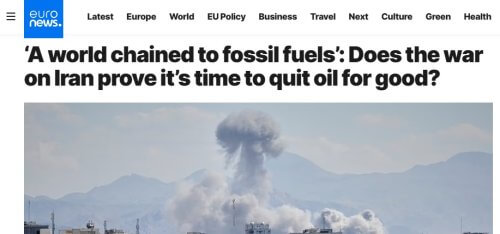
It only get’s more predictable from there.
Oh, but there’s good news too. Major breakthroughs in lab-grown meat tech means “climate-friendly” cubes of yeast goo are going to be easier and cheaper to make.
Isn’t that well timed?
In short, the war in Iran is not a new war, it’s a new theatre of an old war. And theatre is probably a very apt word.
SOURCE: off-Guardian


Leave a Reply