

NICK RENDELL
With her experience as a plumber, could Hannah Spencer MP be a shoo-in as the next Business Minister? Which job might Mothin Ali opt for, Minister of Education or possibly Minister of Housing, Communities and Local Government? It may sound comical but it’s no joke, these people could soon be running the show.
What’s more alarming is that the Greens won’t necessarily need to win a majority at the 2029 General Election to get themselves into the Cabinet. In David Cameron’s 2010 Government, the 57 strong Lib Dems were rewarded with five Cabinet positions in exchange for forming a coalition with the Tories.
I continue to be surprised that so few of the people I discuss the possible outcome of the next General Election with seem to appreciate that the most likely outcome is a ‘progressive’ grouping comprising some or all of the following parties; Labour, Green, SNP, Lib Dem, Plaid Cymru and SDLP.
Current polling puts the combination of ‘progressive’ parties about 6% ahead of the Right of centre parties. However, it’s not just vote share that wins elections, it’s the ability to convert those votes into seats that’s key.
Over the run-up to the next election, it’s possible that the parties on the Right manage to overhaul the Left’s current polling lead but they may still fail to form a government. The reasons are varied. Reform and Conservative voters tend to be more concentrated in the same constituencies than the progressive crowd with the result that, as we saw in 2024, the vote is split, allowing a ‘progressive’ candidate to come through to win.
Adding to the progressive parties’ advantage is the tendency for their voters to be more prepared to vote tactically than voters on the Right often are. Finally, with the SNP, Plaid and Sinn Fein in a strong position to win seats in Scotland, Wales and NI, a progressive alliance could in all probability win a majority on an even lower vote share than Starmer’s record low share of 34% in 2024. Sinn Fein is unlikely to join a coalition but its continued boycott of Westminster effectively reduces the number of seats required for a majority.
Of course, we’re getting into the realm of parlour games here, but I think it’s worth spending a bit of time speculating about what a progressive coalition might look like, where the power would sit and which ministries might go to the junior parties.
A criticism invariably levelled at Reform as a possible party of government is that it lacks the depth of talent and experience required. It’s a valid point. Of its eight current MPs only Suella Braverman and Robert Jenrick have previous senior ministerial experience. But, if it’s true of Reform, what about the Greens, none of whom have prior experience?
A useful guide to how any coalition government in 2029 is constituted may well be the coalition agreement that the Conservatives and the Lib Dems negotiated in 2010. At the time it was assumed that Labour would be a more likely partner for the Lib Dems but, following Lyndon B. Johnson’s famous dictum that the first requirement of a politician is the ability to count, it was clear that Labour and the Lib Dems together would still have been dependent on other third parties to reach a majority. To the surprise of many, Cameron and Clegg found that they could get on well personally and that their political views weren’t so very different – and the result was a surprisingly stable government.
The Lib Dems emerged from the negotiations with Nick Clegg as Deputy PM, Vince Cable as Secretary of State for Business, Innovation and Skills, Chris Huhne as Secretary of State for Energy and Climate Change, Danny Alexander as Secretary of State for Scotland and David Laws as Chief Secretary to the Treasury. Five of the 23 Cabinet posts went to Lib Dems.
It’s perhaps worth repeating an amusing story that Michael Gove tells of how the Lib Dems ended up with the poison pill of university fees. Naturally, the Lib Dems were keen to grab as much turf as possible. Universities, which you might expect to fall within the ‘education brief’, due to various accidents of history ended up on the plate of Vince Cable, the Minister of Business, Innovation and Skills. If only Clegg had been a little more conciliatory or Cable a little less self-aggrandising and let the universities sector revert to Michael Gove’s Education Department then the Liberals would have dodged the student fees betrayal which led to their defenestration at the 2015 election. It’s a lesson any future coalition partner would do well to learn: avoid the hot potatoes!
It’s instructive to look at which ministries Clegg and his team secured. Understandably, the Tories wanted to keep the Great Offices of State, which in addition to that of Prime Minister include the Chancellorship and the Foreign and Home Offices. The Lib Dems in the form of Vince Cable, the ex-chief economist at HSBC, possessed a man with a strong reputation in business and the City. Likewise, Chris Huhne had had a career in journalism and the City and was well known for his strong interest in environmental matters. The Lib Dems clearly looked to play to their relative strengths.
It’s hard to see where the Greens strengths might be, but it’s easy to see where their core interests lie. They’ll look to get the maximum ‘bang for their buck’. The Greens will be ‘culture warriors’ made flesh.
I’m assuming that Labour would be the largest party in any red-green-yellow-rainbow coalition, but that’s by no means certain. However, regardless of which of the parties win the most seats it would seem unlikely that the Greens would get or want the Chancellorship. A Green as Chancellor would inevitably spook the markets. We only have to look back at Liz Truss’s doomed reign to see how the bond markets acting in cahoots with the Establishment can bring down a Prime Minister. Although, in this case, if a newly elected government was brought down by the City and the Establishment within days of being elected, it may cause an unprecedented constitutional crisis.
The only chance for a progressive coalition surviving its first contact with the bond markets is by having a credible Chancellor. What’s more, by agreeing to a Labour Chancellor, the Greens could always subsequently claim that it was the parsimonious Labour Chancellor who prevented them living up to their pre-election promises of extravagant spending.
Something that will hamstring the next government of whichever hue will be the inability to raise spending. Consequently the Greens will look to control ministries where change isn’t necessarily dependent upon big increases in spending, but where they can look to fulfil manifesto pledges.
Coveted departments will be those most associated with cultural change: Education, Culture, Media and Sport and the Department of Housing, Communities and Local Government would be the obvious targets.
If we compare the Green’s 2024 manifesto to that of Labour the differences aren’t so great. However, under Zack Polanski the Greens have shifted their focus away from ‘green’ issues towards a pro-Islamic, anti-Israeli stance.
It doesn’t take a particularly sharp psephologist to recognise that by 2029 there will be about 30 UK constituencies where Muslims represent more than 25% registered voters. Voting as a sectarian bloc for the Greens, in a constituency with a 60% turnout (the turnout in 2024 was 59%), a 25% Muslim vote would represent 42% of all votes cast (if we make the simplifying assumption that all Muslims vote). In a constituency where the non-Muslim vote was split between Labour, Reform, the Tories etc, even without any non-Muslims voting Green then the Muslim vote alone could, on a high enough Muslim turnout, win the seat for the Greens.
Of course, of those constituencies with a high proportion of Muslim voters, three already have Muslim Independent MPs. In addition, Islington North, while having fewer than 15% Muslims amongst its voters, has, in Jeremy Corbyn, an MP who aligns himself with the Muslim Independents.
Interestingly, with the exception of Gorton and Denton, the other Green seats aren’t strongly Muslim areas. Instead, like North Herefordshire, Brighton and Bristol, they tend to be places with a strong ‘alternative’ culture, people genuinely interested in the environment rather than Palestine, having been won prior to Polanski’s leadership and his pivot to Muslim sectarian policies. Such constituencies, alongside those with a disproportionately large student contingent such as Oxford, Cambridge, Bangor, Keele and Loughborough, represent the kind of seats where the Greens can do well.
It’s arguable that the Greens would be able to achieve more (by which I mean do more damage) as part of a progressive coalition than if they won the election outright. Operating under a Labour umbrella that at least kept the bond markets and the Establishment onside, the Greens would have huge leverage to ensure that their Labour Party partners kept to a ‘progressive’ agenda overall, and within those ministries controlled by Greens even more radical policies could be pursued. What might the curriculum look like after a few years of a Green minister of education?
Despite being over three years out from the likely date of the next General Election, the odds of the Greens winning somewhere between 30 and 60 seats are fairly short. The likelihood is that the Lib Dems will also finish up with a similar number of seats leading to the likely outcome that they may both hold the balance of power.
With both the Lib Dems and the Greens supporting rejoining the EU, even if we manage to stay out for the duration of the current Parliament, it seems all too likely that any progressive coalition would see us back in.
The reality is that any progressive coalition would have the tendency to accentuate the more radical policies of each of the constituent parties as each would individually have the power to bring down the Government if its demands aren’t met.
There’s a large faction within the Labour Party that is as alarmed by the prospect of a progressive alliance as are the Tories, recognising that the tail rather than the dog has much of the power. For many in the Labour Party, a coalition with the Greens would be as unthinkable as a coalition with Reform would be for many Tories.
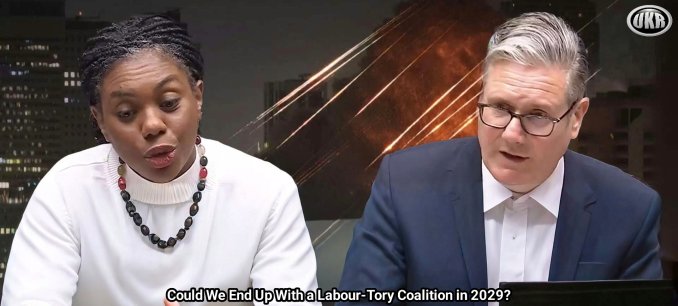
Strangely, I’m beginning to think that the least-worst option come the next election may turn out to be a Labour-Tory coalition. I can’t see any party winning an outright majority and I doubt that the Tories and Reform will get the seats to form an alliance, assuming for a second they could get on well enough to do so. A progressive coalition would trigger a financial crisis, which brings me back to the Labour-Tory coalition.
To borrow a phrase from Sherlock Holmes: “When you have eliminated the impossible, whatever remains, however improbable, must be the truth.” It would be richly ironic if after all these years of claiming to be on opposite poles, Labour and the Tories discovered that becoming a ‘uni-party’ was their only viable option.
This article (Could We End Up With a Labour-Tory Coalition in 2029?) was created and published by The Daily Sceptic and is republished here under “Fair Use” with attribution to the author Nick Rendell

••••
The Liberty Beacon Project is now expanding at a near exponential rate, and for this we are grateful and excited! But we must also be practical. For 7 years we have not asked for any donations, and have built this project with our own funds as we grew. We are now experiencing ever increasing growing pains due to the large number of websites and projects we represent. So we have just installed donation buttons on our websites and ask that you consider this when you visit them. Nothing is too small. We thank you for all your support and your considerations … (TLB)
••••
Comment Policy: As a privately owned web site, we reserve the right to remove comments that contain spam, advertising, vulgarity, threats of violence, racism, or personal/abusive attacks on other users. This also applies to trolling, the use of more than one alias, or just intentional mischief. Enforcement of this policy is at the discretion of this websites administrators. Repeat offenders may be blocked or permanently banned without prior warning.
••••
Disclaimer: TLB websites contain copyrighted material the use of which has not always been specifically authorized by the copyright owner. We are making such material available to our readers under the provisions of “fair use” in an effort to advance a better understanding of political, health, economic and social issues. The material on this site is distributed without profit to those who have expressed a prior interest in receiving it for research and educational purposes. If you wish to use copyrighted material for purposes other than “fair use” you must request permission from the copyright owner.
••••
Disclaimer: The information and opinions shared are for informational purposes only including, but not limited to, text, graphics, images and other material are not intended as medical advice or instruction. Nothing mentioned is intended to be a substitute for professional medical advice, diagnosis or treatment.
Disclaimer: The views and opinions expressed in this article are those of the author and do not necessarily reflect the official policy or position of The Liberty Beacon Project.


Leave a Reply