


IAIN HUNTER

While perusing the digital Telegraph recently my eyes lit upon a story about a revenue, sorry, traffic camera in Oxford which had netted the City Council over £600,000 in fines during its first year of operation. It’s at the Plains roundabout just over Magdalen Bridge and positioned to trap drivers who take the now forbidden but badly signposted sharp left turn from Cowley Road into Iffley Road, something I have done myself in the past when interconnecting streets have been impassable. The story made me start twitching like Captain Queeg in The Caine Mutiny. I hate revenue and spy cameras with a passion.
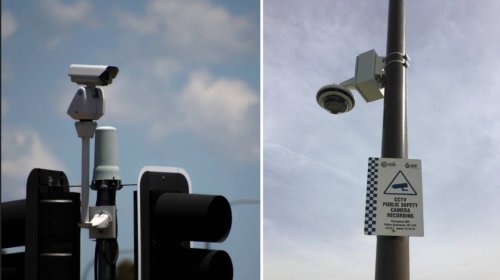
They are everywhere. On the roads, the motorways, monitoring bus lanes, box junctions, guarding car parks, on forecourts recognising our number plates, at supermarket entrances, all around the stores and at the self-checkouts. One does what one can to defeat them in the shops by covering one’s face at the entrance and standing outside the camera’s field of view at the self-check-out, if forced to use one, or by covering it with a hat. But they’re there, surveying, recording, charging and fining us as we go about our lawful daily business.
As with all things, although advanced technology may now be employed, there is very little that is new in this world in principle. So, we should look back to see what some of our forebears did in similar circumstances. We don’t have to go all the way back to the Peasant’s Revolt, or to the Levellers or even the Luddites. The mid 19th Century will do. To mid 19th Century West Wales, in fact, to the counties of Pembrokeshire, Cardigan and Carmarthen between 1839 and 1843. To the Rebecca Riots.
In the late 1830s poverty stalked the land in West Wales. Poor harvests followed prolonged periods of cold and heavy rain (this was during the last years of The Little Ice Age). Farmers had to buy corn at famine prices to feed themselves, their animals and their families, depleting what little capital they might have had. Grain harvests collapsed and the price of butter and livestock were relatively high. By 1842 a general fall in prices occurred throughout the agricultural markets that continued into 1843. Cattle prices slumped sharply in 1842, and the blame was placed on the government, and in particular Robert Peel’s tariff measures which eased importation of foreign cattle and meat. In 1842, the harvest was one of the most successful in years, and that, combined with the contraction in demand, led to a slump in corn prices.
The position of the farmers changed from one of dire grain harvests with life supported by sheep and butter sales, to one where the price of corn was very low. Countrywide, the circumstances had an adverse effect on the prices of butter, cheese, pigs, horses, sheep and lean cattle which hit the Welsh farmers hard.
There was a drastic reduction in their income, but no financial relief in similar reductions in their outgoings – mainly rents, tithes, county rates, poor rates and the turnpike tolls. Farm rents were mainly static, but the tithes, tolls and poor rates increased. Seeing themselves as victims of ‘tyranny and oppression’, the farmers and their workers took the law into their own hands to rid themselves of these taxes. The first institutions to be attacked were the hated toll gates.
The toll gates were operated by turnpike trusts which were supposed to use the toll money to maintain and improve the roads. However, the money was often put to other uses such as filling the bank accounts of the turnpike trust board members. Regardless of where the money actually went, the tolls were an additional burden on the desperately poor rural communities. Matters took a turn for the worse when a group of toll-rentiers bought the right to collect tolls in a number of turnpike trusts and then increased the charges to recoup their investment as quickly as possible.
Farmers could find a way around them by using by-roads, but the toll-collectors countered by setting up sidebar gates. The sidebars were simple tollgates, away from the main turnpike, placed strategically on by-roads to catch anyone who had tried to bypass the main toll booths. These sidebars dramatically increased the cost of farmers’ carting lime to their fields to fertilise and to reduce the acidity of the soil. It was said that it cost ten times as much as the lime itself to cart it from Swansea docks to a farm in the hills.
But it wasn’t just the tollgates that provoked action. They were simply the most tangible representation of a system the rioters loathed and despised. Their only other option would have been to attack the union workhouses as the Poor Law was just as hated as the toll roads. These however could be easily defended and were often garrisoned by troops.
Despite the harshness of life, the people still went to Chapel on Sundays. Legend has it that it was a particular Methodist preacher railing against the turnpike tolls in a sermon and quoting Genesis 24:60 who started the whole affair:
‘And they blessed Rebekah and said unto her, Thou art our sister, be thou the mother of thousands of millions, and let thy seed possess the gate of those which hate them’
And so began the series of protest undertaken by local farmers and agricultural workers in response to the levels of taxation. The rioters, men dressed as women, took their actions against the tollgates and went by the name of Merched Beca which translates directly from Welsh as ‘Rebecca’s Daughters’ or merely ‘The Rebeccas’.
The first protests by “Rebecca” and her “daughters” destroyed the tollgates at Efailwen on the Carmarthenshire/Pembrokeshire border in two attacks in 1839. Other communities later adopted the name and disguise, and other grievances besides the tollgates were aired in the riots. As well as being anti-establishment and anti-extractionist, there was a religious aspect. Anglican clergymen were targets on several occasions. The Church of England could demand tithes and other ecclesiastical benefits even though most of the population of Wales were non-conformist. Other victims were petty local villains such as the fathers of illegitimate children.
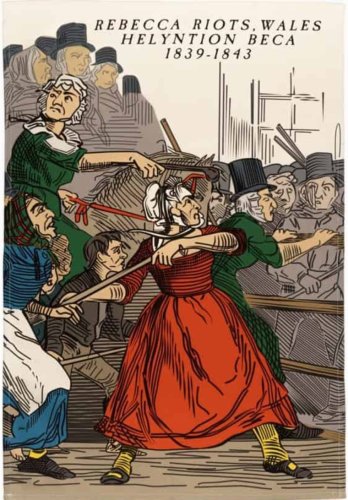
An attack would often start with chants. ‘Rebecca’ would call to his followers who were also dressed as women and then perform a scene along the following lines:
Rebecca: “What is this my children? There is something in my way. I cannot go on….”
Rioters: “What is it, Mother Rebecca? Nothing should stand in your way,”
Rebecca: “I do not know my children. I am old and cannot see well.”
Rioters: “Shall we come and move it out of your way mother Rebecca?”
Rebecca: “Wait! It feels like a big gate put across the road to stop your old mother.”
Rioters: “We will break it down, mother. Nothing stands in your way.”
Rebecca: “Perhaps it will open…Oh my dear children, it is locked and bolted. What can be done?”
Rioters: “It must be taken down, mother. You and your children must be able to pass.”
Rebecca: “Off with it then, My Children”
The tollgates would then be destroyed. Sometimes tollhouses were burned down with them. Although not all members of the mob would wear women’s clothes, those that did, often in white gowns, would also blacken their faces or wear masks. The attacks were accompanied by much noise; and in the earliest, a mock trial would also take place.
The attacks were at first sporadic and infrequent but in the winter of 1842, they intensified becoming widespread. A flash point was when a tollgate was raised by the Mermaid Tavern near the Carmarthenshire village of St Clears. This was an obvious ‘trap’ sidebar and greatly angered the locals who destroyed it and two other gates. Several other tollgates were targeted including the Bolgoed tollgate on the outskirts of Pontarddulais which was attacked and destroyed by a group of some 200 men in July 1843.
Simultaneously representatives of the Rebeccas sent letters to the landlords of farmers. In a move away from simply attacking the tollgates alone they brought out more general grievances. The landlords were threatened if they did not make reductions in the rent of their tenant farmers. Farmers were also holding open protest meetings demanding a lowering of rent by at least a third. In the end, the threats came to little and the meetings had no effect. The rents remained the same and within a month the farmers had changed tactics and began calling for an independent assessment of the regulations of rents.
There was an element of self-preservation in the farmers’ scaling back on violent activity: The presence of increased numbers of dragoons brought in to keep the peace. At the same time groups of petty criminals masquerading as Rebecca and operating from Five Roads near Llanelli turned more respectable people away from the ‘Rebeccas’. However, the leaders of the criminal group, the known trouble-maker John Jones (Shoni Sguborfawr) and David Davies (Dai’r Cantwr), were apprehended, convicted and transported to Australia.
The ‘Rebeccas’ failed to produce an immediate effect on the lives of the farmers they had sought to serve but the very nature of a leaderless uprising of the downtrodden peasantry in an attempt to obtain justice from an unfair system, was an important socio-political event in Wales which still grips people’s imaginations today.
In the aftermath of the riots, some rent reductions were achieved, the toll roads were improved (although destroyed tollhouses were rebuilt) and a royal commission into the question of toll roads led to the South Wales Turnpike Trusts Act 1 1844. This Act consolidated the trusts, simplified the rates and reduced the hated toll on lime movement by half. The riots were also an inspiration for later Welsh protests such as opposition to the privatisation of salmon reserves on the River Wye in the 1860s and 70s, which became known as ‘the second Rebecca riots’.
Could people be stirred by the example of Rebecca and her Daughters to rise against the proliferation of revenue and surveillance cameras, an important part of the infrastructure of digital ID and CBDC? I have my doubts at the moment, but more and more people are now awake and as things tighten up around us in the years running down to 2030 who knows what might happen?
Already the ‘Bladerunners’ in London have acted against ULEZ cameras. Would it be a fantasy to imagine groups of men going into supermarkets, car parks and other surveilled public places equipped with angle grinders, heavy claw hammers, chains and ladders, there to end the useful employment of many a revenue and surveillance camera? History shows that only 1% to 3% of a population, committed and organised, are needed to effect real change. Seven-hundred thousand to two million men and women acting nationwide in a co-ordinated manner would end this and “the forces of law and order” could not cope.
Notes: Several novels were written about the Rebecca Riots, notably The Hosts of Rebecca by Alexander Cordell and Rebecca Riots by Amy Dilwyn.
Dylan Thomas wrote a screenplay titled Rebecca’s Daughters in 1948, but it wasn’t turned into a film until 1992. A comedy, it starred Peter O’Toole as the drunken, mad, decadent Lord Sarn, county judge and Chairman of the turnpike trust, John Rhys as the young squire who decides to become Rebecca and Joely Richardson as Rhiannon, his love interest. Ray Gravell, the former 1980s Wales rugby star has a part as one of the farmers. It starts well with some good, humorous lines but descends into farce before the end. It can be found on YouTube.
If you’re touring in West Wales, you can enjoy breakfast, lunch or afternoon tea at Caffi Beca in Efailwen where it all started.

Safety is the smokescreen for revenue collection. The beast system extraction, that is what it is all about.
This article (Cameras – What Would Rebecca’s Daughters Do?) was created and published by Free Speech Backlash and is republished here under “Fair Use” with attribution to the author Iain Hunter

••••
The Liberty Beacon Project is now expanding at a near exponential rate, and for this we are grateful and excited! But we must also be practical. For 7 years we have not asked for any donations, and have built this project with our own funds as we grew. We are now experiencing ever increasing growing pains due to the large number of websites and projects we represent. So we have just installed donation buttons on our websites and ask that you consider this when you visit them. Nothing is too small. We thank you for all your support and your considerations … (TLB)
••••
Comment Policy: As a privately owned web site, we reserve the right to remove comments that contain spam, advertising, vulgarity, threats of violence, racism, or personal/abusive attacks on other users. This also applies to trolling, the use of more than one alias, or just intentional mischief. Enforcement of this policy is at the discretion of this websites administrators. Repeat offenders may be blocked or permanently banned without prior warning.
••••
Disclaimer: TLB websites contain copyrighted material the use of which has not always been specifically authorized by the copyright owner. We are making such material available to our readers under the provisions of “fair use” in an effort to advance a better understanding of political, health, economic and social issues. The material on this site is distributed without profit to those who have expressed a prior interest in receiving it for research and educational purposes. If you wish to use copyrighted material for purposes other than “fair use” you must request permission from the copyright owner.
••••
Disclaimer: The information and opinions shared are for informational purposes only including, but not limited to, text, graphics, images and other material are not intended as medical advice or instruction. Nothing mentioned is intended to be a substitute for professional medical advice, diagnosis or treatment.
Disclaimer: The views and opinions expressed in this article are those of the author and do not necessarily reflect the official policy or position of The Liberty Beacon Project.


Leave a Reply