

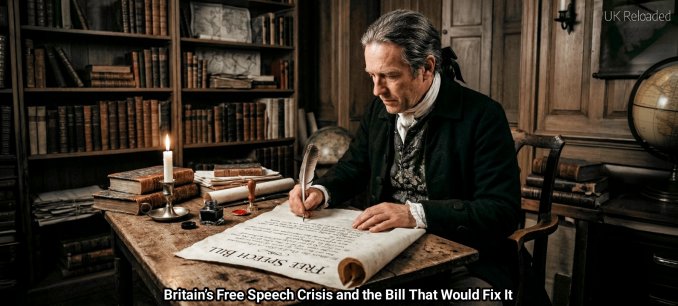
After centuries of prosecuting people for what they say, Britain may be closer than it has ever been to making free speech an actual legal right.
AL LOXLEY
Preston Byrne is a dual-qualified English solicitor and American attorney.
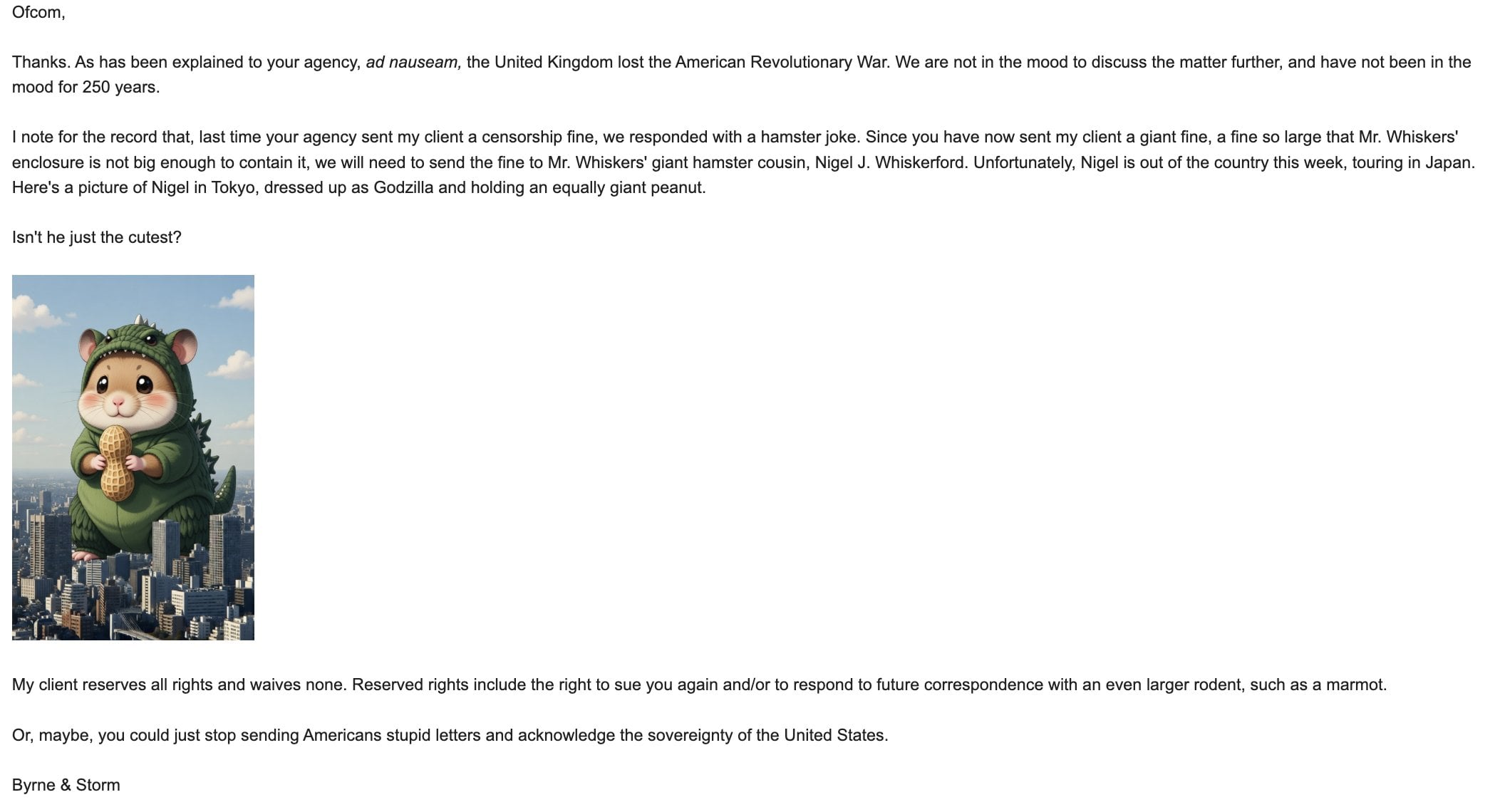
He is currently suing the British speech regulator on behalf of 4chan in US federal court. And when Britain’s internet regulator, Ofcom, sent his client a £520,000 fine for the crime of not checking the age of every visitor, Byrne responded by emailing them an image of a giant hamster dressed as Godzilla, holding a peanut.
The hamster’s name is Nigel J. Whiskerford. He is the giant cousin of Mr. Whiskers, the regular-sized hamster Byrne sent Ofcom the last time they tried to fine 4chan.
The email also noted that 4chan “reserves all rights and waives none,” including “the right to sue you again and/or to respond to future correspondence with an even larger rodent, such as a marmot.”
This is the funniest thing to happen in international regulatory law since, well, ever.
But the hamster was never the point.
The point was that the British government spent £169 million building an online censorship apparatus, staffed it with hundreds of bureaucrats, gave it the power to fine companies up to 10% of their global revenue, and the first time it tried to use those powers against someone who could fight back, it was defeated by a picture of a rodent in a lizard costume.
Which brings us to the Free Speech Act 2026, published this week by the Adam Smith Institute. Byrne wrote it, along with two co-authors named Elijah Granet and Michael Reiners, and it is, without exaggeration, a proposal to burn down the entire British censorship state and salt the earth where it stood.
Seven Acts of Parliament repealed. Ofcom’s online safety empire dismantled. Every conviction under the repealed laws annulled. The whole lot. Gone. Finished. Replaced with a simple statutory right that says: the state cannot punish you for speaking.
It is magnificent. And it will be fought with every weapon available by every institution that currently profits from telling you what you’re allowed to say.
Britain Pretends It Has Free Speech
“We’ve had free speech for a very, very long time in the United Kingdom, and it will last for a very, very long time.”
That was Prime Minister Keir Starmer, speaking to US President Donald Trump and Vice President JD Vance in the Oval Office in February 2025.
Seven months later, five armed police officers arrested Graham Linehan at Heathrow Airport. Linehan is an Irish comedy writer. He created Father Ted. He created The IT Crowd. His crime was posting three tweets from Arizona.
His original bail condition was that he could not use X while in the UK. Even Starmer admitted the police might have gone a bit far. He did not, naturally, change the law that sent them.
This is what “free speech” looks like in Britain, and it has looked like this for quite some time.
Nobody was paying attention because the people being arrested were usually not famous comedy writers who could generate international headlines. They were ordinary people. The sort of people governments find it very easy to prosecute because nobody important will kick up a fuss.
Freedom of information requests compiled by The Times found that over 12,000 people were arrested under the Communications Act and the Malicious Communications Act in 2023. Twelve thousand people. That is 30 arrests a day, every day, for posting things on the internet that someone, somewhere, found “grossly offensive.” The maximum sentence is two years in prison. For writing something rude on Facebook. You could burgle a house and get less.
And these are just the arrests. The real damage is invisible. Polling by YouGov for Prospect magazine found that nearly half of Britons say they cannot say what they think about important issues. In 2026. In a country whose Prime Minister flew to the White House to announce, with a straight face, that free speech is one of Britain’s “founding values.”
A Brief History of Britain Not Having Free Speech
Starmer’s claim that Britain has “had free speech for a very, very long time” is, to put it charitably, historically creative. It is the kind of statement you make when you are confident that nobody in the room has read a book.
The first law against free expression in England was the Statute of Westminster in 1275. It made it a crime to say anything that brought the King into “hatred or contempt.”
The Treason Act of 1351 made criticizing the Crown punishable by death. When the printing press appeared, the Crown immediately established a licensing monopoly to control it.
Tom Paine published The Rights of Man in 1791 and was convicted of seditious libel in absentia. He had to flee to France to avoid prison. Over 200,000 copies of his book sold anyway, because the British people have always been more committed to free speech than the British state.
After the Peterloo Massacre in 1819, Parliament passed the Six Acts, which tightened seditious libel laws and imposed taxes on newspapers to prevent the working class from reading them.
Richard Carlile was jailed for three years for publishing articles about Peterloo. His wife kept publishing while he served his sentence. The British spirit of free expression has never been a gift from the government. It has always been an act of defiance against it.
The Bill of Rights of 1689, which everyone likes to wave about as evidence of Britain’s ancient liberties, guaranteed freedom of speech in Parliament. Not outside it. MPs could say what they liked. Everybody else could shut up or go to prison.
Seditious libel was not formally abolished until 2009. Blasphemous libel survived until 2008. When Parliament finally repealed them, the Ministry of Justice cheerfully acknowledged that their existence had been used by authoritarian governments around the world as justification for their own speech laws. Well done, Britain. Medieval censorship stayed on the books until the year the iPhone 3GS came out, and dictators were copying the homework the entire time.
The honest version of Starmer’s Oval Office pitch would have been: “Britain has had a culture of people bravely speaking despite the law for a very, very long time, and a state apparatus dedicated to punishing them for it for roughly the same period.”
The Machine That Ate People’s Rights
The modern version of the censorship state didn’t appear overnight. It was assembled piece by piece, each component presented as a reasonable response to a genuine problem, each one drafted broadly enough to catch everything from death threats to bad jokes.
The Public Order Act 1986 made it a crime to use “threatening, abusive or insulting” words likely to cause “harassment, alarm or distress.” Note the word “insulting.” Not threatening. Not violent. Insulting. The standard was the feelings of the person who heard you. If they were distressed, you were a criminal. If they were a particularly delicate soul who found everything distressing, you were especially criminal.
Section 127 of the Communications Act 2003 criminalized sending “grossly offensive” messages. The Malicious Communications Act 1988 covered “indecent or grossly offensive” material causing “distress or anxiety.” Each of these laws came with comforting rhetoric about harassment and public safety. Each one gave police the power to arrest someone for posting something rude on the internet.
And arrest they did. Enthusiastically. The numbers doubled between 2017 and 2023. Less than one in ten arrests led to a conviction, which tells you everything about the real purpose. The arrest was the punishment. The knock on the door at six in the morning. The seized laptop. The months of uncertainty. The mugshot. The chilling effect, which is the polite term for terrorizing an entire population into silence by publicly destroying a handful of them.
Then came the Online Safety Act 2023. This was supposed to be the Rolls-Royce of internet regulation. Parliament spent years on it. It turned out to be a clown car.
The government gave Ofcom an estimated £169 million to build the enforcement machine. They hired hundreds of staff. They wrote codes of practice that run to thousands of pages. They gave themselves the power to fine companies up to £18 million or 10% of global revenue, whichever was higher. Criminal liability for directors. Business disruption measures. The works.
Ofcom’s enforcement director, Suzanne Cater, declared that “2025 is the year of action” and promised to “drag them kicking and screaming into compliance.”
The first major target was 4chan. 4chan’s lawyer sent back a hamster. Then sued Ofcom in federal court. Then, it started writing legislation to make it illegal for Ofcom to do what it was doing. The hamster went more viral than any Ofcom enforcement notice in history.
It would be funny if it weren’t so expensive. British taxpayers paid for this. They paid for the staff, the investigations, the codes of practice, the enforcement programs, and the fines that will never be collected from a man who responds to regulatory correspondence with pictures of rodents.
Meanwhile, the same taxpayers are being arrested at a rate of 30 a day for saying things on the internet that someone found offensive.
Why They’ll Fight to Keep It
The Free Speech Act would end all of this. And that is precisely why it will face the most ferocious opposition from the people who should be most ashamed of the current system.
Start with Ofcom. You don’t spend £169 million building an empire and then let someone repeal it. Ofcom has staff. Ofcom has budgets. Ofcom has enforcement programs and codes of practice and a director who goes on the record promising to drag people kicking and screaming.
They will, of course, frame it as being about the children. This is the rhetorical equivalent of a human shield. “If you repeal the Online Safety Act, children will see terrible things on the internet.”
The Free Speech Act actually addresses this directly. It imposes a mandatory obligation on platforms to detect and remove child sexual abuse material and report it within 24 hours. What it removes is Ofcom’s power to censor legal speech. But that distinction, the difference between protecting children and controlling adults, is one that censors have spent the entire history of civilization trying to blur.
Then there’s the government. Labour supported the Online Safety Act. Well, technically, the Conservatives passed it, but Labour has embraced it with the fervor of a convert who has just discovered religion. Admitting the whole thing was a mistake, that the censorship apparatus should be scrapped, that thousands of people were arrested for things that should never have been crimes: that would require a level of honesty from politicians that does not exist in nature.
The Conservatives, meanwhile, had 14 years in government to do something about speech prosecutions. They did nothing. Rishi Sunak publicly opposed Scotland’s hate crime law. He did not repeal it. He did not pass alternative legislation. He made a disapproving face and moved on. The Conservative Party’s contribution to free speech in Britain has been roughly equivalent to expressing concern about a house on fire while holding the matches.
And then there are the quiet beneficiaries. The lobbying groups that have discovered it’s much easier to get their opponents’ speech classified as “harmful” and deleted than to win an argument. The university administrators who have built entire departments around speech codes and training that the Free Speech Act would render illegal. The compliance industry, which makes a very comfortable living telling organizations how to avoid running afoul of speech laws that shouldn’t exist.
These people are not going to send a letter saying “please don’t repeal the censorship that keeps me employed.” They’re going to send a letter saying, “if you repeal these laws, people will be harmed.” Same letter. Different gift wrap.
The American Comparison They Don’t Want You to Make
The Free Speech Act is modeled on the First Amendment of the United States Constitution. This comparison is useful because it immediately exposes the absurdity of every argument against it.
The United States has 350 million people, more guns than people, a political culture that sometimes makes a Premier League locker room look civilized, and social media platforms that host every conceivable variety of unpleasant opinion. It manages all of this with a 45-word constitutional amendment that says, essentially: the government cannot punish you for speaking.
America prosecutes genuine threats. America prosecutes fraud, perjury, and incitement to imminent violence. America protects children from exploitation. America does all of this without arresting comedy writers at airports or jailing women for tweets they deleted and apologized for.
The argument that Britain cannot do what America has done for over two centuries is, when you think about it, an argument that the British people are somehow less mature than Americans. That they are too fragile to handle disagreement. That they need the government to protect them from opinions, like children who might hurt themselves if left alone with scissors. Anyone should find this argument deeply insulting, which in the current legal climate may actually be a criminal offense.
What Happens Next
The Bill was published this week. Any MP can pick it up. Byrne says a couple of parliamentarians know it’s coming. He told GB News that “this bill is designed to do something very simple: It gets the Government out of the business of policing the opinions of the British people.”
The Bill’s authors frame the question as binary. “Do you want the UK to have a free speech right that is equivalent to the First Amendment?” Yes or no. No “yes, but.” No “in principle, subject to safeguards.” Yes or no.
This will drive the political establishment absolutely insane, because the political establishment has spent decades perfecting the art of answering that question with a paragraph that sounds like yes but means no.
The whole infrastructure of modern British censorship has been built on the proposition that free speech is wonderful, in theory, but that in practice there need to be rules about what people can say, and the rules need to be flexible, and someone needs to enforce them, and that someone needs a budget and a staff and the power to fine you into oblivion, and before you know it the country is spending £169 million and arresting 12,000 people a year and sending five armed officers to Heathrow to intercept a comedy writer who posted something rude from Arizona.
The Free Speech Act says: stop. All of it. Now. Replace it with a right.
Define the narrow exceptions. Let the courts handle the edges. Trust the British people to be adults.
This is, admittedly, asking a great deal of a political class that has spent two decades building the opposite system. Ofcom will not go quietly. There are hundreds of people in Whitehall and beyond whose careers depend on the continued existence of laws that criminalize speaking your mind.
The newspapers will fill with op-eds warning of the terrible consequences of allowing British people to say what they think without first checking whether someone, somewhere, might be upset.
But half the population is afraid to speak. Twelve thousand people a year are arrested for words. A man was convicted for praying silently. A woman got 31 months in prison for a tweet she deleted within two hours.
The Prime Minister tells the world Britain protects free speech fiercely, while the country he governs has been downgraded by international monitors to below “Open” status for the first time in history.
This article (Britain’s Free Speech Crisis and the Bill That Would Fix It) was created and published by Reclaim the Net and is republished here under “Fair Use” with attribution to the author Al Loxley
See Related Article Below
Does the UK need a US-style First Amendment?
How can we change the law to guard free speech and build an anti-censorship culture to tackle the daily threats to free expression? A proposed new Freedom of Speech Bill looks promising.
CLAIRE FOX
I spend a lot of time as a legislator in the House of Lords, working on trying to stop the law increasing its censorious powers, expanding the state’s stifling power to criminalise speech said to create hate, harm and offence. I recently supported Lord Jon Moynihan who tabled two detailed amendments trying to untangle present laws in order to allow a presumption of free speech. See his speeches here. (You can also watch and a couple of my contributions further down.)
Jon Moynihan on removing criminalisation of some ‘hate’ speech.
Jon Moynihan on removing criminalisation of elements of hate crime itself.
So it is exciting to see this new initiative from The Adam Smith Institute: a proposed new rigorously drafted and legally sound Freedom of Speech Bill. The Bill has been jointly authored by a radical lawyer based in the US, Preston Byrne, the ASI’s legal fellow and partner at Byrne & Storm LLP, alongside Cambridge-educated English lawyer Michael Reiners, who writes on UK constitutional and political issues, and Elijah Granet, who has dual English and American legal training with professional experience consulting in legislative drafting and analysis.
The proposed law announces itself as: ‘A BILL to recognise and restore the ancient liberty of free speech; to protect expression by the public, subject only to narrow and objective exceptions; to restrict the power of public authorities and essential services to interfere with lawful expression; to repeal or amend enactments which criminalise expression by reference to offence or distress; and for connected purposes.’
You can read the proposed Bill here.
In a joint essay on why they feel this US-proposed UK Free Speech Act is needed, its authors write: ‘This Bill, if enacted, would have a similar effect as the First Amendment in the United States of America, protecting British citizens from government censorship. However, in addition to its protections, the Bill would also prohibit the state from withholding information (other than that which could compromise national security)… There is rarely a liberty more important than that of speech – Thomas Paine, the great contemporary of Adam Smith, wrote “he who dares not offend, cannot be honest”.’ (See the full essay at the Adam Smith Institute website.
Preston Byrne’s Freedom of Speech Bill is a fantastic contribution to this discussion and has already created a lively debate that hopefully adds to re-energising the growing campaign to make speech less strangled by law. But can we really emulate the First Amendment to the US Constitution, passed in 1791, that provides that ‘Congress shall make no law… abridging the freedom of speech or of the press’?
In 2025 Britain, is the spirit that informed the American’s revolutionary First Amendment feasible? And is changing the law the key arena for change? We debated that very question at the Battle of Ideas festival in 2024 – a discussion I really enjoyed chairing because I kept changing my mind. It featured Nico Perrino, executive vice president, Foundation for Individual Rights and Expression (FIRE), Tom Slater, editor, spiked, Thomas Walker-Werth associate editor, The Objective Standard, and Toby Young general secretary, Free Speech Union.
Use this button to listen to the debate on the Battle of Ideas Audio Archive:
Is law change enough?
Law change, and parliament’s role in repealing laws, are definitely desirable, but absolutely not sufficient to tackle the retreat from belief in free speech as a cornerstone of democratic values. For example, parliament recently passed the Higher Education (Freedom of Speech) Act 2023. but campus life for students and academics continues to be a minefield of EDI and censorious regulatory trip-wires that curtail open discussion. The fight for free speech always needs the dynamism of grassroots, bottom-up pressure.
Also, this week the Home Office has announced that at long last it has dumped its invidious non-crime hate incidents. Brilliant news. Those of us who have constantly tried to bring in amendments and force successive governments to act, may well be pleased that at last – via the current Crime and Policing Bill – Labour has succumbed. But we also need to recognise that the real force for change came from outside of parliament.
Credit must go to many people: from former police officer Harry Miller, co-founder of the campaign group Fair Cop (whose LONG fight is summed up here), to journalists such as Allison Pearson (whose writing about her personal experience of NCHIs gained international attention). And credit, too, to all those individuals who fought back (and spoke out), often by taking their cases to the Free Speech Union, which admirably amplified just how far-reaching and unjust these mechanisms for police intimation of citizens for everything from their online posts to ‘wrongthink’ opinions, often expressed privately.
The fear now is that while non-crime hate incidents have been dispatched formally, the culture behind them remains undisturbed. Their ideological premise is still deeply embedded, both in the labyrinth of hate-crime legislation on the statute books but more broadly in policing, HR departments across public- and private-sector workplace. This culture has been especially damaging for younger generations socialised into believing that words, attitudes and beliefs are harmful, and can be interpreted as ‘hate’ subjectively by the alleged victim or a third party and assumed to be motivated by hostility or prejudice towards people with protected characteristics – not proven, but presumed.
That is why some free-speech campaigners are concerned that non-crime hate incidents may well be rebranded (and already the Labour government is talking about using anti-social behaviour regulations such as respect orders, that will be used to surveil, silence and punish those accused of having hateful attitudes.
Building a culture of free speech
So, while we at the Academy of Ideas welcome any law change that rolls back censorship, we feel lots more needs to be done to take on the culture of associating speech with harm. We believe this is essential to counter today’s culture that actively undermines the habit of exercising free speech and has weakened our collective capacity to tolerate disagreement, risk offence and argue ideas in public. I discuss this in depth in a filmed interview with Swiss magazine Schweizer Monat below.
We aim to restore a confident and resilient culture of free expression, and one way we do that is by creating practical opportunities – events, forums and networks – where people come together and can speak freely, exercise the neglected muscle of arguing openly without taking offence and test ideas in public.
If this appeals, please join us and support our work using this button:
Alternatively, become a paid subscriber to this Substack using the button below:
In the meantime, HUGE CONGRATULATIONS to Preston Byrne, Michael Reiners, Elijah Granet and the Adam Smith Institute for its Freedom of Speech Bill. That’s the sort of ‘special relationship’ we need with colleagues in the US. Let’s hope it gets a proper hearing in parliament and amongst the public, so that it becomes part of the anti-censorship culture we so desperately need.
Claire
This article (Does the UK need a US-style First Amendment?) was created and published by Claire Fox and is republished here under “Fair Use”

••••
The Liberty Beacon Project is now expanding at a near exponential rate, and for this we are grateful and excited! But we must also be practical. For 7 years we have not asked for any donations, and have built this project with our own funds as we grew. We are now experiencing ever increasing growing pains due to the large number of websites and projects we represent. So we have just installed donation buttons on our websites and ask that you consider this when you visit them. Nothing is too small. We thank you for all your support and your considerations … (TLB)
••••
Comment Policy: As a privately owned web site, we reserve the right to remove comments that contain spam, advertising, vulgarity, threats of violence, racism, or personal/abusive attacks on other users. This also applies to trolling, the use of more than one alias, or just intentional mischief. Enforcement of this policy is at the discretion of this websites administrators. Repeat offenders may be blocked or permanently banned without prior warning.
••••
Disclaimer: TLB websites contain copyrighted material the use of which has not always been specifically authorized by the copyright owner. We are making such material available to our readers under the provisions of “fair use” in an effort to advance a better understanding of political, health, economic and social issues. The material on this site is distributed without profit to those who have expressed a prior interest in receiving it for research and educational purposes. If you wish to use copyrighted material for purposes other than “fair use” you must request permission from the copyright owner.
••••
Disclaimer: The information and opinions shared are for informational purposes only including, but not limited to, text, graphics, images and other material are not intended as medical advice or instruction. Nothing mentioned is intended to be a substitute for professional medical advice, diagnosis or treatment.
Disclaimer: The views and opinions expressed in this article are those of the author and do not necessarily reflect the official policy or position of The Liberty Beacon Project.


Leave a Reply