Is history being repeated today with The Coming of Islam?

TOM ARMSTRONG
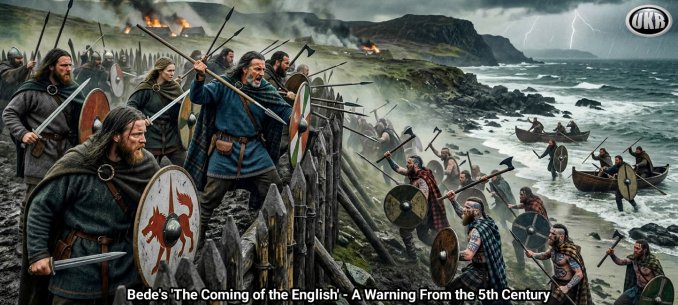
The Venerable Bede’s Ecclesiastical History of the English People, completed around 731 AD, provides one of the earliest and most influential accounts of the arrival of the Germanic peoples in Britain, often referred to as “The Coming of the English.” While Bede draws on earlier sources like Gildas, his narrative integrates historical events with a Christian providential lens, framing the migration as part of God’s plan for the island’s conversion. This story also echoes entries in the Anglo-Saxon Chronicle, a collection of annals compiled from the late 9th century onward, which records similar events under the year 449 AD. Together, they describe a pivotal transformation in Britain’s demographic, cultural, and political landscape during the 5th century, following the collapse of Roman authority.
Bede begins his relevant section in Book I, Chapter 15, by setting the scene in post-Roman Britain. After the Roman legions withdrew around 410 AD, the native Celtic Britons faced relentless raids from northern invaders: the Picts from what is now Scotland and the Scots (Irish raiders). The Britons, weakened by the loss of Roman protection and internal strife, struggled to defend their lands. In desperation, they appealed to the Roman consul Aetius for aid, but none came. Bede quotes their plea: “The barbarians drive us to the sea; the sea throws us back on the barbarians: thus two modes of death await us; we are either slain or drowned.” This vulnerability set the stage for foreign intervention.
According to Bede, in 449 AD, the Britons, under their leader Vortigern (a semi-legendary king), invited Germanic mercenaries from the continental tribes of the Angles, Saxons, and Jutes to assist in repelling the northern threats. These warriors hailed from regions in modern-day northern Germany, Denmark, and the Netherlands, areas Bede specifies as Anglia, Saxony, and Jutland. The first contingent, led by the brothers Hengest and Horsa, landed at Ebbsfleet in Kent with three ships. They were promised land and provisions in exchange for their military service. Initially, the arrangement worked: the Germanic forces defeated the Picts and Scots, securing victories wherever they fought.
However, the alliance quickly soured. Bede describes how the mercenaries, impressed by Britain’s fertility and the Britons’ perceived weakness, sent word back to their homelands for reinforcements. More ships arrived, carrying not just warriors but entire families, signalling a shift from temporary aid to permanent settlement. The Anglo-Saxon Chronicle mirrors this, noting: “They described the worthlessness of the Britons, and the richness of the land. They then sent them greater support.” What began as a defensive pact devolved into betrayal. The Germanic settlers turned their arms against their hosts, launching campaigns of conquest. Hengest and Horsa fought Vortigern at Aylesford in 455 AD, where Horsa was slain, but the Saxons pressed on, establishing kingdoms like Kent under Hengest.
Bede traces the origins of the English peoples from these tribes: the Jutes settled in Kent and the Isle of Wight; the Saxons in Essex, Sussex, and Wessex; and the Angles in East Anglia, Mercia, and Northumbria. He lists their genealogies back to Woden, emphasising their pagan roots before Christian conversion. The migration wasn’t a single event but a prolonged process spanning generations, involving waves of settlers who displaced or subjugated the Britons. Bede notes the cultural and linguistic overhaul: the Britons’ Celtic language retreated to Wales, Cornwall, and Scotland, while Old English took root in the east and south.
Violence marked this era. Bede draws from Gildas, who lambasted the Britons’ sins as inviting divine punishment through the “barbarian” invaders. Battles like Badon Hill (around 500 AD, possibly led by the legendary Arthur) temporarily halted the advance, but the Germanic kingdoms expanded westward. By the 6th century, the Anglo-Saxons dominated much of what became England, pushing Britons into the peripheries. Bede views this as providential: the pagans’ arrival paved the way for Pope Gregory’s mission in 597 AD, led by Augustine, which converted the English to Christianity. Yet, he laments the displacement, describing sacked cities and slaughtered priests.
The Chronicle adds chronological detail, recording under 449: “Hengest and Horsa, invited by Vortigern… landed in Britain… first of all to support the Britons, but they afterwards fought against them.” It lists subsequent invasions and battles, culminating in the establishment of Anglo-Saxon hegemony. Modern archaeology and genetics support elements of this: DNA studies show significant continental admixture in eastern England, suggesting mass migration rather than mere elite takeover, with estimates of 10-40% Germanic ancestry in the population. Some scholars argue for an “apartheid-like” structure, where Germanic elites enjoyed higher status, accelerating cultural replacement.
In essence, Bede’s account portrays an invited migration that morphed into conquest, erasing much of Romano-British culture and birthing a new English identity. It’s a tale of opportunity seized, alliances broken, and a land forever changed. And, from those events fifteen hundred years ago, my fellow Sunderland man Bede sounds a warning to us today.
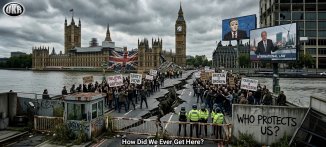
Just as the Britons of the 5th century invited Germanic warriors to bolster their defences, only to see those allies overrun their homeland, Britain today risks a similar fate through unchecked Muslim immigration. What began, ostensibly at least, as post-war labour recruitment has evolved into a demographic tidal wave, threatening to submerge native British culture, sovereignty, and way of life. If trends continue, the United Kingdom could face a dystopian transformation far more insidious than the Anglo-Saxon conquest, one where sharia influences supplant common law, parallel societies erode national unity, and the indigenous population becomes a minority in its ancestral lands. This isn’t scaremongering; it’s a stark projection based on current statistics and societal fractures.
Consider the parallels. In Bede’s era, the Britons, exhausted by raids and economic decline, welcomed Hengest’s forces for security and prosperity. Similarly, after World War II, British governments invited workers from Pakistan, Bangladesh, and other Muslim-majority nations allegedly to help rebuild its economy but in reality to keep wages low. The 1948 British Nationality Act opened doors, and by the 1960s, chain migration swelled numbers. Today, the Muslim population is at least 4 million, or 6% of the UK total, up from 2.7 million (4.9%) in 2011, a terrifying 44% increase in a decade. Projections are alarming: Pew Research estimates that by 2050, under high migration scenarios, Muslims could comprise 17.2% of the population, or 13.5 million. In cities like London, where Muslims are already 15%, or Tower Hamlets at 40%, the shift is palpable.
But numbers alone don’t capture the threat. Like the Anglo-Saxons who initially fought alongside Britons but soon demanded more, some Muslim communities have barely integrated, often forming enclaves that prioritise religious and cultural norms over British values. Surveys reveal stark divides: a 2016 ICM poll found 23% of British Muslims supported introducing sharia law in parts of the UK, while 52% believed homosexuality should be illegal. More recent polling shows 41% of Britons view Muslim immigrants negatively, with 31% believing Islam encourages violence. Younger, UK-born Muslims, because of anti-British woke education, are paradoxically less integrated, more likely to identify with faith over nationality, and view Britain as intolerant. This “integration paradox” mirrors the Anglo-Saxon settlers’ growing assertiveness, leading to cultural dominance.
Critics from diverse viewpoints highlight failures. From a conservative lens, Dame Louise Casey’s 2016 review exposed self-segregation, with some Muslim communities resisting British norms on gender equality and free speech. Liberal voices, like Trevor Phillips, warn that Muslim integration is “the hardest task we’ve ever faced,” citing radicalisation risks indicated by a 2024 Henry Jackson Society poll that found 46% of British Muslims sympathize with Hamas, and nearly half believe Jews have too much influence over government. Fear of Islam and antipathy towards Muslims is real with 70% of Muslims reporting increased anti-Muslim ‘hate’ since October 2023, but the unpalatable fact is that this main stems from actions like the predominantly Muslim grooming gangs, demands for Sharia, claims of ‘Muslim areas’ and of course Islamist terror.
Project this forward, and Britain becomes unrecognisable. High birth rates (Muslim median age: 29 vs. 44 overall) and continued migration could make Muslims a plurality in key regions by mid-century. Enclaves like Birmingham or Bradford already resemble Bede’s conquered territories, with halal mandates in schools and burqa debates fracturing cohesion. Sharia councils, numbering over 85, handle disputes outside common law, echoing Germanic tribal customs supplanting Roman-British systems. Radical elements exploit this: grooming scandals in Rotherham involved 1,400 victims, often dismissed due to cultural sensitivities. Political infiltration grows with Muslim MPs influence on foreign policy on Gaza, paralleling Anglo-Saxon kings imposing pagan rites on Chrisitan Celts.
From perverted progressive angles, integration is a “two-way street,” hindered by racism and poverty (Muslims face higher deprivation). Yet, self-isolation persists: ethnographic studies show British Muslims feeling “exiled at home,” with stereotypes fuelling alienation. One in three Muslims has considered emigrating due to Islamophobia, but many stay, demanding accommodations that erode secular norms. This mirrors Britons fleeing westward as Anglo-Saxons advanced.
The endgame? A fractured UK, where native Christians (now 46%) dwindle, “no religion” rises to 38%, but Islam surges. Sovereignty erodes as supranational influences, EU echoes or global ummah loyalties, prioritise foreign agendas. Economic strain mounts: Muslims occupy 27% of social housing vs. 17% overall. Parallels to the Anglo-Saxon “apartheid” are drawn by scholars, warning of structural divisions. If unaddressed, Britain risks becoming a caliphate-lite, its heritage lost like the Britons’ Celtic legacy.
Patriots must act: enforce borders, promote assimilation, reject multiculturalism’s pitfalls. Bede’s lesson is clear—invited guests can become conquerors. Ignore it, and the UK dissolves.

••••
The Liberty Beacon Project is now expanding at a near exponential rate, and for this we are grateful and excited! But we must also be practical. For 7 years we have not asked for any donations, and have built this project with our own funds as we grew. We are now experiencing ever increasing growing pains due to the large number of websites and projects we represent. So we have just installed donation buttons on our websites and ask that you consider this when you visit them. Nothing is too small. We thank you for all your support and your considerations … (TLB)
••••
Comment Policy: As a privately owned web site, we reserve the right to remove comments that contain spam, advertising, vulgarity, threats of violence, racism, or personal/abusive attacks on other users. This also applies to trolling, the use of more than one alias, or just intentional mischief. Enforcement of this policy is at the discretion of this websites administrators. Repeat offenders may be blocked or permanently banned without prior warning.
••••
Disclaimer: TLB websites contain copyrighted material the use of which has not always been specifically authorized by the copyright owner. We are making such material available to our readers under the provisions of “fair use” in an effort to advance a better understanding of political, health, economic and social issues. The material on this site is distributed without profit to those who have expressed a prior interest in receiving it for research and educational purposes. If you wish to use copyrighted material for purposes other than “fair use” you must request permission from the copyright owner.
••••
Disclaimer: The information and opinions shared are for informational purposes only including, but not limited to, text, graphics, images and other material are not intended as medical advice or instruction. Nothing mentioned is intended to be a substitute for professional medical advice, diagnosis or treatment.
Disclaimer: The views and opinions expressed in this article are those of the author and do not necessarily reflect the official policy or position of The Liberty Beacon Project.