

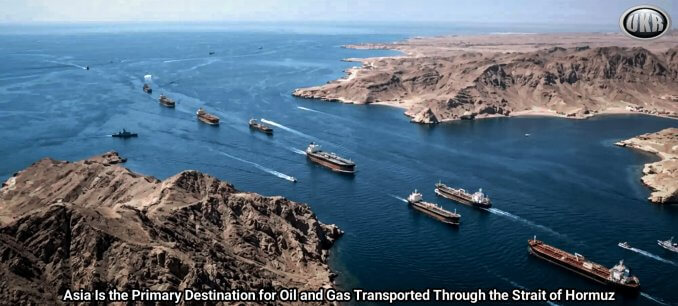
Asia is the primary destination for oil and gas transported through the Strait of Hormuz
RHODA WILSON
The Iranian regime has demanded that vessels passing through the Strait of Hormuz comply with its new laws. So which countries are affected the most?
In 2025, Statista named the Strait of Hormuz as one of 8 maritime “choke points” worldwide. “Located between Oman and Iran, the strait is one of the world’s most important maritime choke points, with flows through it accounting for more than one quarter of total global seaborne traded oil and around one-fifth of global liquefied natural gas (LNG) trade in 2023,” Statista said.
Today, it was reported that Iran has announced plans to reopen the Strait of Hormuz, but only to vessels that comply with new laws imposed by the Iranian regime. So, effectively, which countries is Iran demanding compliance from?
By closing the Strait of Hormuz, Iran is stopping Arab and Muslim oil-producing countries from exporting their oil. 93% of hydrocarbons passing through the Strait are produced by these countries.
Saudi Arabia leads oil exports through the Strait of Hormuz, accounting for 37.2% of the total, followed by Iraq (22.8%) and the United Arab Emirates (12.9%). Other significant exporters include Iran (10.6%), Kuwait (10.1%) and Qatar (4.4%). Saudi Arabia and the UAE are the only nations with alternative pipeline routes to bypass the Strait.
And the countries losing out the most by Iran’s actions are not the West, but the East. 89% of the oil and gas shipped through the Strait of Hormuz goes to Asian markets.
India accounts for 14.7%, South Korea (12.0%) and Japan (10.9%). But China is the dominant importer, receiving 37.7% of the oil and condensate passing through the strait. In fact, China is so reliant on energy transported through the Strait that some have speculated from the start whether China is the primary strategic target of the Strait of Hormuz crisis; 30% of China’s LNG imports and 40% of its oil pass through the Strait.
On the other hand, Europe and the United States only imports 3.8% and 2.5% by share of the volume, respectively, of the oil and condensates transported through the Strait.
Condensates are a mixture of light liquid hydrocarbons along with natural gas found in gas wells, often containing small amounts of sulphur, aromatics and natural gas liquids such as ethane, propane and butane.
The UK, included in the percentages for Europe, does not import significant amounts of crude oil from the Gulf states via the Strait. The UK does, however, import LNG from Qatar.
“Qatar still supplies around 40% of the UK’s imports – second only to the US,” Northern Gas and Power pointed out in June last year when the Iranian regime voted to shut the Strait of Hormuz.
In 2025, North Sea sites produced enough gas to supply 30% of the UK’s demand, though 40% of this output was exported. This leaves the UK needing to import 67.9% of its gas supply, Sunsave said. In a table prepared based on gas import and export data published by the UK government in February 2026, Sunsave shows 47.1% of the UK’s gas comes from Norway and 1.2% from Qatar.
Northern Gas and Power didn’t reference where it got its 40% figure from, and in the 8 months since its article was published, it seems things have dramatically changed.
Further reading:
- No BBC, there is no “international gas price” – and yes, drilling in the North Sea would give the UK gas security
- Global problem + global solution + censorship = scam
- Energy lockdowns begin
Charted: Oil Trade Through the Strait of Hormuz by Country
By Visual Capitalist, 3 March 2026
China receives 37.7% of all oil exports that pass through the Strait of Hormuz, the most of any country. Asian countries are most affected by a closure of the strait, receiving 89.2% of the Strait’s crude oil and condensate flows.
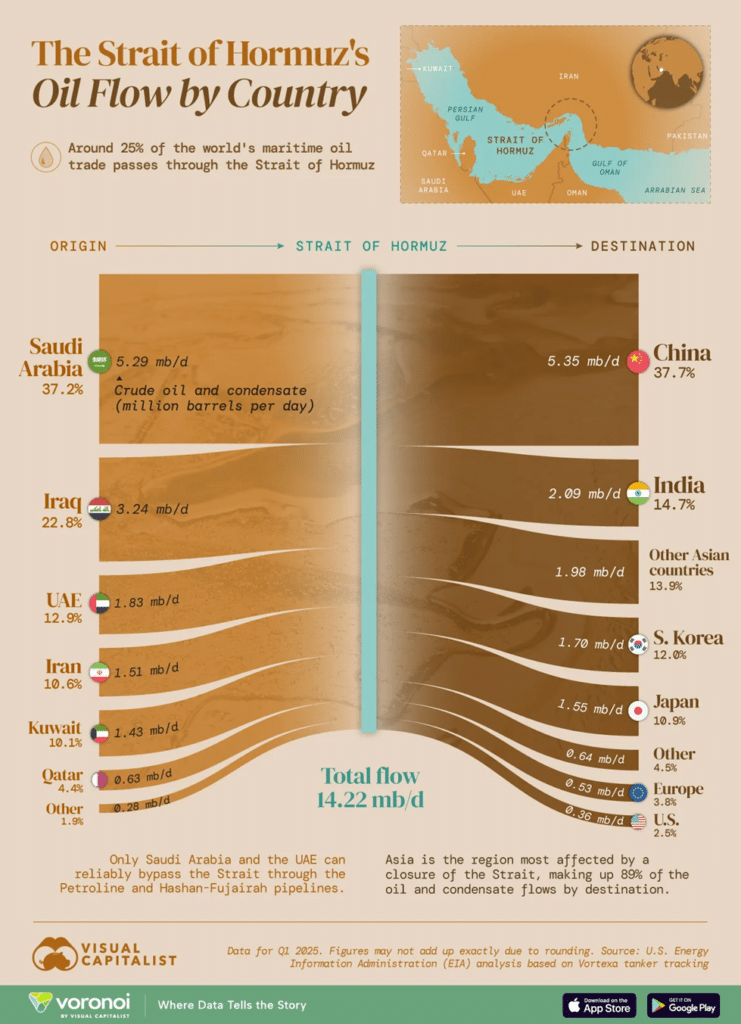
The Strait of Hormuz is one of the world’s most critical energy chokepoints, with both exporters and importers of crude oil heavily reliant on flows through the Strait.
This visualisation maps which countries export crude oil and condensate through the Strait of Hormuz – and, more importantly, which countries import those flows. The data is from the US Energy Information Administration and is for Q1 2025.
Which Countries Export Oil Through the Strait of Hormuz?
Oil flows through the Strait of Hormuz are heavily concentrated among a few Gulf producers. Saudi Arabia accounts for the largest share of crude and condensate exports transiting the strait, at 37.2% of the total.
The data table below breaks down the origin countries and their shares of crude oil and condensate exports through the Strait of Hormuz as of Q1 2025:
| Country | Share of the Strait of Hormuz’s Oil and Condensate Exports |
| Saudi Arabia | 37.2% |
| Iraq | 22.8% |
| United Arab Emirates | 12.9% |
| Iran | 10.6% |
| Kuwait | 10.1% |
| Qatar | 4.4% |
| Other | 1.9% |
Iraq follows with 22.8%, while the United Arab Emirates contributes 12.9%. Iran (10.6%) and Kuwait (10.1%) round out the top five exporters. Together, these five countries account for 93.6% of all crude and condensate volumes moving through the strait.
This concentration underscores how closely global oil markets are tied to production in the Persian Gulf.
With recent military conflict in the Middle East and Iran’s announcement that it would attack any ship passing through the Strait, more than 20% of global oil flows are now at risk.
The Countries Reliant on Oil From the Strait of Hormuz
On the demand side, Asia is overwhelmingly reliant on oil shipments through the Strait of Hormuz. Asian countries collectively receive 89.2% of the crude oil and condensate that transits the waterway.
The data table below shows the destination countries and their shares of crude oil and condensate exports through the Strait of Hormuz as of Q1 2025:
| Country | Share of Oil and Condensate Imports From the Strait of Hormuz |
| China | 37.7% |
| India | 14.7% |
| Other Asia | 13.9% |
| South Korea | 12.0% |
| Japan | 10.9% |
| Europe | 3.8% |
| United States | 2.5% |
| Other | 4.5% |
China alone accounts for 37.7% of total flows – more than any other country by a wide margin. India is the second-largest destination at 14.7%, followed by South Korea at 12.0% and Japan at 10.9%. Other Asian countries make up 13.9% of crude oil and condensate flows that pass through the Strait.
In contrast, the United States receives just 2.5% of these flows, reflecting its increased domestic production and diversified import sources.
Any closure or disruption of the Strait of Hormuz would disproportionately impact Asian economies, particularly China and India, which together receive over half of all volumes passing through the strait.
[Further resources:
- How Much of the World’s Shipping & Oil Goes Through the Strait of Hormuz? 2025 vs 2026 Percentages of Global Supply (TDLR summary, i.e. AI summary), Speed Commerce, 23 March 2026
- Quarter of Maritime Oil Trade Flows Through Strait of Hormuz, Statista, 2 March 2026]
Featured image: Strait of Hormuz, Iran has been controlling the passage of ships in and out of the Persian Gulf. Source: ABC News
This article (Asia is the primary destination for oil and gas transported through the Strait of Hormuz) was created and published by The Expose and is republished here under “Fair Use” with attribution to the author Rhoda Wilson
See Related Article Below
Britain to host 35-nation talks on reopening the Strait of Hormuz and getting oil and gas flowing again to lower prices after Trump’s ‘get your own’ outburst
Britain is to host 35-nation talks aimed at reopening the Strait of Hormuz to tanker traffic, it was revealed today, hours after Donald Trump told them to ‘go get their own oil’.
Foreign Secretary Yvette Cooper will host a meeting of international leaders tomorrow to ‘assess all viable diplomatic and political measures’ to reopen the vital waterway, Keir Starmer said this morning.
Iran’s stranglehold on the key shipping route has seen oil and gas prices soar in the UK and the rest of the world, but questions have been raised as to whether reopening it would be part of Donald Trump’s demands for peace.
He has previously indicated he will be prepared to end military operations without the strait being reopened to shipping traffic, telling the UK and other allies last night to ‘go get your own oil’ in protest at a lack of support for the US-Israeli bombing campaign.
However he U-turned on this position this morning, using a Truth Social post to say reopening the Strait was his main demand to end the bombing.
France, Germany, the Netherlands, Italy, Japan, Australia, South Korea, Canada and the United Arab Emirates are among the countries who will attend the talks, according to a British government statement.
A British official said it was expected that any first phase would focus on mine-hunting, followed by a second phase to protect tankers crossing the area.
A number of working-level meetings are expected to take place afterwards to work through the detail following the talks as the passage, through which a fifth of the world’s oil is shipped, remains blocked.
Military planners will consider how to make the strait ‘accessible and safe’ after the fighting has stopped, although this is not expected to involve the deployment of Royal Navy warships to police the waterway.
The RAC said the average price of a litre of diesel at UK forecourts today was 184.2p, up 29 per cent since the war began on February 28, with petrol up 16 per cent to 153.7p.
The AA advised drivers to cut their speed by 10 per cent to improve fuel efficiency in response to the mounting cost of motoring.
Fuel duty is frozen until September, with the rise scheduled for then under review as a result of the high prices, but other countries including Australia have already taken action to reduce the impact of price hikes for drivers.
But Chancellor Rachel Reeves said she had to be cautious with the nation’s finances to avoid increasing inflation, interest rates and Government borrowing costs.
The Daily Mail: continue reading

••••
The Liberty Beacon Project is now expanding at a near exponential rate, and for this we are grateful and excited! But we must also be practical. For 7 years we have not asked for any donations, and have built this project with our own funds as we grew. We are now experiencing ever increasing growing pains due to the large number of websites and projects we represent. So we have just installed donation buttons on our websites and ask that you consider this when you visit them. Nothing is too small. We thank you for all your support and your considerations … (TLB)
••••
Comment Policy: As a privately owned web site, we reserve the right to remove comments that contain spam, advertising, vulgarity, threats of violence, racism, or personal/abusive attacks on other users. This also applies to trolling, the use of more than one alias, or just intentional mischief. Enforcement of this policy is at the discretion of this websites administrators. Repeat offenders may be blocked or permanently banned without prior warning.
••••
Disclaimer: TLB websites contain copyrighted material the use of which has not always been specifically authorized by the copyright owner. We are making such material available to our readers under the provisions of “fair use” in an effort to advance a better understanding of political, health, economic and social issues. The material on this site is distributed without profit to those who have expressed a prior interest in receiving it for research and educational purposes. If you wish to use copyrighted material for purposes other than “fair use” you must request permission from the copyright owner.
••••
Disclaimer: The information and opinions shared are for informational purposes only including, but not limited to, text, graphics, images and other material are not intended as medical advice or instruction. Nothing mentioned is intended to be a substitute for professional medical advice, diagnosis or treatment.
Disclaimer: The views and opinions expressed in this article are those of the author and do not necessarily reflect the official policy or position of The Liberty Beacon Project.


Leave a Reply