

Starmer isn’t the problem. Replacing him solves nothing.
VIEWS FROM MY CAB
Who would have thought it? Starmer is entertaining us.
In declining to resign our current Prime Minister is providing a gripping psychodrama as the upper echelons of the Labour Party manoeuvre to secure their advancement to his job. At the time of writing, no one has actually challenged Starmer; either they lack the necessary explicit support of 81 MPs or they don’t want to be the one to wield the knife (thought to be a fatal mistake for any Westminster leadership campaign).
While we’re in this period of phoney war, bond market investors are getting anxious. The 10-year gilt yield has risen from around 4.8% on election day to 5.1% this morning. On 7th May £1 bought US$1.36. Today it’s worth US$1.34. Investors are selling UK bonds to buy US ones, which is the classic risk reduction move and is what (largely) accounted for Liz Truss. For sure Starmer and his chancellor Reeves have failed to deliver much in the way of growth or debt reduction (10-year gilt yields were a mere 4.1% on election day); they hail from the more economically sensible end of the Labour Party. The narcissism of those seeking to topple Starmer is already costing us money.
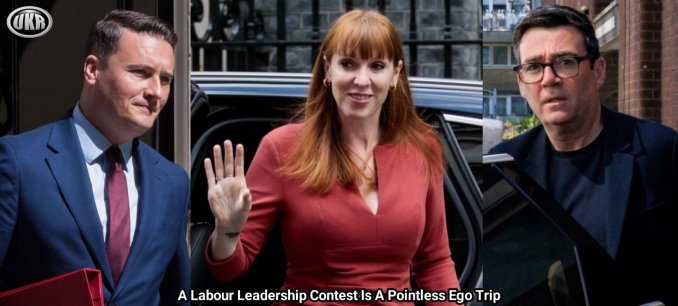
Oddly, none of the media pack have asked Wes Streeting why he thinks he would do a better job than the lacklustre incumbent. As his background is student unions, lobbying groups and local labour politics, they’re unlikely to get a straight answer. (That’s unsurprising; Streeting is thought of as a Blairite, and Saint Tone never defined his “third way” – which turned out not to exist; you can’t be a little bit socialist). Streeting’s track record running the NHS is currently unknowable; he spent more money but the problems with junior doctors remain, as do the ludicrously long wait times.
Other touted runners include (red) Angela Rayner, who may or may not be the darling of Labour’s left but struggles to correctly complete a tax return. She so cares about working people that she pushed through a bill that reduces the number of people in work. Some tout Ed Miliband, the man who can’t eat a bacon sandwich, lost a general election (to Cameron) and committed the country to net-zero and the world’s most expensive electricity (which he still claims will deliver growth). He would be an interesting choice, but as Starmer was hiring yesterday’s people like Gordon Brown and Harriet Harperson, maybe yesterday’s people are the new fad.
And then there is Andy Burnham, the mayor of Manchester, where he is halfway through his third term. He sees himself as soft left and was in government under Blair (Burnham voted for the invasion of Iraq) and Brown, ultimately as Secretary of State for Health. He’s never had a life outside politics, which may explain his extraordinary view that the UK is too much in hock to the bond markets. He even thinks that the bond markets will have to “fall in line” with government policy – he clearly learned nothing in his six month stint as Chief Secretary to the Treasury. Every mention of the possibility of this self-publicising, innumerate loudmouth becoming prime minister increases bond yields.
Other MPs and ministers are mooted as candidates by the press, but these are the key ones. The immediate battle for Streeting is to get a leadership contest underway before Burnham wins a by-election, which is by no means certain. This, of course, plays into Starmer’s hands – he has myriad faults but he has a gift for manipulating process, which in his lawyerly way he considers sacrosanct when convenient. Thus, the idiotic decision to appoint Mandelson as US ambassador was justifiable as due process was followed. Even the parliamentary investigations followed that line, obsessing about process and influence, not who countenanced the demonstrably flawed Mandelson for a crucial job usually filled by an experienced, professional diplomat.
The obsession with process, not outcome, is a feature of modern government. As you sit in A&E waiting for treatment, you know the outcome of NHS policy is unacceptable; that the budgetary and spending processes that led to it were perfectly followed is scant comfort. If a perfectly followed process delivers an unacceptable outcome, the process has failed and must be changed. This is blindingly obvious in the world of business, but few in Parliament (and vanishingly few in the Parliamentary Labour Party) have spent much time in the world of commerce.
The net result? We pay a moron premium on the national debt. The money spent servicing that comes from taxation; it therefore can’t be spent on health or defence or potholes. The higher the moron premium, the less money for public services at any given level of taxation. The Reeves solution of increasing taxation stifles growth. That increases the moron premium and things fail to improve.
Before we disappear over the cliff of a debt crisis let’s step back, admire the view and reflect on how we got here.
The last time the UK government spent less than it raised in taxes or, as business people would say, traded solvently was in 2001 when Gordon Brown was Chancellor but stuck to the previous Tory (John Major) government spending plans. Then it all went wrong as Blair’s “Third Way” turned out to be socialism dressed up to be trendy. The global financial crash was partly caused by economies awash with cash but nothing to invest in, having exported much of the US and UK’s capital intensive industry, such as manufacturing (machines cost money), to Asia. With it went employment and taxable corporate profit.
Over the same period, the number of people employed in central government rose from 2.3 million to 4 million today. The past 25 years have seen massive centralisation, the hallmark of a socialist state. At the same time MPs, whose job includes challenging the state’s spending of their constituents’ funds, have become professional politicians and theorists. In opposition their information comes from think tanks; in government it also comes from civil servants. Few MPs have the experience or intellectual rigour to challenge what they’re told (there are exceptions; successful businessmen Rupert Lowe, Richard Tice and Angus MacDonald spring to mind). The status quo, the ever-increasing and centralising state, has been accepted as the norm.
Unfortunately the socialist dream of a state that cares for its citizens “from the cradle to the grave” (as Beveridge put it in his 1942 report) continues to fail. Beveridge promised to tackle the five giants of want (meaning poverty, not greed), disease, ignorance, squalor, and idleness. That’s not been the trajectory for the past quarter of a century. Why?
In part it’s because hitherto at most elections the British people have had a choice between socialism (Labour) and a managed economy (one nation Tories). The last free market government ended in 1997. Crony capitalism became the norm, and governments sought to manipulate the electorate through sin taxes and the nudge unit. The parallel emergence of careerists led to groupthink, often containing logical fallacies that no careerist politician dared challenge. Diversity good; firm borders bad. Equal rights good; investigating Muslim rape gangs bad. International free trade good; leaving the EU bad.
It was this last one that upset the unstable political apple cart when the nation, for various reasons, voted (against the advice of the government and the opposition parties) to leave the protectionist trade bloc, which is the European Union. That was a decade ago; it still defines and divides British politics. Westminster and Whitehall still don’t grasp that the Brexit vote was a complete rejection of the political and economic status quo. While they can and do yap about the economic costs of leaving (pick a number of your choice), they have done nothing, precisely nothing, to address the public’s rejection of the established political process.
Post the 2016 vote the public has seen nothing to reassure it. After May’s fiascos, Johnson’s antics, the covid overreaction and disaster, the scrabbling for a stable Tory leader and the subsequent election of Keir Starmer, little changed in the Westminster bubble, bar one thing. That thing was the rise of Reform, effectively from nowhere.
In 2024 Reform campaigned on the general theme of the state being incompetent and the government machine being in serious need of restructuring. That returned five MPs; more than 80 Reform candidates came second. Overall Reform received 4.1 million votes, almost 20% more than the Lib Dems, who got 72 seats. Notwithstanding the vagaries of the first-past-the-post system, the outcome (in terms of power and seats) of the general election failed to reflect the vote.
To anyone outside the Westminster bubble it is no surprise that the government (and the establishment) got a further kicking at every available opportunity. Labour lost by-elections and got thoroughly trounced in the local and devolved assembly elections. The surprise was how well the nationalists did. In Wales at least, it was as much due to the ineptitude of Reform (as I explain here) as a surge in desire for independence.
Starmer’s response to the predictable trouncing at the ballot box was typical of him and the problems of the current crop of politicians. He rightly made the point that there is a process to become leader of the Labour Party, that if anyone wants to trigger it, he’ll fight and that as no one has yet amassed the necessary signatures, there is nothing to discuss. What he failed to do was inspire his party with oratory (because he can’t) and then exploit his massive majority to destroy dissent. He didn’t sack Streeting for disloyalty and failing to focus on his job. He hasn’t sacked anyone for failing to deliver on policy – potholes, expensive energy and the lack of houses being built. Starmer frequently sacks non-politicians on a whim. He doesn’t seem able to sack underperforming ministers.
In part that’s because the Labour Party has many factions, all of whom believe in socialism of one form or another. Starmer’s undeserved majority includes many across the socialist spectrum, although it’s probably more left-leaning than the Blair-Brown governments. It’s the nature of a political party leader’s task that they must embrace all factions, but Starmer is focusing on this too much. Not only does he have a huge majority to ram through policy, he also has MPs who know that they’re possibly toast at the next election. They’ll therefore support anything that defers their day of reckoning with the electorate. He has pretty much carte blanche.
Yet Starmer says he won’t block Burnham from standing in the forthcoming Makerfield by-election, triggered by the resignation of Josh Simmons (damaged by a scandal involving him falsely accusing journalists of links to the Kremlin) to create an opening for Andy Burnham. That’s weak; Starmer has great power on Labour’s National Executive Committee (who approve all candidates) and could easily have made the argument that Burnham has committed to the people of Manchester to serve as mayor until the next mayoral election in 2028 and that for him to short change them smacked of putting personal ambition above serving the public.
It is, of course, by no means certain that Burnham will win in Makerfield. Electoral Calculus was forecasting a Reform win, although their methodology doesn’t include either the Burnham factor or the Farage one. Makerfield is 97% white and 68% Christian, so the Gazan Greens probably won’t thrive. It voted leave by 65%. In the General Election Labour won with 46% of the vote; Reform came second with 32%. On the face of it, Markham is a tough place for the pro-EU Burnham, despite his quiet Catholicism.
Reform UK seems twitchy; they have an expensive habit of losing by-elections they should have won on paper (Caerphilly and Gorton & Denton, lost to Plaid Cymru and the Greens respectively). Despite their protestations to the contrary, all is not well in Reform. Their wholesale acceptance of Tory defectors didn’t play well with the membership or on the streets. They’re already blasting former Reform MP Rupert Lowe’s Restore, fretting that if Restore stands a candidate it would split the anti-Labour vote. It’s an argument for another day; had Reform remained an agent for changing the rotting British state, Restore would not need to exist.
And the United Kingdom desperately needs change to its economics, the politics that drive them and the process that selects lacklustre MPs then promotes them far beyond their abilities. People can win a local election by standing on a pro-Gaza platform, despite foreign policy being outside of local government’s remit and Gaza’s problems making the Schleswig-Holstein question seem trivial. Our politics are dysfunctional.
Replacing Starmer with some other ambitious socialist career politician won’t change much. Streeting might be more articulate, Burnham more bruising and Rayner more “working class” but none of them is any more up to the job than the current apparatchik. The only thing that any Labour leadership election contest will achieve is an increase in the moron premium during the protracted process. Increasing interest rates leads us further down the economic doom spiral.
Streeting, Burnham and Rayner going on ego trips will harm the country, whatever the outcome. It would be better if they didn’t bother. It’s a low baseline, but sticking with Starmer is the least bad option.
If you enjoyed this article please remember that Views From My Cab is a reader-supported publication and subscribe, which costs you nothing but makes the SubStack bots more helpful.
Alternatively you could make a small, one off donation to defray my production costs. I am hugely grateful for every donation. The simplest method is via Buy Me a Coffee.
This article (A Labour Leadership Contest Is A Pointless Ego Trip) was created and published by Views From My Cab and is republished here under “Fair Use”
See Related Article Below
This “leadership” talk is yet another devil’s illusion.
SEAN WALSH

Still there.
We were expecting a Jason Statham or a John Wick blockbuster. Instead of that we’re being served up one of those interminable Scandinavian things. Not noir either, like The Killing, but worthier fare. With themes. Of interest only to the critics.
Actually that’s unfair to the interminable Scandinavian things. Whatever is happening in the Labour party is certainly less elevated than a Wild Strawberries, with its cinematic interrogation of themes of memory and personal identity.
Just to be clear: there is no “Labour leadership contest”, any more than there is a “war” in Iran. What we do have is an unseemly and frankly childish sequence of choreographed skirmishes within one section of the entitlement class.
I’ve lived through leadership contests where the unlikeliest candidate emerges as PM. The transition from Thatcher to Major, for example. A story of political entropy, a significant downgrade, to be sure. But real and moment-to-moment unpredictable nevertheless.
I’m less used to the situation we have now, where the sitting PM remains defiantly in place “against the odds”, as imaginary battles are fought out in the minds of potential successors, all dutifully written up by the excitable types in the political media, who for some reason believe, or pretend to believe, that all this stuff is real and assume the rest of us are as captivated as they are.
This is the funniest part of the mass illusion, the cognitive inertia of the “experts” who were so uniformly convinced that Starmer was going to resign last week that they now interpret even the most trivial non-event as confirming the imminence of just that. It’s as if they’re in a Beckett play. The Christians of the early Church were more adept at expectation-adjustment when His return did not fit the presumed timeline.
This, then, is what’s happening now: nothing. The Prime Algorithm, with uncharacteristic adroitness, has filibustered a challenge to his position by walking up to the crisis and pouring a bucket of process all over it. He made Wes Streeting look like the old woman at the supermarket checkout, who when asked to pay looks startled and starts rummaging around in her purse looking for her card and crumpled discount vouchers. “81 votes? Yes of course. It’s in here somewhere. I had it when I left the sheltered flat.”
And then we have the post-modern “candidacy” of Andy Burnham, who will be running in Makerfield on a promise to completely ignore the concerns of the voters there if in return they help him move to Downing Street. A more perverse electoral compact has never been concocted. The strategy seems to genuinely be to insult people into voting for him. Things are so weird now that it wouldn’t be surprising if it worked.
I find all this amusing because it’s so serious and the best way to take serious things seriously is to find ways to laugh at them. Laughter is metanoia, the best spiritual medicine. It’s serious because the politicians and the people who write about them are using language not so much to lie as to distort. Make believe is noble and imaginative; pretence is fake and fantastical. And this is what the devil loves – when something beautiful, in this case language, is distorted and intentionally bent out of shape.
This is what relativism and subjectivism do. They infect the language and go to work turning the beautiful into the ugly by distortion, equivocation, persuasive definition and ambiguity. Thus, the language of environmental stewardship becomes the hard mathematics of Net Zero; the metaphysical truths about sexual intercourse are discarded and sex is talked about as if it is just one more transaction. Etc.
We are being urged to believe that something is happening when a second’s reflection reveals that nothing is changing at all.
Some of the “conspiracy” commentators are half right when they speculate that all this is a distraction, and that the wider Leftist agenda -the dissolution of the nation state via the vaporisation of border control for example- is immune to changes of personnel at the head of a purely nominal government.
But the distraction is cleverer and more theological than that. We are being invited into a world of fantasy politics and the danger is that we will come to talk in the language of that world, of powers and principalities, and forget that a deeper and more sacramental language is still available.
This “leadership” nonsense is fake. Time to wake up to that and laugh it all off. Trust me, there’s plenty of material.
This article (This “leadership” talk is yet another devil’s illusion.) was created and published by Sean Walsh and is republished here under “Fair Use”

••••
The Liberty Beacon Project is now expanding at a near exponential rate, and for this we are grateful and excited! But we must also be practical. For 7 years we have not asked for any donations, and have built this project with our own funds as we grew. We are now experiencing ever increasing growing pains due to the large number of websites and projects we represent. So we have just installed donation buttons on our websites and ask that you consider this when you visit them. Nothing is too small. We thank you for all your support and your considerations … (TLB)
••••
Comment Policy: As a privately owned web site, we reserve the right to remove comments that contain spam, advertising, vulgarity, threats of violence, racism, or personal/abusive attacks on other users. This also applies to trolling, the use of more than one alias, or just intentional mischief. Enforcement of this policy is at the discretion of this websites administrators. Repeat offenders may be blocked or permanently banned without prior warning.
••••
Disclaimer: TLB websites contain copyrighted material the use of which has not always been specifically authorized by the copyright owner. We are making such material available to our readers under the provisions of “fair use” in an effort to advance a better understanding of political, health, economic and social issues. The material on this site is distributed without profit to those who have expressed a prior interest in receiving it for research and educational purposes. If you wish to use copyrighted material for purposes other than “fair use” you must request permission from the copyright owner.
••••
Disclaimer: The information and opinions shared are for informational purposes only including, but not limited to, text, graphics, images and other material are not intended as medical advice or instruction. Nothing mentioned is intended to be a substitute for professional medical advice, diagnosis or treatment.
Disclaimer: The views and opinions expressed in this article are those of the author and do not necessarily reflect the official policy or position of The Liberty Beacon Project.


Leave a Reply