

Britain has survived unrest before, but only when its rulers remembered how to listen.
C.J. STRACHAN
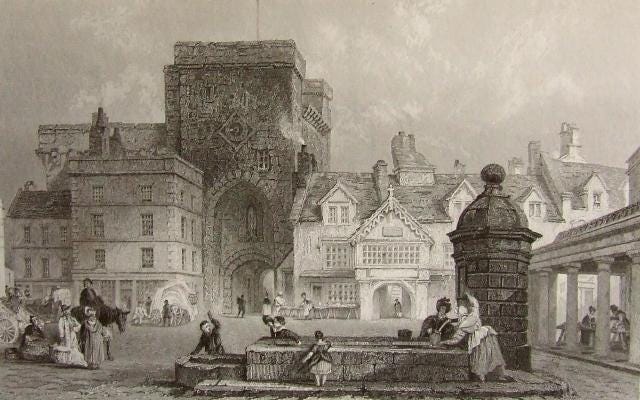
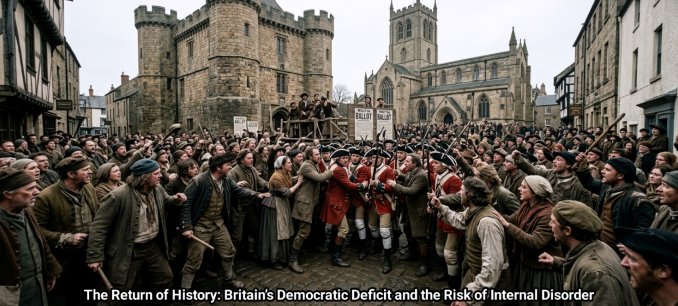
Hexham’s marketplace, about half the size of a modern football pitch, was never built for an army and a multitude. On a cold, blustery Monday morning in March 1761, it became a trap of blood and bodies; the medieval fortified Moot Hall looking down from one side, the great Abbey Church of St Andrew from the other, and the few narrow approaches into the market square choked with thousands of men and women who had come in from Hexhamshire and the surrounding parishes to oppose the new militia ballot.
This was no organised revolutionary mob, nor an armed movement seeking to overturn the constitution. These were farmers, labourers, miners, craftsmen, tenants, sons and apprentices, men whose lives were already hard enough in an economically marginal hill country where a lost wage, a failed crop, or the removal of a working man from a household could mean real suffering. Into that confined space came about 250 men of the North York Militia, raised in the North Riding of Yorkshire, armed, dubiously trained, nervously officered, out of place and surrounded. Around them pressed a crowd, said in some accounts to have reached several thousand, angry at a system imposed by the Militia Act of 1757 under which the poor might be forced into service while the better-off could pay for substitutes.
The crowd’s anger was not merely economic. It came from older seams of loyalty and memory, from a border country where Jacobite sympathies had not vanished on the bloody field of Culloden in 1746, and where Catholic recusant households, often discreet, often watched, still carried the sense of belonging to a defeated and chastised world. To such people, the militia ballot could look like more than a bureaucratic instrument of national defence during the Seven Years War. It could look like the Hanoverian state reaching into the household and parish, claiming the bodies of men for a cause they did not feel was their own.
The result, on the morning of Monday 9 March 1761, was a tinderbox: a small, cramped market square, a hostile crowd, poorly trained and nervous troops, magistrates trying to assert control, and the Riot Act read into wind and noise, possibly from the battlements of the Moot Hall. Rather than disperse, the crowd remained. At some point the fragile peace broke. Was a stone thrown? Was a soldier jostled? Did an officer panic? Did a nervous militiaman fire first? As is so often the case, no one can say with certainty. What is certain is that the soldiers were pressed, the crowd surged, and the militia fired volleys into the crowd. Men and women fell in the marketplace, under the buttresses of the Abbey Church; some shot, some bayoneted, some crushed under the feet of a panicked crowd as people fled bleeding into lanes, doorways and yards. Hexham was left with 51 dead and many hundreds wounded, some of whom would later die of their injuries. The incident would be remembered as the Hexham Massacre, and locally as Bloody Monday.
The question is not only what happened in Hexham, but why it happened. Four years earlier, the Militia Act 1757 had received royal assent as “An Act for the better Ordering of the Militia Forces, in several Counties of that Part of Great Britain called England”. For hundreds of years, the Crown had relied on militia units for domestic service and security. These had developed from the old medieval trained bands, which in turn had grown from the levies and the fyrd that preceded them. By the middle of the 18th century, however, the militia in England and Scotland had become as much about local sociability, gentry uniforms and civic display as military effectiveness.
This weakness had been brutally exposed during the 1745 Jacobite Rising, when forces defending the Hanoverian state were routed at Prestonpans and Coltbridge, unable to withstand the shock of the Highland charge. Bonnie Prince Charlie’s army reached as far south as Derby, causing panic in London, and turned back only because of supply difficulties, uncertainty, and the failure of expected English support to materialise. After Culloden, Westminster drew the obvious lesson. Rushing regular troops home from a European war to deal with domestic danger was hardly ideal. So when the Seven Years War broke out, with fears of French invasion and renewed Jacobite activity never far from official imagination, Parliament reformed the militia.
The new system required counties and parishes to compile lists of able-bodied men, from whom names would be chosen by ballot. Those selected could serve, provide a substitute, or pay a fine. County quotas were allocated broadly according to population, and in Northumberland that meant 560 men. But the mechanics mattered. Because the more prosperous could pay for substitutes or fines, the burden of service had a tendency to fall downwards and outwards, onto smaller and poorer parishes least able to absorb it. A large parish in Newcastle or Berwick might be able to spare several men without great disruption, at least on paper; a small rural parish in Hexhamshire might not. Once the quota reached the parish, the question ceased to be an abstract matter of county administration and became painfully immediate: whose son, servant, apprentice, labourer or husband was going to go?
In a small rural community, losing one working man could be a serious economic injury. The arrangement may have looked rational in Westminster, but in the hills and border parishes it could be experienced as arbitrary, unequal and frightening. The ballot made the pressure personal. With the country at war, there was also deep mistrust of official assurances that militia service would remain domestic, and that those conscripted would not eventually be sent abroad like regular soldiers.
Nor was the Hanoverian Government unaware of the suspicion attached to compulsory military service. Since Cromwell, the idea of forcing Englishmen into arms had been treated as constitutionally suspect, and in popular imagination as distinctly un-British. Officials knew the Act might create flashpoints, which is why magistrates requested the presence of the North York Militia in Hexham on ballot day. They anticipated trouble, but their answer was to insert armed men into a confined space among people who already believed that the state was acting against them. It is not difficult to see how badly that could go wrong.
Had the people of the time enjoyed universal suffrage, and had those votes actually influenced the composition of power in Westminster, it is at least plausible that the Act would have been framed and implemented with greater care. But there was no such mechanism. The state relied on magistrates and local officials to report the temper of the people, but it could not read public opinion for itself in any democratic sense, and there were few direct political consequences for those who designed the policy. A glover in Hexham whose apprentice was drawn by ballot typically had no vote. A tenant farmer who lost a son or servant to militia service had little meaningful recourse. The law came down from above, and the governed were expected to endure it.
That is the central lesson of Hexham. When people believe the state has overreached, when they feel that the law is made without them, applied against them, and justified in language that bears little relation to their own lives, democratic correction matters. Without it, grievance does not disappear. It gathers force.
Britain is an old country, yet its component nations, England, Scotland, Wales, and the contested legacies of Ireland, are older still. The United Kingdom is, in many ways, an artificial political construction layered over ancient peoples and identities: Angles, Saxons, Britons, Gaels, Picts, Norsemen, Normans, and all the later cultural, religious and regional loyalties that flowed from them. It has endured not through inevitability, but through a constitutional tradition of adjustment. When elites lost touch with the governed, the system bent, sometimes reluctantly and often after unrest, in order to restore legitimacy.
That flexibility preserved stability while much of Europe lurched from revolution to revolution. But the pattern of internal fracture runs deep, and it is emphatically not England-centric. Scotland, Ireland and the borderlands have repeatedly supplied some of the most explosive fault lines. From the Peasants’ Revolt of 1381, through the Wars of the Roses, the Civil Wars of the 1640s, the Jacobite Risings, Peterloo, Chartism, Fenianism, Irish partition and the Troubles, the recurring theme is not simply violence, but legitimacy failure: taxation without consent, religious or cultural imposition, centralisation that ignored local identity, clumsy Acts of Parliament, insensitive enforcement, and governing classes too insulated from the consequences of their own decisions.

The Glorious Revolution of 1688 is remembered in England as almost bloodless, yet in Scotland and Ireland it was secured by force. The Jacobite Risings of 1715 and 1745 were not mere romantic episodes of tartan and lost causes, but armed attempts to overturn the settlement of the British state. The 19th century was calmer than the 17th and 18th, but even then Peterloo, Chartism, Irish agrarian violence and repeated coercion Acts showed how often the British state resorted to surveillance, emergency powers and the restriction of rights when parliamentary valves clogged. The Troubles then reminded everyone that the old reflexes had not disappeared. Violence spilled onto the mainland through bombings in England and Scotland, and the settlement of the 1990s remains one of the great examples of constitutional adjustment arriving only after terrible human cost.
I grew up in 1970s and 1980s Scotland, where sectarianism remained one of the defining cultural fault lines. In Glasgow and Lanarkshire, Catholic and Protestant communities, Orange and Green, Celtic and Rangers, often lived parallel lives marked by discrimination, street violence, tribal marches and inherited suspicion. It was moderated eventually by economic change, secularisation and generational exhaustion, but it never vanished completely. Much of it simply went underground, waiting for conditions in which older loyalties and resentments might again find political use.
So yes, our islands have a bloody history of rebellion, riot and civil conflict. Yet we did escape the catastrophic ideological revolutions that later wracked continental Europe. We escaped them, in part, because the British state learned that by patiently and gradually realigning its democracy, the sudden convulsions of Cromwell, Robespierre and Lenin could be avoided. Reform Acts, Catholic emancipation, franchise extension, trade union recognition, Irish settlement, devolution, all of these were, in their different ways, attempts to absorb pressure before it broke the vessel.
Unfortunately, I am now firmly of the view that the British state has forgotten this lesson, and has become, through deliberate constitutional vandalism, so rigidly bureaucratic that it is no longer able to operate the pressure-release valves it spent centuries developing. It has forgotten that managing an internally diverse population, four national identities, deep regional differences, inherited sectarian memories and a small island’s intense proximity requires careful husbandry if the King’s Peace is to be kept.
Given that we lived through a bloody terrorist insurgency between the late 1960s and the 1990s, one that killed and maimed thousands over sovereignty, identity, territory, demography and sectarian allegiance, one might have expected modern politicians to treat questions of population, cohesion and consent with exceptional care. Instead, those questions are too often waved away as administrative matters, economic necessities, or embarrassments to be suppressed by approved language, while unprecedented demographic change has been forced on the nations without consultation and, even when repeatedly rejected at the ballot box, continues anyway.
On 11 May 2026, Prime Minister Keir Starmer delivered what was billed as a reset speech after severe Labour losses in the local elections. Labour had suffered heavily, while Reform UK had made significant gains in areas once regarded as Labour heartland territory. Starmer spoke of closer EU ties, a Youth Experience Scheme, the nationalisation of British Steel in Scunthorpe, and warned of dangerous opponents on the far Right. He framed the moment as one of resolve, insisting that he would not walk away. To many watching, however, it did not sound like resolve so much as denial. The speech appeared to double down on policies already clashing with public sentiment on migration, energy costs and national sovereignty, while treating deeper fractures as problems of messaging or extremism rather than legitimacy.
What makes the present moment different, and potentially more dangerous, is the post-1997 erosion of mechanisms that once allowed gradual political correction. Tony Blair’s constitutional revolution shifted power away from elected politicians and towards courts, regulators, devolved executives, arm’s-length agencies and administrative bodies. Devolution, the Human Rights Act, the Supreme Court, proliferating quangos and layered regulation all changed the texture of British government. Some of these reforms were defensible in themselves; some were presented as modernising necessities; but taken together they helped create a system in which power is increasingly exercised at one remove from direct voter accountability.
The Conservatives talked of reversal but delivered only limited correction. New agencies proliferated around net zero, post-Brexit regulation, public health, equality law, infrastructure, security and pandemic response. The administrative state became more entrenched, more confident and less responsive.
The result is a democratic deficit felt from Lerwick to Liskeard. Local election results, national polls and street-level anger on immigration, living costs, crime and cohesion are too often treated not as signals requiring political response, but as symptoms to be managed. Starmer’s speech exemplified this tendency: a pivot towards closer EU integration while nationalising an industry hammered by energy costs, and a warning about dangerous opponents while saying far less about why so many voters have moved towards those opponents in the first place.
Today’s fractures build on the older fault lines described above, but with a new and ominous twist. The rapid demographic transformation since the 1990s, unprecedented in scale and speed, has layered new cleavages over ancient ones. Grooming scandals, perceptions of two-tier policing, parallel communities, sectarian bloc voting, and a widespread belief that official institutions speak more readily for minority grievance than majority concern have all damaged trust. One does not need to endorse every claim made in this atmosphere to recognise that the atmosphere exists, and that dismissing it as mere prejudice is politically reckless.
Professor David Betz of King’s College London, a serious scholar of insurgency and strategic studies, has written about the conditions under which Western states may become vulnerable to forms of low-intensity internal conflict. The point is not that Britain is about to replay the 17th century with pikes and banners, but that modern disorder would look different: intermittent, networked, asymmetric, localised, communal, urban and difficult to suppress by ordinary policing. If legitimacy erodes, if cultural fragmentation deepens, if the governing class appears insulated from the governed, and if demographic pressures become politically unmentionable, then the risk is not necessarily formal civil war but sustained disorder in places where the state has lost moral authority.
The most dangerous development may be the emerging realignment of communities that once defined themselves by mutual enmity. In August 2024, anti-immigration protests in Belfast saw loyalist elements and activists from the Republic appearing in proximity, with Union flags and tricolours visible in the same charged political space. Reports that some Dublin activists later drank in loyalist bars with UDA-linked figures were startling precisely because such imagery would once have seemed almost impossible. These are not mainstream republican or loyalist paramilitary organisations in their Troubles-era form, and it would be foolish to overstate the coherence of such alliances. But the networks, memories and local knowledge remain. Men and women shaped by the Troubles understand how the state operates, how communities mobilise, how intimidation works, and how violence can be calibrated. When old enemies begin to find common cause against mass immigration and elite indifference, the old civil-war reflexes have not disappeared; they have begun to mutate.
This is the recurring pattern under new pressures. The Blair-era state, never properly dismantled, lacks the nimbleness that once allowed adaptation before rupture. Smears of “far Right” or “racist”, when used as substitutes for engagement, only deepen alienation. History shows that when majority sentiment is ignored, when legitimacy weakens, and when the governed come to believe that the system no longer reflects or protects them, sharper remedies begin to seem thinkable to people who would once have considered them impossible.
The political classes of this country have forgotten their history. Civil peace has never been the default condition of these islands. It has always depended on law, habit, legitimacy, restraint, shared belonging and a governing class capable of sensing the mood before the mood turns against it. The 21st century will be no exception. Restoration is still possible: a serious reduction in the power of unelected administrative bodies, a restoration of parliamentary accountability, honest enforcement of integration, and a border policy that reflects democratic consent rather than elite consensus. Without such correction, the ghosts of the past, of 1381, Towton, Edgehill, Preston, Culloden, Peterloo, Hexham, Guildford, Warrington and the recent riots, will not remain safely buried.
The question is whether the state will correct course before history delivers its familiar and unforgiving lesson: that a people who feel unheard will not remain silent or peaceful indefinitely.
This article (The Return of History: Britain’s Democratic Deficit and the Risk of Internal Disorder) was created and published by C.J. Strachan and is republished here under “Fair Use”

••••
The Liberty Beacon Project is now expanding at a near exponential rate, and for this we are grateful and excited! But we must also be practical. For 7 years we have not asked for any donations, and have built this project with our own funds as we grew. We are now experiencing ever increasing growing pains due to the large number of websites and projects we represent. So we have just installed donation buttons on our websites and ask that you consider this when you visit them. Nothing is too small. We thank you for all your support and your considerations … (TLB)
••••
Comment Policy: As a privately owned web site, we reserve the right to remove comments that contain spam, advertising, vulgarity, threats of violence, racism, or personal/abusive attacks on other users. This also applies to trolling, the use of more than one alias, or just intentional mischief. Enforcement of this policy is at the discretion of this websites administrators. Repeat offenders may be blocked or permanently banned without prior warning.
••••
Disclaimer: TLB websites contain copyrighted material the use of which has not always been specifically authorized by the copyright owner. We are making such material available to our readers under the provisions of “fair use” in an effort to advance a better understanding of political, health, economic and social issues. The material on this site is distributed without profit to those who have expressed a prior interest in receiving it for research and educational purposes. If you wish to use copyrighted material for purposes other than “fair use” you must request permission from the copyright owner.
••••
Disclaimer: The information and opinions shared are for informational purposes only including, but not limited to, text, graphics, images and other material are not intended as medical advice or instruction. Nothing mentioned is intended to be a substitute for professional medical advice, diagnosis or treatment.
Disclaimer: The views and opinions expressed in this article are those of the author and do not necessarily reflect the official policy or position of The Liberty Beacon Project.


Leave a Reply