

MATT ROBERTS
As everyone expected, this month’s local election results confirm that the British electorate know the established system is broken. Voters punished the 20th-century Labour-Conservative duopoly, handing significant advances to insurgent parties, with Reform, the Greens and Plaid Cymru making almost all of the gains once the counts were done. While neither Reform nor the Greens quite matched the most bullish predictions, the shift away from the old governing parties was unmistakable. This was less a protest against one colour of rosette than it was a rejection of the current paradigm.
As the insurgent party on the Left, the Green Party has been gaining ground particularly among Muslims and – crucially – the youth vote. Recent polling shows support for the Greens as high as 46% among 18-24-year-olds. Since the selection of Zack Polanski as leader, the party has been given significant amounts of airtime, which it has used to promote a superficially radical agenda. I say ‘superficially’ because the party’s policy offering amounts to pushing the post-war statist structure even further: more opportunities for taxation, more redistribution of wealth, even larger government and still more state control.
What the party has done particularly well is to diagnose the problem in a way that rings true, especially with the young. As an example, in his March 18th speech to the New Economics Foundation Polanski said: “We live in rip-off Britain: an economy built to reward the few off the work of the many. A country where people work so hard and try to do the right thing but still struggle to afford the basics, and people find themselves constantly cutting back.”
This resonant diagnosis automatically lends undeserved credibility to the party’s radical policy prescription in the minds of disillusioned voters. Because the problems feel systemic, only apparently systemic answers feel adequate to the moment. The electorate increasingly understands that incrementalism has failed, and the Greens are successfully positioning themselves as a party willing to match the scale of the crisis, even if their actual prescriptions would intensify the very statism that is responsible.
None of this is particularly new. The disillusionment is obvious, and the youth vote turning to socialist solutions is unsurprising. Everyone can see the system is broken and that the old two-party order is crumbling. The real challenge for the Right is that it hasn’t yet found the courage to offer the genuinely radical solutions Britain needs to restore stability and prosperity.
The key point of differentiation between the parties of the Right and those of the Left remains immigration. It was the single issue on which Reform UK rose to prominence in the lead-up to the 2024 election. From an electoral point of view, there is clear wisdom in that focus, since immigration has stayed either first or second on voters’ list of important issues ever since the summer of 2024. However, a focus on immigration alone creates two key tactical weaknesses: first, it risks alienating the many voters for whom the cost of living or the stagnant economy are more important issues; and second, it leaves the Right permanently open to being attacked on its own flank by harder-line challengers.
Indeed, personalities and personal animus aside, immigration has become the major locus of fracture among the parties on the Right wing of British politics. The debate is hung up on the subject of ‘civ-nat versus ethno-nat’ and the question of whether Tommy Robinson is a voice to be listened to or a dangerous thug. On economic and institutional questions, however, the Right’s radicalism remains limited across the board. Both Reform and the Conservatives have signalled they would retain the Office for Budget Responsibility, Bank of England independence and the pensions triple lock – all of which are key artefacts of the post-war and Blairite settlements that remove power from elected governments and lock in ever-rising spending. The two parties seem to share Thatcherite instincts for deregulation and marginal cost-cutting, but detailed policy development has been very limited. Beyond a tacit acceptance of the Starkey thesis, the Right has shown little or no appetite for confronting the deeper structural reality of the post-war managerial state.
David Starkey has long argued that Tony Blair’s post-1997 constitutional reforms created a managerial state that is almost impossible to govern except on Blairite terms. He is, of course, right that undoing that revolution is entirely necessary, because no meaningful change is possible without it. However, there is no point in creating the preconditions for meaningful change if you do not then use them to enact it. Talk of a Great Repeal Act to bust the Blob rings hollow when so little of the actual agenda would be radical enough to provoke resistance from the Blob. A reset to 1997 is a necessary first step, but it is not sufficient. The real cage within which politics plays was forged in 1945, when the Attlee government turned the state from a limited protector of order, property and the people’s freedoms into the director of national life.
In the dying months of the Second World War, the coalition government declared that maintaining “a high and stable level of employment” was now one of its primary responsibilities. This was tantamount to an announcement of the official adoption of Keynesian economics by the British state. Attlee’s post-war landslide then ensured the delivery of the NHS, widespread nationalisation and a comprehensive welfare system, all informed by the thought of leading members of the Fabian Society, Sidney and Beatrice Webb. For the next three decades, there was an unchallenged growth of state involvement, driven by Labour and Conservative governments alike.
Through deregulation, privatisation, union reform and tax cuts, Margaret Thatcher’s government took meaningful steps towards redressing this. Still, her achievements should not be exaggerated, as much of the structure of the state (particularly the NHS and the welfare system) remained untouched. Under Thatcher, and more so under Major, the privatisations also saw the growth of the regulatory quangos, meaning that, while finances were handed off, state bureaucratic oversight remained.
This was never Britain’s natural condition. For generations, the central state had been a distant and limited thing, mainly concerned with the defence of the realm, justice and basic order. Meanwhile, the real business of daily life was handled by self-governing individuals, families, local communities, churches, friendly societies and mutuals. The post-war settlement marked a profound rupture. We have lived inside this new dispensation for so long that even many conservatives now speak and act as though the omnipresent managerial state is simply how things have always been and must always be. It is not. It is the anomaly.
The consequences of that enduring settlement are now unmistakable. Government spending routinely absorbs around 45% of GDP, public debt stands above 93% of GDP and the welfare bill alone has outgrown income tax receipts. With almost no fiscal headroom left, Britain lacks the resilience a state is supposed to provide when external shocks arrive, as the recent disruption in the Strait of Hormuz has painfully reminded us.
Worse than this, the managerial state tends toward oppression through structural necessity. Any organisation of this scale is incapable of genuine competence or efficiency, especially when incompetence has no consequences. Chronically unable to live within its means, it has become deeply indebted and must satisfy the bond markets’ demand that the tax base continues to grow. This pressure drives policies – most obviously large-scale immigration – that frequently conflict with public sentiment and the long-term national interest. Government borrowing drives inflation, which erodes the spending power of wages while inflating asset prices for those who already own property and shares. To sustain the model, the state finds itself compelled to manage or discourage dissent across a growing range of issues. Real power steadily drifts away from the electorate. This is the root of the widely held feeling that the system is broken.
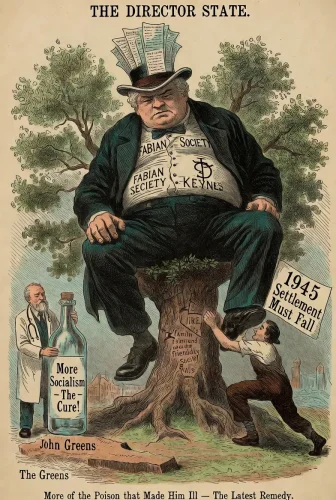
Public anger at the system is real and entirely justified. The most dangerous possible future is one where a party of the right takes power at the next election and fails to deliver an agenda that represents a real change to the dysfunctional paradigm we have lived under for 80 years. The right must find the courage to say that more socialism is not the answer to the problems caused by too much socialism. The Britain that disillusioned young people are rebelling against was not built by capitalism, but by the debt-fuelled, expansive state created in 1945 and reinforced by a technocratic shell after 1997. The Greens are offering a stronger dose of the very poison that made the patient sick.
A genuine counter-revolution would mean examining every function of the central state and asking four honest questions: Is this best run from Westminster? Would it be more effective if localised? Would it benefit from real competition? Could the private, charitable or mutual sectors do it better? The answer will not always be divestment, but in many cases it will be. The NHS, globally unique in its monolithic structure, is a prime candidate. Countries such as Germany, the Netherlands and Switzerland achieve better outcomes for a lower share of GDP through independent clinics and hospitals, with insurance-based funding that follows the patient and a state backstop. Welfare would benefit from far greater localisation, with decisions taken closer to real knowledge of the individual. One of the great tragedies of the post-war settlement was that compulsory National Insurance destroyed the ecosystem of mutual and friendly societies that once provided working people with practical self-help. Those institutions could be actively encouraged to reform and grow again.
Implementation will necessarily be complex and must be handled with care so as not to abandon the genuinely vulnerable. It took only six years to lay the foundations of the expansive state, but it will take far longer to undo them. All the more reason to start now. The electorate today is primed to reach for radical solutions because it correctly senses that the hour is late. We are, in truth, running out of road before the economic maths take our sovereignty away.
In 1979 and in the 2016 referendum, the British people showed they are willing to make hard choices against what the media and the political class told them were their immediate interests. The Right should trust them to do so again. The public know the system is broken. What they lack is a party brave enough to offer the real medicine instead of another dose of the poison. The counter-revolution Britain needs is finally within reach, if only the Right will seize it.
With a background in history and political philosophy and after a long corporate career, Matt Roberts now writes on the political system and current affairs. Find him on his Substack page, the Traditional Pragmatist, and on X.
This article (Why Britain Needs a Real Counter-Revolution Against the Expansive State) was created and published by The Traditional Pragmatist and is republished here under “Fair Use”

••••
The Liberty Beacon Project is now expanding at a near exponential rate, and for this we are grateful and excited! But we must also be practical. For 7 years we have not asked for any donations, and have built this project with our own funds as we grew. We are now experiencing ever increasing growing pains due to the large number of websites and projects we represent. So we have just installed donation buttons on our websites and ask that you consider this when you visit them. Nothing is too small. We thank you for all your support and your considerations … (TLB)
••••
Comment Policy: As a privately owned web site, we reserve the right to remove comments that contain spam, advertising, vulgarity, threats of violence, racism, or personal/abusive attacks on other users. This also applies to trolling, the use of more than one alias, or just intentional mischief. Enforcement of this policy is at the discretion of this websites administrators. Repeat offenders may be blocked or permanently banned without prior warning.
••••
Disclaimer: TLB websites contain copyrighted material the use of which has not always been specifically authorized by the copyright owner. We are making such material available to our readers under the provisions of “fair use” in an effort to advance a better understanding of political, health, economic and social issues. The material on this site is distributed without profit to those who have expressed a prior interest in receiving it for research and educational purposes. If you wish to use copyrighted material for purposes other than “fair use” you must request permission from the copyright owner.
••••
Disclaimer: The information and opinions shared are for informational purposes only including, but not limited to, text, graphics, images and other material are not intended as medical advice or instruction. Nothing mentioned is intended to be a substitute for professional medical advice, diagnosis or treatment.
Disclaimer: The views and opinions expressed in this article are those of the author and do not necessarily reflect the official policy or position of The Liberty Beacon Project.


Leave a Reply