

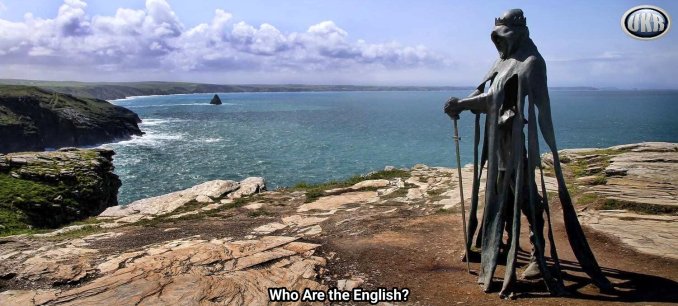
Who are the English?
There is a peculiar rule in modern Anglophone public life. Every people can have a past, except the one that built the country
PAUL BIRCH
A version of this article appears in The European Conservative
The Romans can be studied without apology. Vikings are marketed with cinematic enthusiasm. Celts are endlessly romanticised, their mystique carefully preserved. But introduce the Anglo-Saxons, the civilisation-forming population that gave England (and, consequently, much of the world) its language, law, cultural and political seedbeds, and just watch the institutional mood darken. Cambridge and Nottingham Universities are just the latest to have found the very phrase ’Anglo-Saxon’ sticking in their institutional throats.
Across academia, heritage bodies, and cultural bureaucracies, ‘Anglo-Saxon’ is being methodically edged out of polite usage. University departments quietly rename themselves. Museum labels are sanitised. School materials grow evasive. In its place comes the bloodless substitute: ‘early medieval English,’ a term so neutered it could describe anyone and, therefore, means absolutely nothing. We are assured this is scholarly refinement. It is nothing of the sort. It is historical airbrushing driven by ideology.
I recently bought a biography of King Æthelstan, the first monarch of a united English nation. It purports to be a formative study of this most influential of Anglo-Saxon kings. The sleeve notes positively gush: “England’s founding father deserves this book: at once scholarly and accessible.” Also: “A fascinating, meticulously researched and vital new study.” But, in the introduction, the author himself states that the term ‘Anglo-Saxon’ has, recently, become ‘controversial’, citing the rise of extremism as a reason not to use the term. So he, along with many other academics, seems to be ceding the ground to the nebulous ‘far right’ without so much as a whimper.
The author goes on to assert that: “…any notion that tenth century England was homogenous in racial, ethnic, cultural, linguistic, or religious terms, is radically misplaced. Æthelstan knew this better than anyone.” Did he now? I’d like to know how a 21st century academic knows what made a 10th century English king think like a civil servant wearing a lanyard.
The historical reality is straightforward. After Rome’s withdrawal from the island of Britain in the 5th century, Germanic migrants – Angles, Saxons and Jutes – settled in significant numbers. They established the kingdoms that, eventually, became England. They forged Old English, the linguistic ancestor of modern English. They shaped legal codes, land systems and governance structures. Even England’s name is theirs. This is not scanty nationalist mythology. It is the consensus of chronicles, archaeology, place-name studies, and genetic research. On average, 25%-40% of the modern British DNA is still attributable to the Anglo-Saxons, 1600 years after their first settlement. That is across the whole island of Britain. When one goes further to the south and the east of Britain (i.e. present day England), that percentage is significantly greater.
Yet in elite discourse, the Anglo-Saxons are endlessly qualified into near non-existence. They were not a people but a ‘network’. Not settlers but ‘cultural transmitters’. Not demographically meaningful but merely ‘symbolically dominant.’ One could be forgiven for suspecting that the goal is not accuracy but dilution.
The intelligentsia’s discomfort is not about evidence. It is about implications. To acknowledge a foundational Anglo-Saxon ethno-cultural core is to concede that Britain, like every historic nation, emerged from particular peoples and not abstract processes. That continuity exists. That heritage has demographic as well as institutional roots.
But this jars with the governing worldview of the contemporary Anglophone elite, who prefer their respective nations to be framed as administrative constructs; fluid, interchangeable and morally weightless. In that worldview, majority European ancestry is something to be obfuscated rather than championed. Foundational status implies legitimacy; legitimacy implies inheritance; inheritance implies boundaries. Thus, they have the incentive to rhetorically thin the founders out.
As ever, the American culture wars have further poisoned the well. In the United States, ‘Anglo-Saxon’ became entangled with critiques of ‘WASP power’ and racial hierarchy (the acronym ‘WASP’ stands for white, Anglo-Saxon Protestant). Rather than disentangle historical terminology from modern political misuse, British institutions have imported this anxiety wholesale. The solution was not clarification, but avoidance. If extremists misuse a term, the term must go.
If activists dislike a label, the label is retired. Historical precision becomes subordinate to reputational risk.
What makes the pattern unmistakable is its asymmetry. No campaign exists to rename the Roman Empire for fear of imperial associations. No one proposes retiring the word ‘Viking’ because of raiding ultra-violence. Indigenous ethnonyms worldwide are defended – quite rightly – as essential to cultural dignity. Only the Anglo-Saxons are deemed too dangerous to name. Sensitivity, it seems, only operates in one direction.
Strip away the academic phrasing and something cruder emerges: an almost reflexive suspicion of the historical consciousness among ordinary people. For many Britons, Anglo-Saxon heritage is simply part of the national story; a matter of language, ancestry and place. But elite commentary often recasts such identification as reactionary, exclusionary or intellectually ignorant. Pride in minority heritage is celebrated wholeheartedly as empowerment, whereas pride in majority heritage is pathologised as grievance. The message lands clearly – some pasts are safe to honour; others must be handled with embarrassment.
Of course, Britain’s population history, like that of any other nation, is mixed. Anglo-Saxon migrants integrated with Romano-British populations. Later came Norse settlement, then Norman (who were themselves of Norse heritage) and centuries of further exchange. But mixture does not erase formative influence.
The modern English language remains structurally Germanic. The earliest English law codes are Anglo-Saxon. Settlement patterns, shire systems, place names and many imperial measurements trace back to their original governance. Fusion occurred, unquestionably, but it happened around a dominant cultural framework established by the ancestors of the modern English; ancestors whose identity our elite institutions now dare not name. Complexity, in this debate, is rarely used to add layers. It is used to subtract foundations.
When elites grow visibly uncomfortable with the historic majority, public trust corrodes even further. People know when their inheritance is being downsized. They notice when institutions speak more confidently about Britain’s culpabilities than its civilisational formation. They hear the hesitation around naming the very population that made England culturally, linguistically and politically possible, while immigrant communities are lionised time and again. Erasure rarely announces itself. It treads softly, through euphemism, substitution, omission. Delete the word. Blur the category. Reframe the founders as a footnote. And then insist nothing has been lost.
Despite the fever dreams of the clerisy, none of this requires chauvinism or racial mysticism. England’s story is cumulative: Brittonic, Roman, Anglo-Saxon, Scandinavian, Norman, global. A confident nation can hold all of these threads without embarrassment. But confidence requires proportion. The Anglo-Saxons were not the only makers of England, but they were the pivotal ones. To treat them as linguistically awkward or politically inconvenient is to demote history to fashion. A civilisation unsure how to name its founders is a civilisation unsure of itself. And when the people notice that hesitation, they draw their own conclusions – not just about the past, but about the class now tasked with narrating it.
This article (Who are the English?) was created and published by Paul Birch and is republished here under “Fair Use”
See Related Article Below
Is it time for an English state?
ROBERT ROBINSON
DEFINING national identity is a hot topic, and understanding differences between Britishness and Englishness is part of the debate. The nations of the United Kingdom are distinct, both genetically and culturally, and each has its own well-defined national history. Britain is a political construct, and British identity can have only a relatively superficial civic meaning. Since the creation of a British state, England has been in the unusual position of being a nation without its own state.
The indigenous Celtic population of Britain was left undefended and unable to prevent large-scale settlement following the Roman withdrawal in AD 410. The new arrivals were ethnically and culturally different from the Celts and spoke an unrelated language. Angles and Saxons brought with them a high trust society built around small independent family units. An individualistic way of living replaced the clannish culture of the Celts and the centralised structure of Roman governance. Ancient rights to property, family inheritance and a fair system of justice was codified into written law at a very early stage. Early English kings were elected to office and advised by proto-parliaments (witans). These rulers were subject to God’s law, and absolute Roman-style power was anathema to the Anglo-Saxons.
The Venerable Bede first described the English as a single people in the early eighth century. Over the following 200 years, independent Anglo-Saxon kingdoms began merging into one nation. Athelstan’s victory over Northumbrian Vikings at York in AD 927 established the kingdom of England in a geographical form that is recognisable today. It was the world’s first nation state: a people unified under one language, one culture, one king and one Church.
In the eighth century, King Offa ordered the construction of a huge earthwork to separate his Anglo-Saxon kingdom from the Welsh. Plans to rebuild Hadrian’s Wall existed well into the 16th century. There were no particular designs on territories beyond these defensive lines. Nevertheless, other kingdoms of the British Isles attempted to destroy the new English state at its birth. In AD 937, an invading military alliance of British kings was defeated by a huge Anglo-Saxon army of around 100,000 men at the Battle of Brunanburh in Cheshire. The battles of York and Brunanburh are events of tremendous significance in the story of England, yet are barely remembered by students of history.
England remained a remarkably stable nation in terms of the composition of its population. After the Anglo-Saxon settlement in the fifth and sixth centuries, Viking and Norman invaders provided relatively limited impact on the existing English gene pool. Levels of immigration from other places were extremely low for centuries. Even within England, the movement of people was minimal. For those able to trace ancestors to locations before the Industrial Revolution, many will discover generations of their family living in the same place for hundreds of years.
New arrivals increased during the Industrial Revolution. Around 600,000 people born in Ireland were recorded in the 1861 Census of England (3 per cent of the total population at that time). Communities of Indian, African and Chinese sailors were established in some English port cities, but these numbered just a few hundred people. Between 1880 and 1914, some 250,000 Jews fleeing from Tsarist pogroms in Russia came to England, and in the 1930s a further 70,000 arrived from Nazi Germany.
Immigration at scale started after the Second World War. From the 1950s to 1980s, net migration was around 50,000 a year, with most arrivals coming from Commonwealth countries after the collapse of empire. In 1992, the Maastricht Treaty granted EU citizens the right to live and work in Britain, and annual net migration increased to about 100,000 during the 1990s. The 2004 Treaty of Accession brought an additional ten countries into the EU, and annual net migration grew to 300,000. In spite of Brexit, annual net migration rose to nearly one million after the covid lockdowns.
The level of foreign-born people as a proportion of total population stands at around 20 per cent. This scale of immigration has not happened since the arrival of the Anglo-Saxons, and the rate of change has never been seen before. The vast majority of new arrivals have settled in towns and cities in England, and failure to take back control of national borders after the Brexit vote has denied a democratic decision made by predominantly English voters. Scotland, along with nationalist areas of Wales and Northern Ireland, voted in favour of remaining in the EU.
Devolution has created an unfair situation whereby political representatives from Scotland and Wales are able to vote on English matters without reciprocal arrangements. Political differences between the nations of the Union have also become increasing apparent. The lockdowns highlighted policy variations between the devolved administrations regarding unnecessary restrictions on basic civil liberties.
In the early 17th century, English politicians fiercely resisted attempts by James I and his son Charles I to unite their Scottish and English kingdoms. The Wars of the Three Kingdoms (1639-1653) highlighted ethnic, cultural, and religious differences between the nations of the British Isles. It took the bankruptcy of Scotland, following an ill-conceived Scottish plan for a colonial empire, to bring about a British state following the Acts of Union 1707.
Acceptance of a unified British state started taking root among constituent nations during the Napoleonic Wars. The huge social and economic upheaval caused by the Industrial Revolution and the trauma of the First and Second World Wars helped reinforce bonds between these nations. Since then, the pillars on which British identity was built have been eroded. The end of empire, deindustrialisation, and devolution have raised questions about the future of the Union. On the other hand, English identity is increasingly celebrated and England’s own political, religious and cultural history is starting to be recognised. Britain’s constitutional system is broken and trust in institutions of the British state is at an all-time low. It is perhaps time to revive the idea of a separate English state.
This article (Is it time for an English state?) was created and published by Conservative Woman and is republished here under “Fair Use” with attribution to the author Robert Robinson

••••
The Liberty Beacon Project is now expanding at a near exponential rate, and for this we are grateful and excited! But we must also be practical. For 7 years we have not asked for any donations, and have built this project with our own funds as we grew. We are now experiencing ever increasing growing pains due to the large number of websites and projects we represent. So we have just installed donation buttons on our websites and ask that you consider this when you visit them. Nothing is too small. We thank you for all your support and your considerations … (TLB)
••••
Comment Policy: As a privately owned web site, we reserve the right to remove comments that contain spam, advertising, vulgarity, threats of violence, racism, or personal/abusive attacks on other users. This also applies to trolling, the use of more than one alias, or just intentional mischief. Enforcement of this policy is at the discretion of this websites administrators. Repeat offenders may be blocked or permanently banned without prior warning.
••••
Disclaimer: TLB websites contain copyrighted material the use of which has not always been specifically authorized by the copyright owner. We are making such material available to our readers under the provisions of “fair use” in an effort to advance a better understanding of political, health, economic and social issues. The material on this site is distributed without profit to those who have expressed a prior interest in receiving it for research and educational purposes. If you wish to use copyrighted material for purposes other than “fair use” you must request permission from the copyright owner.
••••
Disclaimer: The information and opinions shared are for informational purposes only including, but not limited to, text, graphics, images and other material are not intended as medical advice or instruction. Nothing mentioned is intended to be a substitute for professional medical advice, diagnosis or treatment.
Disclaimer: The views and opinions expressed in this article are those of the author and do not necessarily reflect the official policy or position of The Liberty Beacon Project.


Leave a Reply